As small offices increasingly rely on bandwidth-hungry applications—cloud backups, video conferencing, large file transfers, and virtualization—network bottlenecks have become the silent productivity killers of modern business. That 1 Gbps uplink that seemed generous five years ago is now choking your network, creating frustrating lag during peak hours and limiting your ability to scale. The solution? 10 Gigabit Ethernet uplinks. But here’s the good news: you don’t need enterprise-level budgets to deploy this technology. Today’s budget-friendly switches with 10 G uplinks deliver performance that was once reserved for data centers, packaged in cost-effective designs perfect for offices with 10-50 employees.
This guide cuts through the marketing jargon and specification sheets to help you understand what truly matters when selecting an affordable 10G uplink switch. We’ll explore the technical features that impact real-world performance, hidden costs that can blow your budget, and deployment strategies that maximize your investment. Whether you’re upgrading an existing network or building one from scratch, you’ll learn how to evaluate options like a network engineer—without needing a CCIE certification or a six-figure IT budget.
Top 10 Budget Ethernet Switches with 10 G Uplink for Small Offices
Detailed Product Reviews
1. TP-Link TL-SX105 | 5 Port 10G/Multi-Gig Unmanaged Ethernet Switch | Desktop/Wall-Mount | Plug & Play | Fanless | Sturdy Metal Casing | Speed Auto-Negotiation, Free Expert Help

Overview: The TP-Link TL-SX105 is a premium five-port unmanaged switch delivering full 10GbE connectivity across all ports. Designed for high-performance home labs, creative workstations, and small business networks, this fanless metal switch offers automatic speed negotiation from 100Mbps to 10Gbps, ensuring maximum compatibility with WiFi 6 access points, NAS devices, and gaming rigs.
What Makes It Stand Out: Every port supports true 10Gbps speeds with intelligent auto-negotiation for five distinct speeds, eliminating compatibility guesswork. The fanless design ensures silent 24/7 operation, while the robust metal chassis supports both desktop and wall-mount configurations. TP-Link’s complimentary expert technical support adds significant value for users needing guidance with complex network setups.
Value for Money: At $229.99, this switch commands a premium but delivers genuine 10Gbps on all ports—unlike budget alternatives that mix 2.5G and 10G connections. For environments requiring maximum throughput on every port, the price is justified. However, those needing only occasional 10G connectivity may find better value in hybrid models.
Strengths and Weaknesses: Strengths include true 10G on all five ports, silent fanless operation, durable metal construction, and excellent brand support. The auto-negotiation feature ensures seamless integration with diverse devices. Weaknesses are the premium pricing, limited port count for larger networks, and lack of advanced features like VLAN support or link aggregation. The 5-port configuration may require additional switches for expansion.
Bottom Line: Ideal for users demanding uncompromising 10Gbps performance on every connection. The TL-SX105 excels in small high-performance environments where silence and reliability are paramount. Worth the investment for professionals, but overkill for basic home networking needs.
2. 10Gbe Ethernet Switch Unmanaged with 2 x 10Gb RJ45 Ports ➕ 4 x 2.5Gb Base-T Ports, Desktop/Wall Mount NICGIGA 6 Port 10Gbps Network Switch for Wireless AP, NAS, PC

Overview: This NICGIGA switch offers a practical blend of two 10GbE ports and four 2.5GbE ports in a compact, unmanaged form factor. Perfect for budget-conscious enthusiasts upgrading specific high-traffic segments of their network, it delivers 60Gbps switching capacity to handle demanding applications like 8K video streaming, NAS backups, and WiFi 7 access points without complex configuration.
What Makes It Stand Out: The strategic port layout provides dedicated 10Gbps channels for backbone connections while serving multiple 2.5Gbps devices simultaneously. Its 6KV lightning protection offers robust surge defense rarely seen at this price point. The fanless, metal enclosure ensures silent operation and excellent heat dissipation, making it suitable for home environments.
Value for Money: At $79.99, this switch represents exceptional value, delivering 10G capabilities at a fraction of premium alternatives’ cost. The hybrid approach lets users prioritize 10G connections for critical devices while maintaining 2.5G for less demanding equipment. This balances performance and affordability better than single-speed switches.
Strengths and Weaknesses: Strengths include affordable 10G access, robust lightning protection, silent operation, flexible mounting options, and lifetime technical support. The auto-MDI/MDIX simplifies installation. Weaknesses are the limited 10G port count, lack of advanced management features, and no SFP+ slots for fiber connectivity. The 60Gbps backplane may bottleneck with all ports saturated simultaneously.
Bottom Line: An outstanding entry-level 10G switch for home labs and small offices. It democratizes multi-gig networking without sacrificing build quality. Perfect for users needing selective 10G connectivity without breaking the bank.
3. UGREEN 2.5Gb Switch, 6-Port Ethernet Switch, 5 x 2.5Gb Uplink + 1 x 10Gb SFP+, Standard/Link Aggregation to 5Gbps/VLAN 3 Modes, Plug & Play Unmanaged Ethernet Splitter, Desktop/Wall Mount, for NAS, PC

Overview: The UGREEN 6-port switch delivers five 2.5GbE ports plus a versatile 10G SFP+ uplink, targeting users seeking flexible backbone connectivity. Its three-mode operation—Standard, Link Aggregation, and VLAN—adds unexpected sophistication to an unmanaged switch, making it ideal for NAS setups, small teams, and advanced home networks requiring basic segmentation without enterprise complexity.
What Makes It Stand Out: The SFP+ port supports both optical modules and RJ45 copper transceivers, offering unmatched connectivity options. Link Aggregation mode combines ports 4-5 for 5Gbps to multi-NAS setups, while VLAN mode isolates ports 1-4 from each other—features typically absent in this price class. 4KV lightning protection and side-grille cooling enhance reliability.
Value for Money: At $69.99, this is arguably the most feature-rich switch in its category. The SFP+ flexibility alone justifies the cost, while bonus features like VLAN and LAG provide enterprise-lite functionality. Users needing fiber connectivity or basic network segmentation won’t find better value.
Strengths and Weaknesses: Strengths include SFP+ versatility, three operational modes, excellent surge protection, silent fanless design, and rock-bottom pricing. The metal chassis ensures durability. Weaknesses are the single 10G port, lack of dedicated 10G RJ45 ports, and potential complexity for users unfamiliar with SFP+ modules. No included transceiver adds hidden cost.
Bottom Line: A remarkably versatile switch for tech-savvy users. The SFP+ port and advanced modes make it perfect for specific use cases like NAS aggregation or fiber uplinks. Unbeatable value if you can leverage its unique capabilities.
4. NETGEAR 8-Port 1G/10G Multi-Gigabit Ethernet Unmanaged Switch (GS108MX) - with 1 x 10G/Multi-gig RJ-45 Ethernet Uplink, Desktop or Wall Mount, and Limited Lifetime Protection

Overview: NETGEAR’s GS108MX provides eight Gigabit Ethernet ports with a single 10G/Multi-gig uplink, catering to small businesses and advanced home users needing high-speed backbone connectivity for their existing Gigabit infrastructure. This unmanaged switch prioritizes reliability and brand trust, offering seamless integration with 10G NAS devices, WiFi 6 access points, and high-performance routers.
What Makes It Stand Out: The lifetime limited hardware warranty with next-business-day replacement sets a new standard for consumer networking gear. NETGEAR’s 24/7 expert chat support provides peace of mind for business-critical deployments. The robust metal construction and proven reliability track record make this a “set and forget” solution for demanding environments.
Value for Money: At $119.99, the premium over no-name brands is justified by the lifetime warranty and superior support infrastructure. For businesses where downtime costs money, this protection is invaluable. However, home users with tight budgets may find better port-per-dollar value elsewhere, as only one 10G port limits high-speed device connections.
Strengths and Weaknesses: Strengths include exceptional warranty coverage, brand reliability, eight Gigabit ports, silent operation, and professional support. The 10G uplink effectively eliminates backbone bottlenecks. Weaknesses are the single 10G port, no multi-gig ports (only 1G or 10G), lack of advanced features, and higher cost per port compared to competitors. No SFP+ option reduces flexibility.
Bottom Line: Perfect for small businesses prioritizing reliability over port count. The lifetime warranty makes it a long-term investment. Choose this for proven stability and support, but look elsewhere if you need multiple 10G connections.
5. 10Gbe Ethernet Switch Unmanaged with 2 x 10Gb RJ45 Ports ➕ 8 x 2.5Gb Base-T Ports, Desktop/Wall Mount NICGIGA 10 Port 10Gbps Network Switch for Wireless AP, NAS, PC
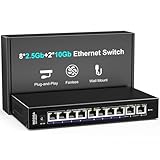
Overview: This 10-port NICGIGA switch expands the successful 6-port formula with eight 2.5GbE ports and two 10GbE uplinks, delivering greater connectivity for growing networks. Ideal for larger home labs and small offices, it maintains the same 60Gbps switching capacity while providing flexible high-speed access points for NAS arrays, WiFi 7 routers, and multiple high-bandwidth workstations without management complexity.
What Makes It Stand Out: The port density rivals enterprise gear at a fraction of the cost, offering two dedicated 10G channels for backbone redundancy or server connections. The 6KV lightning protection, wide operating temperature range (-10~50°C), and dual-side cooling holes ensure reliable operation in harsh conditions. Lifetime technical support remains a standout benefit.
Value for Money: At $139.99, this switch delivers exceptional scalability per dollar. The eight 2.5G ports provide future-proofing for WiFi 7 and multi-gig devices, while dual 10G ports enable redundant uplinks or dual-NAS setups. Competing solutions with similar port counts cost significantly more, making this a budget-conscious expansion champion.
Strengths and Weaknesses: Strengths include high port density, dual 10G connectivity, robust surge protection, silent fanless design, and outstanding support. The hybrid port configuration balances performance and device compatibility. Weaknesses are the shared 60Gbps backplane limiting simultaneous full-speed operation, lack of SFP+ ports, and absence of advanced management features. The single-speed 2.5G ports may underutilize some 5G-capable devices.
Bottom Line: The ultimate value proposition for expanding multi-gig networks. Perfect for users outgrowing smaller switches but unwilling to pay enterprise premiums. Highly recommended for NAS-heavy setups and smart home backbones requiring multiple high-speed connections.
6. 6-Port 10G/2.5G Ethernet Switch with Dual 10GBASE-T, Vimin 4X 2.5G +2 x 10Gb RJ45 Ports Unmanaged Switch, 60Gbps Capacity, 10G Switch Desktop/Wall Mount Network Switch for NAS, PC, Wireless AP

Overview: The Vimin 6-port switch delivers a compelling mix of multi-gigabit connectivity with four 2.5G RJ45 ports and two 10GBASE-T ports, offering 60Gbps non-blocking capacity for demanding home and small office networks. This unmanaged fanless switch targets users upgrading NAS systems, gaming PCs, and wireless access points without the complexity of managed switches. Its metal enclosure supports desktop or wall mounting, while backward compatibility with CAT5e/CAT6 cabling reduces infrastructure upgrade costs.
What Makes It Stand Out: Unlike most budget switches that use 10G SFP+ ports requiring expensive modules, this unit provides native 10GBASE-T RJ45 connections—plug standard RJ45 cables directly into your 10G NAS or workstation. The dual-mode flow control (IEEE 802.3x and backpressure) ensures stable data transmission under heavy loads, preventing packet loss during 4K streaming or large file transfers. The fanless design maintains silent operation, ideal for living spaces or quiet offices.
Value for Money: At $74.99, this switch undercuts many competitors offering dual 10G RJ45 ports. Comparable SFP+ switches often cost $60-80 before adding $30-50 per module. For users with existing CAT6 cabling, this eliminates hidden costs while providing future-proof 10G scalability. The 2.5G ports handle WiFi 6 APs and modern PCs efficiently, making it a balanced investment.
Strengths and Weaknesses: Strengths: Native 10G RJ45 ports; silent fanless operation; robust metal housing; plug-and-play deployment; CAT5e/CAT6 compatibility; flow control for stability. Weaknesses: Only six total ports; no PoE support; lacks VLAN functionality; no SFP+ flexibility for fiber uplinks.
Bottom Line: This switch excels for users needing affordable 10G RJ45 connectivity without SFP+ module expenses. Perfect for NAS-to-PC connections and 2.5G device aggregation, though port count limitations may require daisy-chaining for larger setups.
7. 10-Port 2.5Gb PoE Switch Unmanaged, 2.5G Ethernet Switch with 82.5G PoE Ports and 210G SFP+ Uplink, IEEE802.3af/at, Compatible with 100/1000/2500Mbps for 2.5Gb NAS/PC, WiFi6 Router, Wireless AP

Overview: This 10-port PoE switch combines eight 2.5G PoE+ ports with two 10G SFP+ uplinks, delivering a 120W power budget for high-performance networks. Designed for WiFi 6 access points, 2.5G NAS systems, and 4K PoE cameras, it provides unmanaged plug-and-play simplicity with enterprise-grade hardware. The all-metal fanless chassis operates silently across -10°C to 50°C, supporting desktop, wall, or rack-mount installations without noise pollution.
What Makes It Stand Out: The 120W PoE budget powers up to four 30W devices simultaneously—exceptional for a sub-$80 switch. Each 2.5G port automatically negotiates 100M/1G/2.5G speeds while delivering IEEE 802.3af/at power, eliminating separate power injectors for WiFi 6 APs. The 10G SFP+ uplinks create a high-speed backbone to routers or servers, preventing bottlenecks. Side cooling vents maintain thermal performance without fans, crucial for 24/7 surveillance or office deployments.
Value for Money: At $79.99, this switch disrupts the market by merging 2.5G PoE and 10G uplinks at a consumer-friendly price. Competitors with similar specs typically exceed $150, often requiring separate PoE injectors. The integrated 120W power supply and flexible mounting options deliver professional features without the premium tax, making it ideal for budget-conscious SMBs and advanced home labs.
Strengths and Weaknesses: Strengths: High 120W PoE budget; 2.5G PoE+ ports; silent fanless design; versatile mounting; 10G SFP+ uplinks; wide operating temperature range. Weaknesses: SFP+ modules not included; unmanaged (no VLAN/QoS); limited to eight PoE devices; no 10G RJ45 option.
Bottom Line: A powerhouse for PoE-enabled 2.5G networks, offering unmatched PoE budget and 10G uplink flexibility. Perfect for WiFi 6 deployments and IP camera systems where power and speed converge.
8. 4-Port 2.5G Ethernet Switch with 2 x 10G SFP+ Uplink – TEROW VLAN Supported Network Switch, Compatible with Gigabit/2.5GbE/10GbE for Home Office, NAS, Gaming & Access Points

Overview: TEROW’s compact switch delivers four 2.5G RJ45 ports paired with two 10G SFP+ uplinks in a fanless metal chassis for just $31.99. Supporting IEEE 802.3bz standards with auto-negotiation across 100M/1G/2.5G speeds, it provides 60Gbps switching capacity in an unmanaged form factor. The one-key VLAN mode isolates ports 1-4 to communicate exclusively with SFP+ uplinks, enhancing security for small networks without managed switch complexity.
What Makes It Stand Out: The price-to-performance ratio is exceptional—this is the most affordable 2.5G/10G switch available. The hardware VLAN isolation feature is rare in unmanaged switches, preventing inter-port broadcast storms and improving security for multi-tenant or guest network scenarios. Its 60Gbps capacity matches larger switches, ensuring full wire-speed performance across all ports. The fanless design and metal construction provide silent, durable operation for home offices.
Value for Money: At $31.99, this switch redefines budget networking. Comparable 2.5G switches start at $50+, and adding 10G SFP+ uplinks typically pushes prices past $70. While SFP+ modules add cost, the base unit delivers premium features at entry-level pricing. For small setups needing 10G backbone connectivity without PoE or numerous ports, it’s nearly impossible to beat.
Strengths and Weaknesses: Strengths: Unbeatable price; hardware VLAN isolation; silent fanless operation; robust metal housing; 60Gbps capacity; compact form factor. Weaknesses: Only four ports; no PoE support; SFP+ modules sold separately; unmanaged (limited advanced features); no 10G RJ45 option.
Bottom Line: The budget champion for minimalist high-speed networks. Ideal for connecting a NAS, gaming PC, and AP to a 10G backbone while VLAN isolation adds unexpected security value. Port count limits expansion, but the price justifies its focused purpose.
9. 10 Port 2.5Gb Unmanaged Ethernet Switch with 8* 2.5G Base-T Ports + 2* 10G SFP+ Ports. NICGIGA 8 Port 2.5Gbps Network Switch for 2.5Gbps NAS/PC, WiFi6 Router, Wireless AP. Fanless Design.

Overview: NICGIGA’s 10-port switch provides eight 2.5G RJ45 ports and two 10G SFP+ uplinks, delivering 60Gbps switching capacity for bandwidth-intensive applications. The unmanaged design ensures instant deployment with auto-negotiation across 100M/1G/2.5G speeds, supporting WiFi 6 APs, 2.5G NAS, and gaming PCs. A rugged metal case with 6KV lightning protection, fanless silent operation, and a wide -10°C to 50°C temperature range ensure reliability in diverse environments.
What Makes It Stand Out: The 6KV lightning protection and one-year warranty differentiate this from generic alternatives, offering peace of mind for critical connections. Side cooling holes and fanless design maintain zero noise while dissipating heat effectively. LED indicators provide clear port status and speed identification, simplifying troubleshooting. The switch supports automatic MDI/MDIX and non-blocking forwarding, eliminating configuration headaches for non-technical users.
Value for Money: Priced at $67.49, this switch sits in the sweet spot between budget and premium. It lacks PoE and VLAN features found in similarly priced alternatives, but compensates with lightning protection and warranty coverage. For users prioritizing reliability over advanced features, the build quality and manufacturer support justify the modest premium over entry-level models. It’s a solid mid-tier choice for 2.5G network expansion.
Strengths and Weaknesses: Strengths: Lightning protection; 1-year warranty; silent fanless design; metal construction; 10-port capacity; wide temperature range. Weaknesses: No PoE support; unmanaged (no VLAN); SFP+ modules not included; price slightly higher than budget alternatives.
Bottom Line: A dependable workhorse for pure 2.5G networking with 10G uplink capability. The warranty and surge protection make it ideal for users valuing reliability over PoE or advanced management features in home or small office deployments.
10. UGREEN Ethernet Switch, 10-Port PoE Switch, 8 PoE+@60W + 2 Gigabit Uplink, Plug & Play, Standard/VLAN/Extend Mode, PoE Auto Recovery, Desktop/Wall Mount Metal Network Splitter for Security Camera

Overview: UGREEN’s 10-port PoE switch delivers eight Gigabit PoE+ ports with a 60W total budget and two Gigabit uplinks, targeting security camera installations and wireless AP deployments. The switch offers three modes: Standard for normal operation, VLAN to isolate ports 1-8 for broadcast storm prevention, and Extend mode pushing PoE transmission to 820 feet at 10Mbps. Intelligent power management prioritizes ports 8-1 during overloads, while PoE Auto Recovery automatically reboots frozen cameras or APs.
What Makes It Stand Out: The Extend mode and PoE Auto Recovery are standout features rarely found in sub-$40 switches, addressing real-world surveillance challenges. Extend mode dramatically reduces cabling costs for remote cameras, while Auto Recovery eliminates manual intervention for hung devices. The three-mode switch provides flexibility for mixed deployments, and independent short-circuit protection on each port prevents cascade failures. UGREEN’s brand reputation adds reliability confidence.
Value for Money: At $39.98, this is the most affordable branded PoE switch with intelligent management features. While limited to Gigabit speeds (not 2.5G), it excels for 4MP/8MP camera systems where bandwidth requirements stay under 100Mbps per device. The 60W budget supports 2-3 typical PoE cameras simultaneously. For pure surveillance or VoIP applications, it’s exceptional value, though users needing 2.5G+ speeds must look elsewhere.
Strengths and Weaknesses: Strengths: PoE Auto Recovery; Extend mode (820ft); intelligent power management; VLAN isolation; brand reliability; competitive price. Weaknesses: Gigabit only (no 2.5G/10G); modest 60W PoE budget; no SFP+ uplinks; unmanaged beyond mode selection.
Bottom Line: Perfect for security camera systems prioritizing distance and reliability over raw speed. The intelligent PoE features solve common surveillance headaches, making it a specialized but highly effective tool for its intended purpose. Not suitable for high-speed NAS or WiFi 6 backhaul.
Understanding 10 G Uplink Technology for Small Offices
What Exactly Is a 10 G Uplink?
A 10 Gigabit Ethernet uplink is a high-speed connection port on a switch designed to connect to core network infrastructure, servers, or other switches. Unlike standard access ports that connect to employee workstations and typically run at 1 Gbps, uplink ports handle aggregated traffic from multiple devices. Think of it as a highway on-ramp: while individual cars (devices) travel at normal speeds, the on-ramp (uplink) must accommodate many cars merging simultaneously without causing congestion.
In small office contexts, these ports typically use SFP+ (Small Form-factor Pluggable Plus) interfaces, which accept either fiber optic or DAC (Direct Attach Copper) cables. This flexibility lets you connect to a core switch in another room via fiber, or directly to a NAS server just a few feet away using inexpensive copper cables. The key distinction: uplink ports aren’t for end devices—they’re the backbone that prevents your network from becoming a digital traffic jam.
Why Small Offices Benefit from 10G Connectivity
The math is straightforward: if you have 24 employees each with 1 Gbps connections, theoretically they could generate 24 Gbps of traffic. When that traffic funnels through a 1 Gbps uplink to your server or internet gateway, you’ve created a 23 Gbps bottleneck. In reality, not everyone uses full bandwidth simultaneously, but modern workflows have changed the equation. Cloud-based AutoCAD files, 4K video editing from shared storage, simultaneous Zoom calls, and automated cloud backups mean peak usage now regularly saturates 1 Gbps links.
A 10 G uplink provides ten times the headroom, eliminating the most common network chokepoint. The impact is immediate: file transfers that once crawled during busy hours now zip along at wire speed, video calls remain crisp when everyone joins the 9 AM standup, and your NAS responds instantly even during backup windows. For small offices, this isn’t about luxury—it’s about maintaining competitive productivity without paying enterprise premiums.
Decoding “Budget”: What Value Really Means
Total Cost of Ownership Beyond the Price Tag
That $299 switch might seem like a steal until you factor in the three-year reality of ownership. Budget-conscious buyers must calculate total cost of ownership (TCO), which includes initial purchase price, power consumption over time, cooling costs, management overhead, and potential downtime expenses. A switch consuming 30 watts continuously costs approximately $35 annually in electricity (at $0.13/kWh). Over three years, that’s $105—potentially one-third of your initial savings.
Consider management time too. An unmanaged switch requiring manual troubleshooting might cost you 10 hours of IT consultant time at $150/hour when issues arise. A slightly more expensive smart-managed switch with remote diagnostics could reduce that to one hour. Suddenly, the “expensive” option saves $1,350. Factor in warranty length—does the manufacturer offer lifetime versus one-year coverage? What’s the advance replacement policy? A failed switch causing 24 hours of downtime could cost a 20-person office thousands in lost productivity. True budget wisdom means looking three years ahead, not just at the invoice.
Hidden Costs That Inflate Your Investment
Beware the SFP+ tax. Many budget switches advertise 10G capability but don’t include the required SFP+ modules, which can run $50-150 per port. A “cheap” 24-port switch with two 10G uplinks might need an extra $200 in transceivers just to function. DAC cables are more economical for short runs, but if your server room is 100 feet away, fiber becomes mandatory—and those costs multiply.
Power supply redundancy is another hidden budget-buster. Single PSU switches cost less upfront but become single points of failure. Some budget models offer external power supply options for redundancy, but that’s another $100-200. Licensing fees for advanced features represent the sneakiest cost. Certain vendors require annual subscriptions for VLAN management, QoS, or even basic firmware updates. Always ask: “What features require paid licensing?” and “Are firmware updates free for the product’s lifetime?” before committing.
Essential Features to Prioritize
Port Configuration Strategies
The 24-port switch remains the sweet spot for small offices, but don’t just count ports—think about your growth trajectory. A 24-port switch with 4x 10G uplinks gives you two uplinks to your core and two for servers or future expansion. Alternatively, 48-port models often provide better per-port value if you’re already at 20+ devices, but they consume more power and space.
Consider the mix: how many PoE ports do you need for phones, access points, and cameras? Some switches offer partial PoE—maybe 12 of 24 ports—which matches real-world needs without the cost of full PoE. Combo ports (RJ45 + SFP) provide flexibility but often disable one interface when the other is active, so read the fine print. For small offices, the best value typically comes from switches with 24x 1G RJ45 ports and 4x SFP+ uplinks—enough for current needs and reasonable expansion without paying for unused capacity.
PoE/PoE+ Capabilities Explained
Power over Ethernet transforms your switch into a power distribution unit for IP phones, wireless access points, and security cameras. PoE provides 15.4W per port; PoE+ delivers 30W. Modern devices increasingly require PoE+, especially 802.11ac/ax access points and pan-tilt-zoom cameras. Budget switches often skimp on total power budget—the maximum wattage available across all PoE ports simultaneously.
Calculate your needs: eight IP phones at 7W each (56W) plus three access points at 20W each (60W) requires 116W total. A switch with a 150W budget handles this comfortably, but a 100W budget forces you to choose which devices get power. Some budget switches also have aggressive power management that cycles power unexpectedly. Look for per-port power monitoring and scheduling capabilities—these features prevent overloads and let you reboot devices remotely without climbing ladders.
Management Level: Managed vs Smart vs Unmanaged
Unmanaged switches are plug-and-play but offer zero visibility when problems occur. They’re black boxes that can’t tell you which port is flapping or why latency spiked. For small offices, smart-managed (web-managed) switches hit the budget-performance sweet spot. They provide web-based configuration for VLANs, QoS, and port monitoring without the complexity or cost of full CLI-based management.
Fully managed switches bring enterprise features like SNMP, RMON, and command-line interfaces. While powerful, they require networking expertise and often carry price premiums. The key question: will you ever need to isolate a guest network, prioritize VoIP traffic, or troubleshoot port errors? If yes, avoid unmanaged. For most small offices, smart-managed provides 90% of needed features at 50% of the managed price. Some vendors now offer cloud-managed options—subscription-based but with remote monitoring apps that alert you to issues before users notice.
Layer 2 vs Layer 3: Making the Right Call
Layer 2 switches forward traffic based on MAC addresses within a single network segment. Layer 3 switches add IP routing capabilities, essentially combining switch and router functions. For small offices with simple networks—one subnet, basic internet access—Layer 2 suffices and saves money. However, if you plan to segment departments into separate VLANs (finance, engineering, guest), a Layer 3 switch eliminates the need for an external router between VLANs.
Budget Layer 3 switches have become surprisingly affordable, often just $50-100 more than Layer 2 counterparts. This small premium buys you future flexibility and simplifies network design. Consider this: adding a dedicated router later costs $300+ and introduces another device to manage. If there’s any chance you’ll implement VLANs within two years, the Layer 3 upgrade pays for itself. Just ensure the switch supports static routing—some budget Layer 3 models only offer rudimentary routing that can’t handle complex networks.
Performance Metrics That Matter
Switching Capacity and Forwarding Rates
Switching capacity, measured in Gbps, represents the total data the switch can handle simultaneously. A 24-port gigabit switch with 2x 10G uplinks needs at least 48 Gbps capacity (24x 1G + 2x 10G) to be non-blocking—meaning it can run all ports at full speed without internal congestion. Budget switches sometimes cut corners here, offering only 32 Gbps capacity. During peak usage, this creates internal bottlenecks even if uplinks are idle.
Forwarding rate, measured in Mpps (million packets per second), indicates how many packets the switch can process. For gigabit Ethernet, each port needs 1.488 Mpps to achieve wire-speed performance. A 24-port switch should deliver at least 35.7 Mpps. Budget models might spec lower rates, causing dropped packets during traffic bursts. Always verify these numbers in the data sheet; if they’re missing, that’s a red flag. Real-world testing shows some budget switches achieve only 60% of advertised rates under sustained load.
Buffer Size: The Silent Performance Killer
Buffer memory temporarily stores packets when outgoing ports are congested. Too small, and packets drop during microbursts—brief traffic spikes that last milliseconds but overwhelm ports. Too large, and you introduce bufferbloat, where excessive queuing causes latency and jitter. The sweet spot for small office switches is 1-2 MB per port group.
Budget switches often skimp on buffers, providing just 512 KB total for all ports. This works fine for light web browsing but fails during large file transfers or backup windows. When evaluating switches, look for buffer size specifications and whether the switch supports dynamic buffer allocation—smartly distributing memory where needed rather than dividing it equally among idle ports. Some advanced budget switches now offer shared buffer pools that adapt to traffic patterns, delivering enterprise-like performance without the price.
Latency and Jitter Requirements
Latency—the time it takes for a packet to traverse the switch—directly impacts user experience. For TCP-based applications like file sharing, sub-50 microsecond latency is acceptable. For real-time traffic like VoIP and video conferencing, you want sub-10 microsecond latency to prevent noticeable lag and audio dropouts.
Jitter, the variation in latency between packets, proves even more critical. Voice and video streams require consistent timing; high jitter causes choppy audio and frozen video frames. Budget switches often omit advanced QoS features that minimize jitter. Look for switches supporting strict priority queuing and weighted round-robin scheduling—these features ensure your CEO’s video call gets consistent performance even when someone starts a massive download. Some switches include automatic VoIP detection that prioritizes traffic without manual configuration, a valuable feature for offices without dedicated network administrators.
Build Quality Considerations
Fanless vs Active Cooling: Real-World Implications
Fanless switches use passive cooling through heat sinks and metal chassis, offering silent operation perfect for open offices or reception areas. However, they typically max out at 24 ports and lower power budgets due to thermal constraints. Active cooling with internal fans supports higher port densities and PoE budgets but introduces noise and potential failure points.
The real consideration is operating temperature. Fanless switches often throttle performance when internal temperatures exceed 40°C (104°F). In cramped wiring closets without air conditioning, this happens frequently during summer months. Active-cooled switches maintain full performance up to 50°C or higher. For budget-conscious buyers, consider placement: a fanless switch on a desk in an air-conditioned office works beautifully; the same switch in a hot closet becomes unreliable. Some hybrid designs use temperature-controlled fans that spin only when needed, blending silent operation with thermal headroom.
MTBF and Warranty: Reliability Indicators
Mean Time Between Failures (MTBF) provides statistical reliability estimates. Budget switches should exceed 100,000 hours MTBF—roughly 11 years of continuous operation. Be skeptical of manufacturers who don’t publish MTBF; this often indicates subpar components or insufficient testing. Cross-reference MTBF with warranty length: a switch rated for 200,000 hours but warrantied for only one year suggests the manufacturer lacks confidence in early-life reliability.
Warranty terms reveal true quality. Lifetime warranties with advance replacement mean the vendor stands behind their product. One-year warranties with mail-in service indicate budget compromises. For small offices without spare switches, advance replacement is worth a 10-15% price premium. Some vendors offer extended warranties for purchase; calculate whether the cost exceeds simply buying a cold spare switch. Remember: the cheapest switch that fails during your busiest week costs far more than a reliable one with a higher upfront price.
Vendor Support and Ecosystem
Firmware Updates and Long-Term Support
A switch is only as secure as its last firmware update. Budget vendors fall into two camps: those providing free lifetime updates and those abandoning products after 12-18 months. Before purchasing, check the vendor’s support site for recent firmware releases. A product with no updates in the past year likely has unpatched security vulnerabilities.
Examine the update process. Some switches require TFTP servers and command-line incantations; others offer one-click web updates. For small offices without IT staff, simplicity matters. Also verify whether configuration backups are portable—can you restore settings to a replacement switch without manual reconfiguration? This feature becomes invaluable during hardware failures. The best budget vendors maintain firmware for 5+ years, treating their entry-level products with the same respect as enterprise gear.
Community Support vs Enterprise Support Models
Enterprise vendors offer 24/7 phone support with sub-hour response times—for a price. Budget switches typically rely on community forums, knowledge bases, and email support with 24-48 hour response times. This trade-off works fine for planned deployments but hurts during emergencies.
Evaluate your risk tolerance. If network downtime costs you $1,000 per hour, premium support pays for itself. If you can tolerate half-day outages while troubleshooting via forum posts, community support suffices. Some vendors offer middle-ground support packages—business-hours phone support for a flat annual fee. For small offices, these often provide the best value. Also investigate the community’s health: active forums with thousands of posts indicate a large user base and quick answers to common problems. Dead forums mean you’re on your own.
Energy Efficiency and Operating Costs
802.3az Energy-Efficient Ethernet Standard
The 802.3az standard reduces power consumption by putting ports into low-power idle mode when no data transmits. In typical office environments where devices burst traffic rather than streaming continuously, savings reach 30-50% compared to non-compliant switches. All modern budget switches should support this; if not, walk away.
The real magic lies in implementation quality. Premium switches detect link status and cable length, reducing power for shorter cable runs. A port connected via a 10-foot cable uses less power than one spanning 300 feet. Some switches also adjust power based on device type—phones need less power than laptops. These optimizations seem minor but save $50-100 annually in a 24-port deployment. Check if the switch lets you monitor per-port power usage; this visibility helps identify faulty devices drawing excessive power.
Real-World Power Consumption Expectations
A 24-port gigabit switch without PoE typically consumes 15-25 watts at idle and 30-40 watts under load. Add PoE, and consumption jumps dramatically—up to 400 watts if all ports deliver full PoE+ power. When budgeting, calculate your actual PoE needs rather than assuming worst-case scenarios. Most offices use 30-40% of maximum PoE capacity.
Power supply efficiency matters too. An 80% efficient power supply wastes 20% of electricity as heat, increasing cooling costs. Look for 85%+ efficiency ratings, commonly marked as 80 Plus Bronze equivalent. Some switches include redundant power supply options that load-share, improving efficiency while adding reliability. For small offices, a single efficient PSU often provides the best value, but ensure it has overvoltage and overcurrent protection—budget switches sometimes omit these safeguards, risking connected devices during power fluctuations.
Deployment Strategies for Small Offices
Single Switch Deployment for Compact Offices
For offices under 2,000 square feet with fewer than 30 devices, a single 24-port switch often suffices. Place it centrally to minimize cable runs—every 100 feet of cable adds signal degradation and installation cost. Mount it in a wall-mounted cabinet rather than a full rack to save space and money. Ensure the location has adequate ventilation; even fanless switches need airflow.
Connect your core devices (NAS, router, server) directly to the 10G uplinks using DAC cables if within 7 meters—this saves hundreds compared to fiber transceivers. Use the remaining 1G ports for workstations, phones, and printers. Reserve 2-3 ports for future expansion; running out of ports forces expensive upgrades or awkward daisy-chaining. Label every cable at both ends using a simple numbering system that maps to your documentation. This 30-minute investment saves hours of troubleshooting later.
Multi-Switch Topologies for Growing Spaces
When office space spans multiple rooms or floors, resist the temptation to cascade switches (switch-to-switch connections). This creates multiple points of failure and unpredictable performance. Instead, implement a star topology: each access switch connects directly to a central aggregation switch using those 10G uplinks. This design isolates failures and provides consistent performance.
Calculate your oversubscription ratio—the relationship between total access port bandwidth and uplink capacity. With 24x 1G ports feeding a 10G uplink, you have a 2.4:1 ratio, which works well for typical office traffic patterns. If you add a second 24-port switch, connect both 10G uplinks to your core switch, balancing load. For budget-conscious deployments, consider switches with link aggregation (LAG) support—combining two 10G ports for 20G uplinks when your budget allows, without replacing hardware.
Future-Proofing Your Network Investment
Scalability Pathways and Stackability
Stackability lets you combine multiple switches into a single logical unit, simplifying management and providing redundancy. True stacking uses dedicated high-speed cables between switches; budget switches often offer “virtual stacking” through standard Ethernet ports, which works but consumes valuable uplinks. Evaluate whether the stacking bandwidth matches your needs—a 10G stacking connection becomes a bottleneck between two 48-port switches.
For small offices, consider modular uplink options. Some switches accept expansion modules that upgrade 1G ports to 10G as needs grow. This pay-as-you-grow model prevents overprovisioning. Also examine whether the switch supports firmware features you might need later: IPv6 management, advanced QoS policies, or 802.1X authentication. A switch that can’t grow with your security requirements forces premature replacement. The best budget options include these features but keep them disabled until needed, providing a seamless upgrade path.
Emerging Technologies to Watch
While 10G uplinks meet today’s needs, consider tomorrow’s landscape. Wi-Fi 7 access points will push multi-gigabit speeds, potentially requiring 2.5G or 5G access ports. Some budget switches now include multi-gigabit RJ45 ports that auto-negotiate 1G/2.5G/5G/10G over existing Cat5e/Cat6 cables. This future-proofs your access layer without rewiring.
Software-defined networking (SDN) support is appearing in budget switches through OpenFlow or vendor-specific APIs. While overkill for most small offices today, SDN simplifies network management as complexity grows. Also watch for MACsec encryption support—hardware-level link encryption that prevents eavesdropping on physical connections. As security threats evolve, this feature transitions from enterprise luxury to small office necessity. Choosing a switch with these emerging capabilities extends its useful life by 3-5 years.
Security Features Worth Paying For
VLAN and Network Segmentation
VLANs (Virtual LANs) segment your network into isolated broadcast domains, preventing guest devices from accessing internal servers and containing malware spread. Budget switches vary wildly in VLAN support—some offer 32 VLANs (adequate), others 256 (overkill), and some truly budget options offer none. For small offices, support for at least 16 VLANs covers typical scenarios: staff, guests, VoIP, security cameras, and management.
More important than VLAN count is inter-VLAN routing capability. Without it, VLANs can’t communicate, requiring an external router. Layer 3 switches solve this elegantly. Also examine whether the switch supports VLAN trunking (802.1Q) for passing multiple VLANs over a single uplink—essential for multi-switch deployments. Some budget switches limit trunking to specific ports or require convoluted configuration. Test this in the vendor’s demo interface before purchasing.
Access Control and Authentication
Port security features prevent unauthorized devices from connecting. MAC address limiting lets you restrict each port to a specific number of devices—useful for preventing employees from connecting unmanaged switches that bypass security policies. 802.1X authentication integrates with RADIUS servers to require username/password or certificate-based access, though this requires infrastructure most small offices lack.
A more practical budget feature is MAC authentication bypass (MAB), which allows devices like phones to authenticate via their hardware address without complex certificates. Also valuable: DHCP snooping, which prevents rogue DHCP servers from handing out malicious IP addresses, and dynamic ARP inspection, which blocks ARP spoofing attacks. These features cost manufacturers little to implement but provide significant security value. If a budget switch lacks them, you’re sacrificing protection for minimal savings.
Common Shopping Mistakes to Avoid
Feature Creep vs Actual Needs
The specification sheet is a siren song, tempting you with features you’ll never use. Do you really need 48 ports when you have 18 employees? Will you ever configure 256 VLANs? Does your office require 40G stacking when 10G uplinks suffice? Each unnecessary feature adds cost and complexity. Start with a clear requirements document: count current devices, project 3-year growth, list required applications, and define acceptable downtime.
Beware the “just in case” trap. Buying a 48-port switch “for future expansion” when you need 20 ports wastes money and power. Instead, choose a 24-port model with solid 10G uplinks. If you outgrow it in two years, the money saved can fund a newer, more capable switch that better matches evolved requirements. Technology advances rapidly; today’s overprovisioned switch becomes tomorrow’s underperforming anchor.
Port Density Miscalculations
Underestimating port needs proves even more costly. A 16-port switch saves $100 but forces you to buy an additional 8-port switch six months later, creating management headaches and consuming more power than a single 24-port unit. The rule of thumb: buy 1.5x your current device count, rounding up to the next standard size. With 12 devices today, a 24-port switch provides comfortable growth.
Remember to count non-obvious devices: network-attached storage, printers, wireless access points, IP cameras, door controllers, and even your router. Each consumes a port. Also consider management ports—some switches require dedicated ports for out-of-band management, reducing available ports. And never run switches at 100% capacity; reserve 10-15% of ports for troubleshooting (connecting a laptop directly) and temporary devices.
Evaluation Framework for Decision Making
Building Your Requirements Matrix
Create a weighted scoring system based on your priorities. Assign points: performance (30 points), reliability (25 points), management features (20 points), support (15 points), and cost (10 points). Under each category, list must-have and nice-to-have features. For performance, must-haves include non-blocking architecture and sub-20 microsecond latency. Nice-to-haves include large buffer pools and jumbo frame support.
Score each switch candidate objectively. This prevents emotional decisions based on brand loyalty or slick marketing. Involve end-users in defining requirements; the finance team cares about cost, while engineers prioritize performance. Compromise becomes easier when everyone sees the scoring rationale. Revisit this matrix annually—your needs evolve, and what scored poorly today might become tomorrow’s winner as firmware updates add features.
Vendor Comparison Methodology
Never evaluate switches in isolation. Create a comparison spreadsheet with identical test scenarios: connect identical clients, run iperf3 throughput tests, measure power consumption with a Kill-A-Watt meter, and document configuration time for basic VLAN setup. Many vendors offer evaluation programs—take advantage of 30-day trials to test in your actual environment.
Check third-party reviews on professional forums and Reddit communities. Vendor-sponsored reviews glow with praise; real users share warts-and-all experiences. Pay special attention to long-term reliability posts—switches that fail after 18 months reveal manufacturing defects. Also investigate firmware update frequency and whether the vendor backports security patches to older models. A company supporting five-year-old switches demonstrates commitment that transcends quarterly sales targets.
Installation and Setup Best Practices
Physical Deployment Guidelines
Mount switches with adequate clearance—minimum 2 inches on sides, 4 inches front and back—for airflow. In dusty environments, face the switch front outward to prevent debris intake through side vents. Use cage nuts and rack rails, not wood screws driven into drywall; vibrations loosen screws over time, causing intermittent connections. For fanless switches, position them with heat sinks oriented vertically to maximize convection cooling.
Cable management impacts performance as much as specifications. Keep power cables separated from Ethernet by at least 6 inches to prevent electromagnetic interference. Use Velcro straps, not zip ties—zip ties overtighten and damage cable jackets. Label both ends of every cable with a unique identifier using a label maker; handwritten labels fade and become illegible. Leave service loops of 12-18 inches of extra cable at each end. This slack allows for re-termination and strain relief without replacing entire runs.
Initial Configuration Checklist
Before connecting to your live network, perform initial configuration on an isolated laptop. Change the default management password immediately—botnets actively scan for default credentials. Set a static IP address for management, outside your DHCP range, and document it. Update firmware to the latest stable version; don’t use the shipping firmware which may contain bugs.
Configure basic security: disable unused ports, enable port security with MAC limiting, and set up management VLAN isolation. Create VLANs for staff, guests, and voice if needed. Test each VLAN with a client device before going live. Set up SNMP monitoring with read-only community strings—this lets you monitor switch health without exposing configuration interfaces. Finally, back up the configuration to a secure location. A simple USB drive in the server room suffices; cloud storage works if encrypted.
Troubleshooting Guide for Common Issues
Identifying Performance Bottlenecks
When users complain about “slow internet,” isolate the problem. Connect a laptop directly to the switch with a known-good cable and run speed tests. If speeds are normal, the issue is downstream (cabling, Wi-Fi, or ISP). If speeds are poor, check switch CPU utilization—budget switches sometimes skimp on control plane processors, causing management functions to impact forwarding performance.
Use port statistics to identify errors. CRC errors indicate cable or port hardware issues; collisions suggest duplex mismatches (though rare in modern networks). Run continuous ping tests across the switch during peak hours; latency spikes above 5ms indicate buffer exhaustion or internal congestion. If the switch supports sFlow or NetFlow, enable sampling to identify which devices generate the most traffic. Often, a single user running an unauthorized torrent client saturates uplinks, and simple QoS policies solve the problem.
Resolving Connectivity Problems
Intermittent connectivity often stems from power-saving features incorrectly disabling ports. Disable Energy-Efficient Ethernet on ports connecting to critical devices like servers and access points. For PoE devices that randomly reboot, check power budgets—overloaded switches cycle power to prevent thermal shutdown. Increase the power budget reservation or reduce PoE port count.
If a port stops working after a thunderstorm, the internal surge protection may have sacrificed itself. Some budget switches include replaceable surge protection modules—check before replacing the entire unit. For VLAN issues, verify native VLAN matches on both ends of trunk links. Mismatched native VLANs cause mysterious connectivity problems where some traffic passes but other traffic vanishes. When all else fails, factory reset and restore from your backed-up configuration—configuration corruption happens, especially after power outages.
Frequently Asked Questions
What makes a 10G uplink switch “budget-friendly” for small offices?
Budget-friendly doesn’t mean cheapest upfront. It means delivering essential 10G uplink performance, reliable hardware, and necessary management features at a price point that doesn’t require enterprise approval processes—typically under $500 for a 24-port model. The best value switches prioritize features small offices actually use while omitting data-center-only capabilities like 40G stacking or advanced MPLS support.
Do I need SFP+ modules, or can I use regular Ethernet cables?
SFP+ ports require SFP+ modules or DAC cables. For connections under 7 meters (23 feet), DAC cables are most economical—passive versions cost $30-50. For longer runs, you’ll need fiber optic cables with SFP+ transceivers. Standard RJ45 Ethernet cables won’t physically fit in SFP+ slots. Some switches offer 10GBase-T ports that accept regular Ethernet, but these consume more power and generate more heat, often making them less reliable in budget designs.
How many 10G uplink ports do I actually need?
Most small offices need a minimum of two: one for your core router/firewall and one for a NAS or server. If you have multiple switches, each needs at least one 10G uplink to the core. Four uplink ports provide maximum flexibility—use two for link aggregation to your core and two for servers. Remember that using SFP+ ports for stacking consumes uplinks, so factor that into your count.
Can I mix 10G uplink switches with my existing 1G network?
Absolutely. 10G uplink ports automatically negotiate down to 1G if connected to 1G devices. The primary benefit comes when connecting to other 10G-capable equipment like modern NAS units, servers, or core switches. Your existing 1G workstations continue working normally while servers and inter-switch connections gain 10x bandwidth. This makes 10G uplink switches a seamless upgrade path rather than a rip-and-replace project.
What’s the difference between SFP+ and 10GBase-T ports?
SFP+ ports use small, hot-swappable transceivers supporting fiber or DAC cables. They’re more power-efficient, generate less heat, and offer longer reach (up to 10km with fiber). 10GBase-T ports use standard RJ45 connectors and work with existing Cat6/Cat6a cables but consume 2-3 watts more per port and require better cable quality. For budget small office deployments, SFP+ with DAC cables typically provides better reliability and lower TCO.
Will a budget 10G switch handle my video editing workflow?
Yes, if properly configured. Video editing requires both high bandwidth and low latency. Connect your NAS directly to a 10G uplink port using a DAC cable. Enable jumbo frames (9000 MTU) on both the switch and NAS to reduce packet overhead. Configure QoS to prioritize video traffic, and ensure your switch has adequate buffer memory—at least 1MB per port group. Test with your actual editing software; some applications benefit more from multi-gigabit connections than raw 10G speed.
How important is PoE capability in a budget 10G switch?
PoE importance depends on your device mix. If you have IP phones, wireless access points, or security cameras, PoE eliminates separate power supplies and installation costs. Calculate your total PoE budget: count devices and their power requirements. A switch with 24 PoE+ ports but only a 185W budget can power about six access points at 30W each, not 24. Partial PoE switches (12 of 24 ports) often provide better value if you don’t need every port powered.
What management features should I prioritize for a small office?
Focus on VLAN support, port mirroring for troubleshooting, and basic QoS for VoIP prioritization. SNMP monitoring lets you track performance proactively. Loop prevention (STP/RSTP) is essential—one accidentally looped cable shouldn’t bring down your network. Web-based management is more practical than CLI for small offices. Avoid paying for advanced features like OSPF routing or BGP unless you have specific requirements; these add complexity without benefit.
How long should I expect a budget 10G switch to last?
Quality budget switches last 5-7 years in typical office environments. MTBF ratings above 100,000 hours suggest 11+ year statistical lifespans, but real-world factors like power surges, dust, and heat reduce this. Plan for a 5-year depreciation cycle. By year five, advances in power efficiency and features often justify replacement even if hardware still functions. Choose switches with lifetime warranties to maximize longevity; avoid one-year warranty models for critical infrastructure.
Can I use a 10G uplink switch without any 10G devices and still benefit?
Yes, through improved internal architecture. Switches with 10G uplinks typically have higher-performance backplanes and processors than pure 1G switches. This reduces internal congestion and improves latency for all traffic. Additionally, having 10G uplinks ready means you can upgrade servers or add a second switch later without replacing the core switch. Think of it as buying a car with a bigger engine—you may not use full power daily, but it’s available when needed, and the underlying engineering is more robust.