You can’t see them, smell them, or taste them, but the invisible threats circulating through your home could be undermining your family’s health and safety every single day. Radon gas silently seeps through foundation cracks, ranking as the second leading cause of lung cancer, while modern security risks—from environmental contaminants to unauthorized access—evolve faster than traditional alarm systems can adapt. The convergence of environmental monitoring and security technology has birthed a new generation of intelligent sensors that don’t just detect threats; they predict, analyze, and integrate with your entire home ecosystem. Understanding these sophisticated devices isn’t just about buying gadgets—it’s about architecting a comprehensive defense strategy for the place your family trusts most.
Top 10 Environmental Monitoring Sensors for Radon Detection
Detailed Product Reviews
1. Airthings 325 Corentium Home 2 Smart Digital Radon Detector - Portable and Easy-to-use Radon Testing with Bluetooth connectivity and Humidity & Temperature Sensors

Overview: The Airthings 325 Corentium Home 2 represents the evolution of the best-selling original, adding Bluetooth connectivity and environmental sensors while maintaining the proven radon detection accuracy that made its predecessor a household name. This portable unit enables continuous monitoring without recurring lab fees, providing homeowners with real-time data about cancer-causing radon gas through an intuitive smartphone app.
What Makes It Stand Out: Bluetooth integration transforms this from a simple detector into a comprehensive home monitoring system. The companion app displays detailed graphs showing radon fluctuations, while personalized tips help you take corrective action with confidence. As the choice of thousands of radon professionals, it leverages Airthings’ patented sensing technology. The addition of temperature and humidity sensors provides broader environmental context, making it more than just a single-purpose device.
Value for Money: At $179.99, this sits at the premium end of consumer radon detectors. The price is justified by professional-grade accuracy, app connectivity, and multi-sensor capability. Compared to single-use test kits or basic digital units, the long-term savings from eliminating lab fees and the peace of mind from continuous monitoring offset the initial investment for serious homeowners.
Strengths and Weaknesses: Strengths: Proven Airthings accuracy; Bluetooth app with detailed graphs; No lab fees or waiting periods; Added temperature/humidity monitoring; Trusted by professionals; Personalized remediation guidance.
Weaknesses: Highest price among competitors; Requires smartphone for full functionality; Battery life not as extensive as some alternatives; Limited to Airthings ecosystem.
Bottom Line: The Corentium Home 2 is ideal for tech-savvy homeowners seeking comprehensive, professional-quality radon monitoring with modern connectivity. The premium price delivers genuine value through accuracy and features that cheaper alternatives cannot match.
2. SAF Aranet Radon Detector for Home: 10-Min Measurement, Temperature, Relative Humidity, Pressure, E-Ink Display, 7-Year Battery, Portable with Free App, Bq/m3 & pCi/L Selectable

Overview: The SAF Aranet revolutionizes radon monitoring with its groundbreaking 10-minute measurement cycle and extraordinary 7-year battery life. This truly portable detector combines radon sensing with comprehensive environmental monitoring in a sleek package featuring an easy-to-read E-Ink display. It delivers professional-level data without the professional-level maintenance, making continuous monitoring virtually effortless.
What Makes It Stand Out: No other consumer detector offers 10-minute measurement intervals, providing near real-time awareness of radon fluctuations. The patented ultra-low-power architecture enables unparalleled battery longevity. The E-Ink display offers clear, color-coded alerts (green/yellow/red) visible even in bright light. Supporting both Bq/m³ and pCi/L units with multiple averaging options (real-time, 24h, 7d, 30d), it adapts to any user’s preference or regional standard.
Value for Money: Priced at $169.00, the Aranet competes directly with premium detectors while offering unique advantages. The 7-year battery life eliminates the cost and hassle of frequent replacements, representing significant long-term value. For homeowners wanting instant feedback without sacrificing accuracy, it undercuts professional systems while outperforming basic models.
Strengths and Weaknesses: Strengths: Ultra-fast 10-minute readings; Exceptional 7-year battery life; Comprehensive environmental data (temp, humidity, pressure); Crisp E-Ink display; Dual measurement units; Highly portable design.
Weaknesses: Lesser-known brand compared to Airthings; App experience less refined; Fewer third-party validations; E-Ink slower to update than LCD.
Bottom Line: The Aranet excels for users prioritizing instant data and minimal maintenance. Its revolutionary measurement speed and battery life make it perfect for basements, rentals, or anyone wanting continuous awareness without the upkeep.
3. AEGTEST HOUND-1011 Portable Radon Detector for Home, Lightweight, High-Accuracy Sensor, 45-Day Monitoring, Easy-to-Use Radon Tester, Short- & Long-Term in pCi/L or Bq/m³ for Basement – Gray

Overview: The AEGTEST HOUND-1011 democratizes radon detection with an aggressive $79.99 price point while maintaining respectable accuracy and features. This lightweight, portable unit measures radon from 0.09 to 1000 pCi/L with first results appearing in just 6 hours. It supports both short-term spot-checking and long-term monitoring up to 504 days, making it versatile for various testing scenarios.
What Makes It Stand Out: Remarkable affordability without critical compromises defines the HOUND-1011. The high-precision semiconductor sensor delivers hourly updates after the initial period, while the 45-day battery life in sleep mode surpasses many budget competitors. USB-C charging modernizes the experience, and the included lanyard and stand enhance portability. The ability to mute alarms in eco mode shows thoughtful design for bedroom use.
Value for Money: This offers the best price-to-performance ratio in the consumer market. At less than half the cost of premium brands, it delivers essential features: accurate readings, multiple timeframes, unit switching, and decent battery life. While lacking app connectivity, it provides core functionality that meets EPA guidelines without the premium tax.
Strengths and Weaknesses: Strengths: Extremely affordable; Fast 6-hour initial results; 45-day battery life; USB-C charging; Lightweight and portable; Multiple timeframe views; Alarm mute function.
Weaknesses: No smartphone app or Bluetooth; Lesser brand recognition; Basic LCD display; Shorter long-term battery than premium models; Limited professional validation.
Bottom Line: The HOUND-1011 is the smart choice for budget-conscious buyers needing reliable, no-frills radon monitoring. It sacrifices connectivity for affordability, making it ideal for first-time testers, rentals, or as a secondary verification unit.
4. Ecosense RD200 RadonEye, Home Digital Radon Detector: Fast and Accurate Detection of Fluctuating Radon Levels, Short and Long Term Continuous Monitoring with Trend Charts

Overview: The Ecosense RD200 RadonEye targets users wanting professional-grade responsiveness in a consumer package. Delivering its first reading in just 10 minutes, it boasts an impressive 30 counts per hour per pCi/L sensitivity through patented ion chamber technology. This performance-focused detector prioritizes raw detection capability over supplementary features, providing fast, accurate data capture for both short-term assessments and long-term trend analysis.
What Makes It Stand Out: The RadonEye’s exceptional counting efficiency sets it apart, offering sensitivity that approaches professional instrumentation. Smart trend charts visualize hourly averages, helping identify patterns and validate mitigation efforts. Third-party validation provides credibility, while the free app enables detailed analysis. The focus on pure detection performance rather than environmental sensors makes it a specialist tool for radon-specific concerns.
Value for Money: At $174.00, it commands a premium price justified by professional-level speed and sensitivity. For homeowners in high-risk radon areas or those with existing mitigation systems requiring precise validation, the accuracy provides peace of mind worth the cost. However, the lack of additional sensors makes it less versatile than similarly priced competitors.
Strengths and Weaknesses: Strengths: Extremely fast 10-minute first reading; High 30 counts/hour sensitivity; Patented ion chamber technology; Third-party validated accuracy; Comprehensive trend charts; Solid app integration.
Weaknesses: No temperature/humidity/pressure sensors; Higher price for single-function device; Less brand recognition than Airthings; Requires power cable for continuous use.
Bottom Line: The RadonEye suits users who prioritize detection speed and accuracy above all else. It’s ideal for post-mitigation verification, real estate transactions, or high-risk areas where precise, rapid readings justify the focused feature set and premium price.
5. Airthings Corentium Home Radon Detector 223 Portable, Lightweight, Easy-to-Use, (3) AAA Battery Operated, USA Version, pCi/L

Overview: The original Airthings Corentium Home 223 pioneered battery-operated digital radon detection, establishing the category standard before app connectivity became common. This lightweight, portable unit runs on three AAA batteries and provides both short-term and long-term readings on a clear LCD display. It remains the entry point into Airthings’ trusted ecosystem, offering the same core radon sensing technology that professionals rely on without modern connectivity frills.
What Makes It Stand Out: As the first of its kind, it perfected the balance of accuracy, portability, and simplicity. The ability to generate self-inspection reports directly from the device distinguishes it from basic detectors. Long-term monitoring capability captures daily fluctuations that single tests miss, while short-term readings provide immediate feedback on mitigation actions. Its straightforward operation requires no smartphone or WiFi, appealing to less tech-oriented users.
Value for Money: At $109.99, it occupies a sweet spot between budget unknowns and premium smart detectors. You’re paying for Airthings’ proven sensor technology and brand reliability without the $70+ premium for Bluetooth features. For homeowners wanting professional accuracy and report generation without app dependency, this represents excellent value.
Strengths and Weaknesses: Strengths: Proven Airthings accuracy; Affordable entry price; Battery operated (no outlet needed); Self-inspection report generation; Simple, intuitive operation; Lightweight and portable; Trusted brand.
Weaknesses: No Bluetooth/app connectivity; No additional environmental sensors; Basic LCD display; AAA batteries require periodic replacement; Limited data visualization compared to smart models.
Bottom Line: The Corentium Home 223 is perfect for users wanting reliable, professional-grade radon detection without smartphone dependencies. It delivers Airthings accuracy and reporting at an accessible price, making it ideal for seniors, rentals, or as a primary detector for the tech-averse.
6. Ecosense EQ100 EcoQube, Digital Radon Detector, Fast Capture of Fluctuating Levels, Short & Long-Term Continuous Monitoring with Trend Charts, Remote Data Access, Only Support 2.4 GHz Networks

Overview: The Ecosense EQ100 EcoQube positions itself as a professional-grade digital radon detector designed for homeowners who demand laboratory-quality accuracy without recurring fees. This device delivers its first reading just 10 minutes after power-up and provides continuous monitoring with sophisticated trend analysis through a companion mobile app.
What Makes It Stand Out: The EcoQube’s patented high-counting efficiency sensor is 15 times more sensitive than professional testing minimums, capturing rapidly fluctuating radon levels with exceptional precision. Its standout feature is seamless smart home integration via IFTTT, allowing automated actions like activating ventilation systems when levels spike. The device offers both short-term snapshots and long-term trend visualization, with remote data access that keeps you informed anywhere.
Value for Money: At $172.99, the EcoQube represents significant savings compared to professional radon testing services that charge $150-300 per assessment. For homeowners in high-risk areas or those with mitigation systems requiring validation, the one-time investment pays for itself within a single testing cycle while providing perpetual monitoring.
Strengths and Weaknesses: Strengths include lightning-fast initial readings, superior sensitivity, comprehensive trend charts, and smart home automation capabilities. The dedicated mobile app provides hourly data and customizable alerts. Weaknesses include 2.4 GHz Wi-Fi limitation (problematic for mesh networks), mandatory app installation with notifications enabled, and a premium price point that may exceed casual users’ budgets.
Bottom Line: The EcoQube is ideal for health-conscious homeowners and those requiring professional validation. Its unmatched sensitivity and smart integration justify the cost for serious radon monitoring, though tech-savvy users will benefit most from its advanced features.
7. Airthings 2950 Wave Radon - Smart Radon Detector with Humidity & Temperature Sensor – Easy-to-Use – Accurate – No Lab Fees – Battery Operated - Free App

Overview: Airthings Wave Radon combines radon detection with environmental monitoring in a battery-powered, user-friendly package. This smart detector continuously tracks radon levels while simultaneously measuring humidity and temperature, providing a comprehensive picture of indoor air quality without requiring professional installation or recurring laboratory fees.
What Makes It Stand Out: The device’s innovative wave-activated, color-coded indicator delivers instant air quality feedback—green, yellow, or red—without needing to check your phone. Bluetooth connectivity syncs detailed data directly to the free Airthings app, where users can generate professional reports for real estate transactions or peace of mind. The year-round battery operation enables flexible placement anywhere in the home.
Value for Money: Priced at $169.99, it competes directly with the EcoQube while offering multi-sensor functionality. Eliminating lab fees and providing unlimited testing makes it economical for long-term use, particularly valuable during home sales or after radon mitigation installations.
Strengths and Weaknesses: Strengths include intuitive operation, comprehensive environmental monitoring, reliable battery life, and robust app reporting features. The visual indicator is perfect for quick checks. Weaknesses include Bluetooth’s limited range requiring proximity for data sync, no Wi-Fi remote access, and potential delays in receiving data compared to continuous cloud-connected alternatives.
Bottom Line: The Airthings Wave excels for users wanting simplicity combined with professional-grade accuracy. Its multi-sensor approach and effortless operation make it perfect for homeowners prioritizing ease-of-use over advanced smart home integration.
8. LifeBasis Radon Detector with TFT Color Display First Data Display in 6 Hours, Portable Radon Monitor for Home Rechargeable Radon Tester Long Data Storage with Visual and Audible Alarm pCi/L or Bq/m³

Overview: The LifeBasis Radon Detector offers an affordable entry into continuous radon monitoring with its portable, rechargeable design and vibrant TFT color display. Delivering initial readings within six hours and updating hourly, this device provides accessible radon detection for budget-conscious homeowners without sacrificing core functionality.
What Makes It Stand Out: Remarkable data storage capacity sets this unit apart, maintaining up to 504 days of historical records across 10 separate detection sessions. The dual alarm system combines color-coded visual alerts with customizable audible warnings, ensuring immediate notification when hazardous levels are detected. Its 45-day battery life with display off maximizes placement flexibility.
Value for Money: At $69.99, the LifeBasis undercuts premium competitors by over $100 while delivering essential monitoring capabilities. For users needing basic continuous monitoring without cloud connectivity or smart home features, it provides exceptional value and pays for itself compared to even a single professional test.
Strengths and Weaknesses: Strengths include affordability, extensive data storage, rechargeable battery, dual-unit display (pCi/L or Bq/m³), and loud audible alarms. The portable design suits multi-location testing. Weaknesses include slower initial reading (6 hours), no wireless connectivity or app integration, limited trend analysis on-device only, and less sophisticated sensor technology than professional-grade units.
Bottom Line: The LifeBasis is perfect for cost-aware consumers seeking reliable radon monitoring without frills. While lacking smart features, its robust data logging and clear alarms make it a practical choice for basements, rentals, and periodic testing needs.
9. GQ Radon Detector Radonscan Home Radon Monitor Alpha Radiative Gas Radiation USA Product Large Color Display Short and Long Term continuously Monitor Accurate Fast Sensitive Data Saving
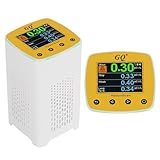
Overview: The GQ Radonscan delivers rapid radon detection in a straightforward, no-frills package designed for American homeowners. This domestically marketed device promises results in just five minutes and provides continuous monitoring with data logging every second, making it one of the fastest-responding units in its price category.
What Makes It Stand Out: Speed defines this detector—its five-minute calculation algorithm provides near-instant feedback compared to hours-long waiting periods of competitors. The large color LCD display presents data in simple, large fonts without requiring smartphone apps or Wi-Fi setup. Continuous second-by-second logging creates granular datasets for detailed analysis directly on the device.
Value for Money: At $59.80, it’s the most economical option reviewed, making professional-style monitoring accessible to virtually any budget. For homeowners needing quick spot-checks or post-mitigation verification without ongoing costs, it delivers core functionality at an unbeatable price point.
Strengths and Weaknesses: Strengths include exceptional speed, affordability, straightforward operation, audible/visual alarms, and USB-C power for continuous operation. The USA-focused marketing appeals to domestic buyers. Weaknesses include unknown brand reputation, limited documentation, no wireless connectivity, basic display interface, and potentially less accurate long-term trending than premium sensors.
Bottom Line: The Radonscan suits users prioritizing speed and simplicity above all else. While it lacks advanced features, its rapid response and ultra-low price make it ideal for quick assessments, rental property screening, or as a secondary verification device alongside more sophisticated monitors. Its plug-and-play nature requires no technical expertise, making it accessible to all users.
10. Airthings 2950 Wave Radon – Smart radon detector with humidity and temperature gauge. Accurate and user-friendly, wireless

Overview: This Airthings 2950 Wave Radon appears to be a streamlined version of its higher-priced sibling, offering core radon detection plus humidity and temperature monitoring at a significantly reduced price point. The battery-powered, wireless design maintains the series’ signature simplicity while delivering accurate continuous monitoring.
What Makes It Stand Out: The touchless wave activation for color-coded air quality feedback remains the hallmark feature—green, yellow, and red indicators provide instant status without app dependency. Bluetooth connectivity to the free Airthings app enables detailed trend analysis and report generation without subscription fees, while the compact Scandinavian design blends seamlessly into home décor.
Value for Money: At $72.90, this represents a dramatic price reduction from the $169.99 listing, making Airthings’ reputable technology accessible to budget-conscious buyers. The value proposition is exceptional: brand reliability, multi-sensor capability, and proven accuracy at nearly half the typical cost, delivering premium features without the premium price tag.
Strengths and Weaknesses: Strengths include trusted brand reputation, intuitive operation, environmental sensors, reliable battery life, and robust app ecosystem. The visual indicator is ideal for families. Weaknesses likely include limited inventory at this price, possible reduced feature set compared to premium version, Bluetooth range constraints, and lack of Wi-Fi remote monitoring.
Bottom Line: If available at this price, it’s arguably the best value in radon detection. Airthings’ proven accuracy and user-friendly design, combined with humidity/temperature monitoring, make this an outstanding choice for most homeowners seeking reliable, hassle-free radon awareness and long-term health protection without technical complexity.
Understanding the Invisible Threats Lurking in Your Home
The Radon Reality: A Silent Health Hazard
Radon is a radioactive noble gas that forms naturally when uranium breaks down in soil, rock, and water. Unlike carbon monoxide or natural gas, radon provides zero immediate sensory warnings—no odor, no visual haze, no physical symptoms until long-term exposure manifests as serious health complications. The gas enters buildings through foundation cracks, construction joints, gaps around service pipes, and even directly through concrete pores. What makes radon particularly insidious is its variability; levels can fluctuate by 50% or more within 24 hours based on barometric pressure, soil moisture, and ventilation patterns. This dynamic nature demands continuous monitoring rather than one-time test kits, which only capture a fleeting moment in your home’s environmental profile.
Modern Security Threats: Beyond Traditional Alarms
Today’s security landscape extends far beyond break-and-enter scenarios. Environmental security encompasses unauthorized chemical substances, volatile organic compounds (VOCs) from industrial accidents or malicious acts, and even changes in air pressure that might indicate forced entry. Advanced sensors now monitor for particulate matter spikes that could signal fires in their incipient stages—long before smoke detectors activate. The modern home faces a complex threat matrix where environmental degradation and physical security intersect, requiring detection systems that think holistically rather than in isolated silos.
How Environmental and Security Monitoring Technologies Merge
The Rise of Multi-Threat Detection Platforms
The most sophisticated monitoring solutions now employ hybrid sensor arrays that share processing power and communication infrastructure. A single device might house an ionization chamber for radon detection alongside infrared motion sensors, electrochemical VOC detectors, and acoustic glass-break analyzers. This consolidation isn’t merely about convenience; it’s about correlation analysis. When a sensor detects a rapid pressure drop (potential forced entry) simultaneously with a VOC spike (chemical interference), the system can assign higher threat probability than either trigger would merit independently. This sensor fusion approach reduces false positives while dramatically improving detection confidence.
Shared Sensor Architectures and Data Fusion
Multi-threat devices leverage overlapping physical principles. The same semiconductor sensor that detects radon decay products can be calibrated to recognize certain industrial chemicals. Photoelectric chambers designed for smoke detection can be tuned to identify specific particle sizes associated with environmental contaminants. The magic lies in firmware algorithms that parse signal signatures, distinguishing between alpha particles from radon decay versus those from other natural sources. This architectural synergy means you’re not buying separate devices but rather a unified detection platform with multiple analytical personalities.
Detection Technologies Demystified
Alpha Particle Tracking for Radon Measurement
Professional-grade radon detection relies on alpha spectrometry or ionization measurement. When radon decays, it releases alpha particles with specific energy signatures—typically 5.49 MeV. High-quality sensors use silicon photomultipliers or specialized photodiodes to count these events with precision timing. The best systems differentiate radon alphas from thoron (radon-220) interference, which has a different energy profile and vastly shorter half-life. This discrimination is crucial because thoron can artificially inflate readings, leading to unnecessary mitigation expenses. Look for sensors that specify “radon-specific detection” rather than generic alpha counting.
Infrared and Motion Sensing for Security
Passive infrared (PIR) sensors detect thermal radiation changes across their field of view. Premium systems use multi-element pyroelectric sensors that create spatial thermal maps, distinguishing between a human intruder (bipolar heat signature) and a pet or HVAC draft. Advanced models incorporate microwave Doppler modules for dual-technology verification—both sensors must trigger simultaneously to generate an alert. This cross-validation reduces false alarms by over 90% compared to single-technology devices. For perimeter security, look for sensors with adjustable sensitivity zones and temperature compensation algorithms.
Electrochemical and Semiconductor Gas Sensors
Electrochemical cells excel at detecting specific gases through oxidation-reduction reactions, producing precise current outputs proportional to concentration. These are ideal for VOCs, ozone, and combustion byproducts. Semiconductor sensors, typically metal-oxide varieties, change resistance when gas molecules adsorb onto their heated surface. They’re less specific but respond to a broader spectrum of threats, making them excellent “first alert” components. The most effective systems pair both technologies—semiconductor for broad surveillance and electrochemical for targeted confirmation.
Spectroscopic and Laser-Based Analysis
Cutting-edge systems employ non-dispersive infrared (NDIR) spectroscopy for CO₂ and hydrocarbon detection, or laser scattering for particulate analysis down to 0.3 microns. While traditionally laboratory-bound, miniaturized NDIR modules now appear in premium residential units, offering laboratory-grade accuracy without drift issues that plague cheaper sensors. Laser particle counters can distinguish between combustion particles, dust, and chemical aerosols based on scattering patterns—critical for identifying threats before they become emergencies.
Critical Features That Separate Premium from Basic Systems
Sensitivity Thresholds and Detection Ranges
For radon, sensitivity below 0.5 pCi/L is essential for capturing subtle trends, though actionable EPA levels start at 4 pCi/L. Security sensors should detect motion at distances appropriate for your space—typically 30-40 feet with 90° coverage for indoor PIRs. More importantly, examine the signal-to-noise ratio specifications. A sensor that claims high sensitivity but poor SNR will generate endless false alerts. Look for minimum detection thresholds paired with maximum false alarm rates—reputable manufacturers publish both.
Real-Time Alert Systems and Notification Pathways
The difference between a good and great system lies in its alert architecture. Basic units beep locally; sophisticated platforms offer escalating notification chains. Imagine radon levels climbing steadily over three days—the system should first log the trend, then send an informational alert, followed by urgent warnings if thresholds breach. Critical features include SMS, push notifications, email, and IFTTT integration for custom responses. The best systems provide API access, allowing integration with home automation platforms that can automatically activate ventilation systems or lock down HVAC zones when threats are detected.
Smart Home Ecosystem Compatibility
Your sensors shouldn’t exist in isolation. Matter, Zigbee 3.0, Z-Wave Plus, and Thread protocols enable mesh networking where sensors communicate with each other, not just a central hub. This creates redundancy—if one node fails, others reroute data. Evaluate whether devices support local processing (edge computing) or require constant cloud connectivity. Local processing ensures functionality during internet outages, while cloud integration enables sophisticated analytics but introduces latency and privacy concerns. The sweet spot is hybrid architecture with local alert capability and optional cloud enhancement.
Power Resilience: Battery, Hardwired, and Backup Solutions
Radon sensors require continuous operation for accurate long-term averaging. Battery-only units with 2-year lifespans sound convenient but may miss critical data during battery transitions. Hardwired systems with battery backup offer superior reliability. Examine the battery chemistry—lithium thionyl chloride cells provide 10+ year life but aren’t user-replaceable, while lithium-ion packs need annual replacement but offer better cold-weather performance. For security sensors, consider power-over-ethernet (PoE) options that eliminate battery concerns while providing tamper-evident installation.
Historical Data Analysis and Pattern Recognition
Simple sensors display current readings; intelligent systems analyze trends. Look for devices that store at least one year of hourly data locally, with cloud backup options. Advanced platforms employ machine learning to establish baseline patterns—recognizing that your basement radon spikes every Tuesday evening when the furnace cycles, or that security events correlate with trash collection days. This baseline deviation approach reduces alert fatigue while highlighting truly anomalous events. The interface should visualize data with zoomable timelines, exportable reports, and comparative analytics across multiple sensors.
Strategic Placement for Optimal Protection
Radon Sensor Location Science
Radon concentrations vary dramatically by location and height. The EPA recommends placing detectors in the lowest lived-in level, but that’s oversimplified. For multi-story homes, install sensors on each level to map the stack effect—warm air rising pulls radon from lower levels upward. Keep sensors away from drafts, direct sunlight, and exterior walls that create thermal currents. The ideal position is 20 inches above the floor (radon is heavier than air but mixes readily), centrally located, at least three feet from windows and doors. For slab-on-grade construction, place sensors near expansion joints where cracks commonly develop.
Security Sensor Positioning Methodology
PIR sensors require clear lines of sight but shouldn’t face windows where passing cars trigger false alarms. Mount them in corners for maximum coverage, 7-8 feet high, angled slightly downward. Avoid aiming at heat sources like radiators or direct HVAC vents. For glass-break sensors, position them within 15 feet of windows with an unobstructed acoustic path—drywall, heavy curtains, and furniture absorb the high-frequency signatures these sensors detect. Consider the “creep zone”—the path an intruder would logically take—and ensure sensors cover these vectors redundantly.
Environmental Factors That Skew Readings
Humidity above 70% can cause semiconductor sensors to report false positives for certain gases. Radon detectors near dehumidifiers will show artificially low readings because moisture affects ionization efficiency. Security sensors in garages may trigger during temperature inversions when the concrete slab rapidly cools. Barometric pressure drops before storms temporarily increase radon ingress—understand these patterns to avoid panic. The best systems include environmental compensation sensors (temperature, humidity, pressure) that automatically adjust primary detection algorithms for these variables.
Calibration, Maintenance, and Long-Term Reliability
Manufacturer Calibration Protocols
Radon sensors drift over time as internal components age and accumulate radioactive progeny. Reputable manufacturers specify recalibration intervals—typically every 12-24 months for professional-grade units. Some employ self-calibration routines using internal reference sources, but these should be verified against certified test atmospheres periodically. Ask whether calibration certificates are NIST-traceable and if the company offers mail-in recalibration services. For security sensors, sensitivity should be tested quarterly using manufacturer-provided test wands or simulated intrusion patterns.
User-Serviceable Components and DIY Upkeep
While most sensor elements are sealed, some maintenance extends operational life. Radon sensor inlets often contain dust filters that need annual cleaning or replacement—clogged filters reduce airflow and cause low readings. Security sensor lenses accumulate household films that degrade IR transmission; clean them with isopropyl alcohol every six months. Battery contacts in humid environments develop oxidation that increases internal resistance, causing premature low-battery warnings. A quarterly inspection schedule prevents most failures, but document your maintenance—some warranties require proof of user upkeep.
Navigating Certification Standards
EPA Recognition and Radon Industry Credentials
The EPA doesn’t “certify” radon devices but maintains a recognition program for measurement proficiency. Look for sensors tested under EPA’s former Radon Measurement Proficiency Program or current National Radon Proficiency Program (NRPP) standards. The gold standard is ANSI/AARST MAH-2019 certification, which specifies accuracy requirements, interference testing, and environmental operating ranges. Be wary of vague claims like “EPA approved”—this is marketing language without technical meaning. Legitimate devices publish their measurement uncertainty, typically ±10-15% at 4 pCi/L after 48 hours of measurement.
Security Device UL Certification and NIST Traceability
Underwriters Laboratories (UL) 639 standard governs intrusion detection sensors, specifying environmental endurance, electromagnetic immunity, and tamper resistance. UL 268 covers smoke detectors often integrated into multi-threat units. For professional installations, look for UL 2050 certification for mercantile and industrial security systems. NIST traceability ensures measurement accuracy against national standards—critical if sensor data might be used for insurance claims or legal proceedings. Some jurisdictions require specific certifications for alarm systems to qualify for police response; verify local requirements before purchasing.
Decoding Your Monitoring Data
pCi/L, Bq/m³, and Action Levels Explained
Radon concentrations are measured in picocuries per liter (pCi/L) in the US or becquerels per cubic meter (Bq/m³) internationally. The conversion is straightforward: 1 pCi/L = 37 Bq/m³. The EPA’s action level of 4 pCi/L is based on risk modeling, not a safety threshold—there’s no “safe” radon level, only lower risk. World Health Organization guidelines are stricter at 2.7 pCi/L. Your sensor should display both instantaneous readings and long-term averages (3-month and 1-year). Short-term spikes above 20 pCi/L during storms are normal; sustained elevations above action levels require mitigation consultation.
Security Alert Tiers: From Low to Critical
Intelligent systems categorize alerts hierarchically. Informational alerts might include minor threshold exceedances or maintenance reminders. Warning alerts indicate sustained anomalies requiring attention—radon trending toward action levels or repeated motion detection in low-traffic zones. Critical alerts demand immediate action: radon above 20 pCi/L, glass-break detection, or motion during armed-away mode. The best platforms allow custom threshold setting per sensor and time-of-day scheduling. You might want immediate alerts for basement radon at 2 a.m. but only daily summaries for the same levels during active ventilation hours.
Building a Unified Home Safety Network
Hub-Centric vs. Distributed Architectures
Traditional systems rely on a central hub that collects data and makes decisions. While cost-effective, this creates a single point of failure. Modern mesh architectures distribute processing across nodes—each sensor performs local analysis and shares conclusions rather than raw data. This approach is more resilient and scalable; adding sensors strengthens the network rather than burdening a central processor. Evaluate whether your system supports “hubless” operation where sensors communicate directly with your router via Thread or Wi-Fi, or if you’re locked into proprietary hub hardware that becomes obsolete.
Professional Monitoring vs. Self-Managed Systems
Professional monitoring services add $15-50 monthly but provide 24/7 human oversight and emergency dispatch. For radon, this is overkill—no emergency service responds to radon alerts. For security, professional monitoring may be required for insurance discounts and police response. Hybrid models are emerging where AI pre-filters alerts, escalating only verified threats to human operators, reducing costs while maintaining responsiveness. Self-monitoring through smartphone apps offers maximum control but requires you to be available 24/7. Consider your lifestyle: frequent travelers benefit from professional monitoring, while homebodies may prefer direct control.
Investment Analysis: True Cost of Ownership
Hardware Pricing and Feature Correlation
Budget radon-only detectors start around $150 but lack connectivity and trend analysis. Mid-range multi-threat sensors ($300-600) offer Wi-Fi, data logging, and basic smart home integration. Premium systems ($800-1500) provide professional-grade accuracy, multiple detection modalities, and API access. The price jump reflects not just features but component quality—cheaper sensors use commodity components with higher drift rates and shorter lifespans. Calculate cost per protected year: a $200 sensor lasting two years costs more annually than a $500 sensor warrantied for ten years. Factor in calibration costs ($75-150 per service) when evaluating long-term value.
Subscription Services and Data Plan Implications
Many connected sensors require cloud subscriptions for full functionality—$5-15 monthly for data storage, advanced analytics, and remote access. Some manufacturers cripple local functionality without active subscriptions, essentially holding your safety data hostage. Look for devices offering full local control with optional cloud enhancement. Data plans for cellular backup connectivity add another $10-20 monthly but ensure alerts during internet outages. Consider whether the subscription includes professional radon analysis services—some platforms have certified radon professionals review your data for mitigation recommendations, adding tangible value beyond basic storage.
Next-Generation Innovations on the Horizon
Machine Learning for Predictive Threat Detection
Emerging systems don’t just alert—they predict. By analyzing years of data across thousands of homes, cloud-based AI models can forecast radon spikes based on weather patterns, soil conditions, and seasonal trends specific to your geography. For security, predictive algorithms learn your family’s movement patterns, flagging anomalies like a bedroom door opening at 3 a.m. when historical data shows no activity. Edge AI chips are bringing this processing onboard, enabling predictive alerts without cloud dependency. Within five years, expect sensors that recommend specific mitigation actions before problems manifest.
Mesh Networking and Edge Computing
Thread and Matter protocols are revolutionizing sensor connectivity, creating self-healing networks that remain operational even when individual nodes fail. Edge computing means your sensor doesn’t just collect data—it processes it locally using neural networks trained on thousands of similar installations. This reduces latency from seconds to milliseconds, critical for security applications. The next evolution includes energy harvesting, where sensors power themselves from ambient light, temperature differentials, or radio frequency energy, eliminating battery concerns entirely. Early adopters should prioritize devices with firmware update capabilities to remain compatible as these standards evolve.
Common Installation Mistakes to Avoid
Placement Errors That Compromise Accuracy
Installing radon sensors in laundry rooms with dryers creates negative pressure that pulls in outside air, diluting readings. Mounting security sensors facing stairwells causes PIRs to trigger on heat rising from lower levels. Avoid placing any sensor within five feet of HVAC returns, which create unpredictable air currents. Radon sensors in sump pump pits measure pit concentration, not living space levels—always place them in breathable air zones. For crawl spaces, position sensors at the access point rather than deep inside where readings may not represent air migrating into the home.
Network Configuration Pitfalls
Many users connect sensors to guest Wi-Fi networks that block device-to-device communication, breaking mesh functionality. Others place the hub in basements where concrete and rebar create Faraday cages, attenuating signals. Zigbee and Z-Wave operate on crowded frequencies—perform a spectrum analysis before installation to identify interference from neighbors’ networks or baby monitors. Security sensors require static IP addresses or DHCP reservations; dynamic IPs cause them to drop off the network when leases renew. Always test alert delivery with your phone in airplane mode to verify cellular backup paths function independently of home internet.
Privacy and Data Security Concerns
Encryption Standards and Transmission Security
Your sensor data reveals when you’re home, your sleep patterns, and potential vulnerabilities. Ensure devices use TLS 1.3 encryption for cloud transmission and AES-256 for local storage. Wi-Fi Protected Access 3 (WPA3) is non-negotiable for wireless sensors. Some budget devices transmit data unencrypted or use hardcoded encryption keys that are easily compromised. Ask manufacturers about their security audit history—reputable companies undergo annual third-party penetration testing. For security sensors, look for tamper-evident enclosures that trigger alerts if opened, preventing physical attacks on the device itself.
Local vs. Cloud Storage Considerations
Cloud storage offers convenience and off-site backup but creates privacy risks and requires trusting the vendor’s security practices. Local storage on SD cards or internal memory keeps data under your control but risks loss during device failure or theft. The optimal approach is hybrid: local storage with encrypted, anonymized cloud backup. Some advanced systems store data on a local NAS using standard protocols like MQTT, giving you complete ownership while enabling sophisticated self-hosted analytics. Evaluate whether the sensor functions during internet outages—if not, you’re trading reliability for connectivity.
Your Decision Framework: From Research to Purchase
Conducting a Home Risk Assessment
Start with a radon risk map from your state’s geological survey, but remember these are coarse estimates—your specific lot may vary based on soil composition and construction. Test with a simple charcoal canister kit first to establish baseline risk before investing in continuous monitoring. For security, perform a “threat walkthrough” at night, identifying all entry points and vulnerable zones. Consider your neighborhood’s crime statistics, but also environmental risks—proximity to industrial zones increases chemical threat probability. Document your findings in a risk matrix, scoring each threat by likelihood and potential impact. This objective analysis prevents emotional overspending on low-probability risks while ignoring genuine vulnerabilities.
Developing Your Non-Negotiable Feature List
Based on your risk assessment, create a prioritized feature list. If radon is your primary concern, prioritize accuracy certification and long-term data logging over security features. For high-crime areas, focus on alert speed and professional monitoring integration. Non-negotiables might include: NIST-traceable radon measurement, UL 639 security certification, local data storage, API access, and a five-year warranty. Nice-to-haves could be voice assistant integration or color displays. Use this list to filter options ruthlessly—manufacturers excel at adding flashy features that distract from core detection capabilities. Remember, a sensor that perfectly measures the wrong parameter is worthless.
Frequently Asked Questions
How long does it take for a radon sensor to provide accurate readings?
Most quality continuous radon monitors provide meaningful short-term readings after 24 hours, but you should wait at least 7 days for reliable trend data and 90 days for a definitive assessment. The first day often shows elevated readings as the sensor acclimates to your home’s specific environment and the internal ionization chamber reaches equilibrium. For real estate transactions, always use a device that has been collecting data for a minimum of 48 hours to satisfy regulatory requirements.
Can a single sensor effectively detect both radon and security threats?
Yes, but with important caveats. Multi-threat sensors use separate detection chambers for each threat type, so you’re essentially getting multiple devices in one enclosure. The advantage is integrated data analysis and unified alerting. However, placement becomes critical—radon sensors belong in lower levels while security sensors need strategic perimeter coverage. A single location rarely optimizes both. Consider a hub-and-spoke model: one multi-threat sensor per floor for radon and environmental monitoring, supplemented by dedicated security sensors at entry points.
What’s the difference between a radon detector and a radon monitor?
A detector typically provides a single reading or uses chemical reaction strips that require laboratory analysis. A monitor continuously measures and records radon levels over time, creating trend data. For health protection, monitors are superior because radon levels fluctuate dramatically. A one-time detector might capture an unusually low or high day, giving false confidence or unnecessary alarm. Monitors reveal patterns, seasonal variations, and the effectiveness of ventilation or mitigation systems.
Do I need professional installation for these sensors?
Most residential-grade sensors are designed for DIY installation with adhesive mounts or simple screws. However, professional installation ensures optimal placement, proper network configuration, and integration with existing systems. For hardwired units or whole-home systems with multiple sensors, professional installation ($200-500) often pays for itself through improved accuracy and avoided troubleshooting. Some manufacturers require professional installation to maintain warranty coverage, so verify terms before purchasing.
How often do radon sensors need recalibration?
High-quality radon sensors require recalibration every 12-24 months, depending on the detection technology. Ionization chamber devices typically need annual service, while photoelectric-based sensors may stretch to two years. Some manufacturers offer mail-in recalibration for $75-150, returning a new certificate of accuracy. Budget sensors often lack user-serviceable calibration entirely, requiring full replacement every 2-3 years. Always check whether calibration is covered under warranty—premium brands often include one free calibration within the first two years.
Will security sensors trigger false alarms from pets?
Modern PIR sensors include pet immunity up to specified weights (typically 40-80 pounds) using dual-element or quad-element designs that require IR signatures above a certain size and thermal mass. However, active pets jumping on furniture can still trigger sensors. For reliable pet immunity, choose dual-technology sensors combining PIR with microwave Doppler—both must activate simultaneously, which rarely happens with animals. Some systems allow you to set “pet modes” that reduce sensitivity during specified hours when pets are active.
Can these sensors integrate with my existing smart home system?
Most new sensors support Matter, Zigbee 3.0, Z-Wave, or have official integration with major platforms like SmartThings, Hubitat, or Home Assistant. However, “works with” claims can be misleading. Verify specific functionality—does the sensor expose all data points to the platform, or only basic alerts? Can you create automation rules based on radon levels, or just receive notifications? Check community forums for real-world integration experiences before purchasing, as manufacturer claims often exceed actual capability.
What happens to my data if the sensor manufacturer goes out of business?
This is a critical consideration for cloud-dependent devices. Choose sensors with local data storage and open API access, ensuring functionality regardless of corporate stability. Some manufacturers offer data export in standard formats like CSV or JSON. Avoid proprietary cloud platforms without clear data portability policies. For long-term reliability, consider devices from established companies in the building sciences or security sectors rather than startups that might pivot or fold.
Are there any health risks from the sensors themselves?
Radon sensors contain no radioactive materials—they detect external radiation. Ionization chamber models contain tiny amounts of americium-241 in reference sources, but these are sealed and exempt from regulatory controls due to minimal activity. Semiconductor and electrochemical sensors are inert. The primary health consideration is electromagnetic emissions from Wi-Fi or Zigbee radios, which are well below FCC safety limits and comparable to a smartphone in standby mode. Photoelectric sensors use harmless LED light sources, not lasers.
How do I know if my sensor readings are accurate?
Perform periodic cross-checks using independent measurement methods. For radon, run a charcoal canister test for 48-96 hours and compare results—discrepancies within ±25% are acceptable due to temporal variation. Many states offer free or low-cost radon test kits for verification. For security sensors, conduct monthly walk tests using the manufacturer’s test procedure. Some advanced systems include self-diagnostics that compare sensor readings against internal references and flag potential drift. If readings seem anomalous, check environmental factors first—recent construction, weather changes, or new appliances can dramatically affect baselines.