Your garage door is more than just an entry point—it’s one of the most vulnerable security gaps in your home. According to recent FBI crime data, detached garages and carports experience significantly higher rates of property crime than main residences, with darkness being a criminal’s greatest ally. Ultra-bright LED motion lights have revolutionized perimeter security, transforming passive illumination into an active deterrent system that responds to threats in real-time. Unlike the dim, slow-to-warm-up halogen fixtures of the past, today’s LED motion sensors deliver instantaneous, blinding illumination that can stop a would-be intruder in their tracks while consuming a fraction of the energy.
But not all motion-activated lights are created equal. The difference between a light that genuinely protects your property and one that merely annoys the neighbors with false alarms often comes down to nuanced technical specifications most homeowners never consider. This comprehensive guide cuts through marketing jargon to equip you with the expert knowledge needed to evaluate ultra-bright LED garage motion lights like a security professional. We’ll explore the critical features, installation strategies, and optimization techniques that separate effective security lighting from expensive outdoor decorations.
Top 10 Garage Motion Lights with Ultra-Bright LEDs for Security
Detailed Product Reviews
1. TANBABY 2 Pack Motion Sensor Garage Light, Total 30000LM Deformable Garage Lighting, 150W LED Ceiling with Motion, Ultra Bright Motion Activated LED Shop Light for Attic, Basement

Overview: The TANBABY 2 Pack delivers a combined 30,000 lumens across two 150W units, making it ideal for illuminating multiple garage bays or separate spaces. Featuring a microwave motion sensor with 360° detection spanning 10-16 feet, these lights activate automatically and shut off after 30 seconds of inactivity. The six-panel deformable design allows 90° adjustment to eliminate shadows and direct light precisely where needed.
What Makes It Stand Out: Unlike most competitors using PIR sensors, TANBABY employs microwave technology for superior motion detection that isn’t fooled by temperature variations, reliably sensing people, vehicles, and doors. The two-pack configuration at under $40 represents exceptional value, essentially providing dual-room coverage for the price of many single units. The rapid 30-second auto-off maximizes energy savings while the 50,000-hour lifespan ensures years of maintenance-free operation.
Value for Money: At $19.40 per unit, this package significantly undercuts buying two separate lights. The microwave sensor alone typically commands a premium, making this an economical upgrade for homeowners wanting smart lighting in both garage and basement or attic spaces without separate purchases.
Strengths and Weaknesses: Strengths include the dual-pack pricing, advanced microwave sensor, easy screw-in E26/E27 installation, and comprehensive coverage. Weaknesses: the 30-second shutoff may frustrate during extended projects, and 6500K color temperature can feel stark in living-adjacent spaces. The sensor cannot distinguish between daytime and nighttime.
Bottom Line: Perfect for multi-space illumination needs, the TANBABY 2 Pack offers professional-grade motion sensing technology at consumer pricing. It’s the smartest choice for homeowners prioritizing detection accuracy and coverage area over extended timer options.
2. Kryoza Motion Sensor Garage Light 200W 20000LM, Deformable LED Sensing Shop Lighting with Timer Setting - 6500K Bright Motion Activated Light Bulb for Basement/Workshop/Attic

Overview: The Kryoza 200W garage light delivers 20,000 lumens of 6500K daylight through 273 LED chips, controlled via an innovative dual-system interface. Users can operate it through a wall switch or included remote from up to 9.84 feet away. The PIR motion sensor detects movement within 12 feet and offers customizable auto-off timers of 1, 3, or 5 minutes.
What Makes It Stand Out: The remote control functionality eliminates ladder climbs for mode adjustments—a practical feature rarely seen in this price class. The adjustable timer provides flexibility that fixed-duration competitors lack, adapting to quick grab-and-go tasks or longer workshop sessions. Switching between motion-sensing and always-on modes accommodates both security and active work needs.
Value for Money: At $23.99, Kryoza positions itself in the mid-range while offering premium convenience features. The remote adds significant value for high-ceiling installations where manual adjustments prove cumbersome, effectively saving time and improving safety.
Strengths and Weaknesses: Strengths include versatile control options, adjustable timer, solid brightness, and 360° PIR coverage. Weaknesses: the PIR sensor lacks dusk-to-dawn intelligence, potentially triggering during daylight hours, and the single-pack limits multi-room value. The 60-second default may feel long for energy-conscious users.
Bottom Line: Kryoza excels for users who prioritize control flexibility and convenience. The remote feature makes it ideal for hard-to-reach installations, while adjustable timers accommodate varied usage patterns. It’s the best choice for workshop enthusiasts wanting customization without premium pricing.
3. Craftersmark Motion Sensor Garage Light, 20000LM 200W Garage Lights Ceiling Led Motion Activated,Motion Light Indoor with Dusk to Dawn, E26/E27 Screw in Shop Light for Basement Barn Attic Warehouse

Overview: Craftersmark’s 200W motion sensor light produces 20,000 lumens at a warmer 5000K daylight temperature, using 312 LEDs across six adjustable panels plus a central panel. Its upgraded PIR sensor specifically detects human body temperature to reduce false triggers, while an integrated dusk-to-dawn module prevents daytime activation. Three modes—including always-on and sensor-only—provide operational flexibility.
What Makes It Stand Out: The dual-sensor system combining PIR with dusk-to-dawn intelligence sets this apart, ensuring lights only activate when genuinely needed. Human-specific detection minimizes false triggers from pets, swaying objects, or passing cars—addressing a common frustration with standard motion lights. The 60-second runtime balances visibility with energy conservation.
Value for Money: At $23.99, this unit packs intelligent features typically found in higher-priced models. The false-trigger prevention and daylight sensing deliver measurable energy savings, paying back the investment through reduced electricity waste.
Strengths and Weaknesses: Strengths include smart dual-sensor technology, human-only detection, multiple modes, and high LED count for even illumination. Weaknesses: 5000K temperature appears less bright than 6500K alternatives, and the 15-second self-check mode may confuse first-time users. No remote control or linking capability limits advanced installations.
Bottom Line: Ideal for energy-conscious homeowners tired of nuisance activations, Craftersmark offers intelligent automation that respects both your schedule and utility bill. It’s the top pick for those wanting set-it-and-forget-it reliability without unnecessary complexity.
4. toberich Motion Sensor Garage Light Plug in- Ultra Bright 200W 20000LM Motion Activated Shop Light with 3 Modes, 6500K Indoor Motion Light Bulb for Garage, Workshop, Utility Room (1 Pack)
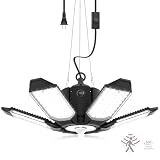
Overview: The toberich motion sensor garage light delivers 200W and 20,000 lumens through 312 LEDs with a unique linkable design that connects up to four units via 9.84-foot power cords. Its PIR sensor detects motion at 15 feet with 360° coverage, while three operational modes—including a 15-second self-test sequence—accommodate different scenarios. Six adjustable panels plus a central light provide comprehensive coverage.
What Makes It Stand Out: Linkability transforms this from a single fixture into a scalable lighting system for large workshops or multi-bay garages. The plug-in design with extended cord offers installation flexibility where ceiling outlets exist, bypassing hardwiring needs. A 15-foot detection range exceeds most competitors, capturing movement earlier for seamless illumination.
Value for Money: At $29.99, the premium is justified for users needing multiple connected lights, as four units share one outlet and operate in unison. This eliminates the cost and complexity of separate motion sensors for each fixture while ensuring coordinated lighting.
Strengths and Weaknesses: Strengths include linkable architecture, extended detection range, flexible plug-in installation, and robust panel adjustability. Weaknesses: higher single-unit cost, corded design may appear less tidy than direct screw-in models, and PIR sensor lacks dusk-to-dawn discrimination.
Bottom Line: Perfect for expansive spaces requiring uniform lighting, toberich’s linkable system offers professional scalability at DIY pricing. It’s the optimal solution for workshop owners and mechanics needing coordinated illumination across large areas without electrical rewiring.
5. Ontel Beyond Bright Ultra LED Ultra-Bright Motion Activated Garage Light

Overview: The Ontel Beyond Bright offers a compact 40W LED solution producing 6,000 lumens through 96 LEDs on three adjustable panels. Marketed as an ultra-bright motion-activated light, it screws into any standard E26 socket without tools or wiring. The unit claims 750% more light than a 60W incandescent bulb while using minimal power.
What Makes It Stand Out: Ontel’s brand recognition and 30-year lifespan claim suggest dependable quality, while the ultra-low 40W consumption appeals to energy-conscious buyers. The three-panel design simplifies adjustment compared to six-panel competitors, offering straightforward directional control for smaller spaces.
Value for Money: At $29.99, this represents poor lumens-per-dollar value compared to 20,000-lumen alternatives at similar prices. However, the low power draw may benefit those with limited circuit capacity or off-grid applications where wattage constraints matter more than absolute brightness.
Strengths and Weaknesses: Strengths include brand reputation, extreme energy efficiency, simple installation, and reduced heat output. Weaknesses: significantly lower brightness limits utility to single-car garages or supplemental lighting, three panels provide less coverage than competitors, and the 30-year claim lacks independent verification.
Bottom Line: Suitable only for small garages, closets, or as secondary lighting, Beyond Bright falls short for serious workshop needs. Choose this for energy-critical applications or tight spaces where moderate illumination suffices, but look elsewhere for primary garage lighting requiring serious brightness.
6. toberich Motion Sensor Garage Light, 8000LM LED Garage Lights Motion Activated, 3 Switch Modes, 6500K Indoor Motion Sensor Light Bulb for Garage, Stairway, Laundry Room, Basement (1 Pack)

Overview: The toberich Motion Sensor Garage Light delivers impressive 8000-lumen brightness in a compact, deformable design. This single-pack LED fixture features 144 energy-efficient chips at 6500K daylight temperature, making it ideal for garages, basements, and utility rooms. With three operational modes and a 360-degree motion sensor, it offers versatile lighting solutions for indoor spaces.
What Makes It Stand Out: The three-switch functionality sets this apart from basic motion lights. Mode I provides standard on/off wall switch control, Mode O keeps it off, while Mode II activates the intelligent PIR sensor with 12-15 foot detection range. The four adjustable panels rotate 90 degrees, eliminating dark corners. Its 60-second auto-shutoff timer balances convenience with energy conservation.
Value for Money: At $19.99, this represents exceptional value for an 8000-lumen motion-activated light. Comparable products typically cost 30-50% more while offering similar brightness levels. The 50,000-hour lifespan and 80% energy savings versus traditional bulbs ensure long-term cost efficiency, paying for itself within months through reduced electricity bills.
Strengths and Weaknesses: Strengths include the versatile three-mode operation, excellent brightness-to-price ratio, and flexible panel adjustment. The 360-degree sensor coverage is comprehensive for indoor use. Weaknesses involve the relatively short 12-15 foot detection range, which may not suit larger garages, and the 60-second fixed timer lacking customization. Indoor-only design limits versatility.
Bottom Line: For under twenty dollars, the toberich garage light is a standout choice for homeowners seeking bright, motion-activated illumination in medium-sized indoor spaces. While it lacks advanced customization, its core performance and reliability make it a worthwhile investment for garages, laundry rooms, and basements.
7. papasbox 2 Pack 100w Led Motion Sensor Flood Light - 10000lm 6500k Daylight Whie Ultra Thin Security Lights Outdoor with Remote Control and Plug IP65 Waterproof Floodlight for Work Garage House Porch

Overview: The papasbox 2 Pack LED Motion Sensor Flood Light provides 10,000 lumens of daylight white illumination per unit, designed for outdoor security applications. Each 100W fixture incorporates 108 high-brightness lamp beads with PIR human body sensing technology. The IP65 waterproof rating and included remote control make these versatile options for garages, porches, and yard lighting.
What Makes It Stand Out: The plug-in design with 150cm wiring offers immediate installation without hardwiring, appealing to renters and DIY novices. The remote control adds convenience for mode adjustments from a distance. With 90% energy savings over halogen alternatives and a 120-degree beam angle, these lights deliver efficient, wide-area coverage for various outdoor scenarios.
Value for Money: At $22.80 per unit, this two-pack delivers solid value for outdoor motion lighting. The IP65 waterproofing and remote functionality typically command premium pricing, yet papasbox maintains affordability. While not the cheapest option, the durability claims and 50,000-hour lifespan justify the moderate investment for security-conscious homeowners.
Strengths and Weaknesses: Strengths include true outdoor waterproofing, flexible plug-and-play installation, and energy efficiency. The adjustable 180-degree bracket allows precise positioning. Weaknesses involve potential brightness exaggeration compared to market-leading alternatives, and the plug design may limit placement options near outlets. The product description contains grammatical errors that raise quality concerns.
Bottom Line: The papasbox floodlight twin pack serves as a practical, budget-friendly security solution for outdoor spaces. While build quality may not match premium brands, the convenience features and weather resistance make it suitable for garages, driveways, and porches where easy installation is prioritized over maximum performance.
8. Onforu 5 Head 70W Motion Sensor Outdoor Lights, 7000LM Flood Light Outdoor Hardwired, IP65 Waterproof LED Security Lights, Motion Lights for Outside Garage, Yard, Porch, Entryway

Overview: The Onforu 5 Head Motion Sensor Outdoor Light delivers 7000 lumens through an innovative five-panel design, offering exceptional coverage for large exterior spaces. This 70W fixture features advanced PIR motion detection and IP65 waterproofing, making it ideal for garages, yards, and entryways. The unique graphene and PA66 construction ensures durability while maintaining lightweight flexibility.
What Makes It Stand Out: Five individually adjustable heads provide unprecedented lighting customization, covering up to 1230 square feet when optimally positioned. The graphene-infused housing represents cutting-edge material science, offering superior heat dissipation and rust resistance compared to traditional aluminum fixtures. The motion sensor integrates seamlessly with the adjustable heads for targeted illumination.
Value for Money: Priced at $35.50 per unit (two for $70.99), this sits in the premium mid-range category. The five-head design and advanced materials justify the cost for those needing extensive coverage. While pricier than basic dual-head models, the 70W efficiency and 50,000-hour lifespan deliver long-term value for property owners requiring comprehensive security lighting.
Strengths and Weaknesses: Strengths include massive coverage area, innovative material construction, and individual head adjustability. The IP65 rating ensures all-weather reliability. Weaknesses involve the lower 7000-lumen output relative to price, potentially requiring multiple units for very large areas. Hardwired installation demands electrical expertise, limiting DIY appeal. The motion sensor range specifications are vague.
Bottom Line: The Onforu five-head light excels for homeowners needing customizable, wide-area outdoor illumination. Its premium materials and adjustable design make it ideal for complex lighting scenarios, though the moderate brightness and installation requirements suggest it’s best for specific use cases rather than universal applications.
9. Craftersmark Motion Sensor Garage Light, 250W Motion Sensor Light Indoor,Deformable Garage Lights Ceiling LED,25000LM Super Bright Motion Activated LED Shop Light for Stairway,Basement 2Pack
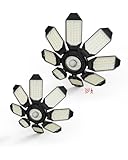
Overview: The Craftersmark Motion Sensor Garage Light twin pack delivers an extraordinary 25,000 lumens per unit through 375 LED chips and eight deformable panels. These 250W fixtures feature advanced dual-sensor technology combining PIR motion detection with dusk-to-dawn photocells. Designed for large indoor spaces, they provide daylight 5000K illumination across 250 square feet per light.
What Makes It Stand Out: The intelligent sensor system prevents false triggers from fans, vacuums, or curtains—a common frustration with standard motion lights. The dusk-to-dawn sensor ensures lights remain off during daylight hours, maximizing energy savings. Eight adjustable panels offer superior directional control, while the anti-interference technology allows multiple units in one room without sensor conflicts.
Value for Money: At $24.50 per light, these offer remarkable brightness-per-dollar value. The 25,000-lumen output rivals commercial fixtures costing twice as much. Dual-sensor intelligence and false-trigger prevention add premium functionality at a mid-range price point. For illuminating warehouses, high-ceiling garages, or large basements, the cost-to-performance ratio is outstanding.
Strengths and Weaknesses: Strengths include exceptional brightness, smart dual-sensor operation, and false-trigger immunity. The eight-panel design provides comprehensive coverage. Weaknesses involve potential overkill for standard residential garages, as 25,000 lumens may be uncomfortably bright in small spaces. The 250W power consumption, while efficient per lumen, still draws significant current. Indoor-only design limits versatility.
Bottom Line: For large indoor areas requiring massive illumination, the Craftersmark twin pack is unmatched in value. The intelligent sensors and extraordinary brightness make it perfect for workshops, warehouses, and oversized garages, though standard garages may find it excessively powerful. It’s a commercial-grade solution at residential pricing.
10. Onforu 100W LED Security Lights Motion Sensor Light Outdoor, 9000LM Ultra Bright, 6000K, IP65 Waterproof Flood Light Motion Detector with 3 Head, Exterior Floodlight Wall Light for Entryway, Garage

Overview: The Onforu 100W LED Security Light delivers 9000 lumens through three adjustable heads, providing robust outdoor illumination for security applications. This hardwired fixture features a 180-degree motion sensor with 16.4-32.8 foot detection range and customizable lighting duration from 10 seconds to 7 minutes. The die-cast aluminum construction ensures durability in harsh weather conditions.
What Makes It Stand Out: The adjustable lighting duration offers exceptional customization, from brief alerts to extended illumination—far surpassing competitors’ fixed timers. The full-metal design with beaded cover reduces glare while protecting eyes. With a 270-degree detection zone through three adjustable heads, it provides comprehensive coverage. The 32.8-foot maximum range exceeds most residential motion lights.
Value for Money: At $75.99, this commands a premium price but delivers professional-grade features. The adjustable duration, extended range, and robust metal construction justify the cost for security-conscious homeowners. While cheaper alternatives exist, the build quality and customization options ensure long-term reliability that budget models cannot match, making it a worthwhile investment.
Strengths and Weaknesses: Strengths include superior motion detection range, adjustable timer settings, durable aluminum housing, and IP65 waterproofing. The three-head design offers flexible positioning. Weaknesses involve the higher price point for a single unit and hardwired installation requiring professional help. The 6000K color temperature may appear slightly cooler than the advertised daylight balance.
Bottom Line: The Onforu 100W security light is a top-tier choice for serious home security applications. Its professional features and durable construction make it ideal for entryways, driveways, and large yards where customizable, long-range detection is essential. The premium price is justified by performance that exceeds standard consumer-grade alternatives.
Understanding Ultra-Bright LED Technology in Motion Lights
Lumens vs. Watts: What Actually Matters
When shopping for security lighting, your first instinct might be to check the wattage—but that’s outdated thinking from the incandescent era. LEDs produce light through electroluminescence, not heat, making wattage a measure of energy consumption, not brightness. For security applications, lumens are the only metric that counts. A quality ultra-bright garage motion light should deliver between 2,000 and 3,500 lumens to effectively startle intruders and provide usable illumination for identification purposes.
To put this in perspective, 2,000 lumens approximates the brightness of a 150-watt halogen bulb while consuming only 20-25 watts of electricity. The most effective security lights concentrate this output into a focused beam pattern rather than diffusing it broadly. Look for fixtures that specify both total lumens and beam angle—narrow beams (45-90 degrees) create intense spotlighting for targeted areas like garage doors, while wider beams (120+ degrees) provide general area coverage but with reduced intensity.
Color Temperature and Its Impact on Security
Color temperature, measured in Kelvin (K), dramatically affects how your security camera footage appears and how the human eye perceives threats. Ultra-bright LEDs typically range from 3,000K (warm white) to 6,500K (daylight). For security applications, 5,000K to 6,000K delivers optimal results. This “cool daylight” spectrum renders colors accurately on surveillance footage, making it easier to identify clothing, vehicles, and skin tones—critical details that warm lighting can distort.
Cooler temperatures also create a psychological effect that warm lighting lacks. The stark, clinical appearance of daylight-temperature LEDs feels institutional and surveilled, triggering what security professionals call “hostile environment perception” in potential intruders. Your goal isn’t to create a welcoming ambiance; it’s to make your garage appear actively monitored and inhospitable to unauthorized visitors.
LED Lifespan and Durability Factors
Quality ultra-bright LEDs should last 50,000 hours or more—roughly 10 years of nightly operation. However, motion-activated lights experience unique stressors that can shorten lifespan. Rapid on-off cycling generates thermal stress, and outdoor exposure to temperature extremes tests component durability. Look for fixtures with integrated heat sinks and constant-current drivers rather than cheaper resistor-based designs.
The LED chip itself matters enormously. COB (Chip-on-Board) LEDs offer superior thermal management and more uniform light distribution than older SMD (Surface-Mounted Device) arrays. For garage security, COB technology provides that intense, unified beam that eliminates dark spots between individual diodes—creating a wall of light that leaves no shadows for intruders to exploit.
Key Features to Evaluate Before Buying
Detection Range and Angle
Passive Infrared (PIR) sensors detect heat signatures from moving objects, but their effectiveness depends entirely on range and coverage pattern. Most residential garage lights offer 40-70 feet of detection range, but the detection angle determines whether you’re getting a security system or a raccoon alarm. Wide-angle sensors (180-270 degrees) monitor broad approaches but trigger more false alarms. Narrow-angle sensors (90-120 degrees) focus on specific pathways like driveways and walkways.
For typical two-car garages, dual-head fixtures with adjustable sensors provide the best flexibility. Position one sensor to monitor the driveway approach (long-range, narrow angle) and the other to cover the pedestrian path (wide angle, shorter range). This configuration minimizes false triggers from street traffic while ensuring no human approach goes undetected.
Adjustable Sensitivity Settings
Sensitivity controls aren’t just convenience features—they’re essential tuning mechanisms that separate reliable security from nuisance lighting. Low-quality motion lights offer simple on/off sensitivity, while professional-grade fixtures provide multi-level adjustment (typically 10-100% in 10% increments) and even pet-immunity settings that ignore animals under a certain weight threshold.
The sweet spot for garage security lies in the 70-85% sensitivity range, calibrated to detect human-sized heat signatures at 15-20 feet while ignoring distant heat sources like passing cars or small animals. During installation, test your settings during different times of day. Afternoon sun heating your driveway can create thermal currents that trick sensors, while cold winter nights might require increased sensitivity to detect properly insulated figures.
Time Delay Controls
Time delay determines how long your light stays illuminated after motion ceases. Options typically range from 5 seconds to 12 minutes, but security effectiveness peaks at 30-60 seconds. Anything shorter creates a strobe effect that annoys neighbors and reduces the psychological impact. Longer durations waste energy and diminish the “surprise factor” that makes motion lights effective deterrents.
Advanced fixtures offer dual-stage timing: an initial high-intensity blast for 30 seconds, followed by a dimmed “standby” mode that maintains visibility without full power consumption. This hybrid approach balances security presence with energy efficiency—particularly valuable for solar-powered installations.
Dusk-to-Dawn Sensors
Don’t confuse motion sensors with photocells. Dusk-to-dawn sensors keep lights off during daylight hours, preventing unnecessary activation and extending LED lifespan. However, the response time of these photocells matters significantly. Cheap sensors react slowly to changing light conditions, potentially leaving your garage dark during dawn/dusk periods when many break-ins occur.
Look for fixtures with adjustable light-level thresholds (typically 2-50 lux). Setting your threshold around 10 lux ensures activation during overcast days and twilight hours while preventing daytime triggering. Some advanced models include “smart dusk-to-dawn” that learns your local lighting patterns over a week-long calibration period.
Power Source Options Explained
Hardwired Installations
Hardwired motion lights connect directly to your home’s electrical system, providing unlimited runtime and consistent performance. This is the gold standard for primary garage security lighting. Installation requires a 120V junction box, typically positioned above the garage door or on a side wall. The key advantage is reliability—no batteries to change, no solar panels to clean, and no weather-related power fluctuations.
When planning a hardwired installation, consider the circuit load. A 2,500-lumen LED fixture draws only 20-25 watts, allowing multiple lights on a single 15-amp circuit. However, code requirements mandate GFCI protection for outdoor circuits, and many jurisdictions require a dedicated switch for maintenance override. Professional installation typically costs $150-300 per fixture but ensures proper weather sealing and code compliance.
Solar-Powered Solutions
Solar motion lights have evolved from dim, unreliable gadgets to legitimate security tools, but they come with critical limitations. The best solar units produce 1,500-2,000 lumens—sufficient for supplemental lighting but not primary security. Panel efficiency and battery capacity are the limiting factors. Look for monocrystalline panels (18-22% efficiency) and lithium-ion batteries rated for at least 2,000 charge cycles.
Solar works best in regions receiving 6+ hours of direct sunlight daily. Even then, winter months with shorter days and snow coverage can reduce performance by 40-60%. For garage security, consider solar units as layered backups—illuminating side paths or dark corners where running conduit is impractical, while relying on hardwired lights for primary coverage.
Battery-Operated Flexibility
Battery-powered motion lights occupy a niche role in garage security. Modern units using lithium batteries can deliver surprising brightness (up to 1,800 lumens) for 6-12 months between changes. They’re ideal for rental properties where permanent installation isn’t possible, or for illuminating detached garages without underground trenching.
The hidden cost is battery replacement—both financial and environmental. A high-use security light might consume $30-50 in batteries annually. Look for units with battery-life indicators and “eco modes” that reduce brightness by 30% after the initial motion detection to extend runtime. Rechargeable lithium packs offer better long-term value than disposable alkaline batteries.
Weather Resistance and Durability
IP Ratings Decoded
That “IP65” rating isn’t just marketing fluff—it’s your guarantee of survival through monsoons and blizzards. The Ingress Protection scale measures dust and water resistance. For garage motion lights, IP65 is the minimum acceptable rating: completely dust-tight and protected against water jets from any direction. IP67 (temporary submersion) or IP68 (continuous submersion) offers overkill protection for most residential applications.
Pay special attention to the sensor housing rating, which sometimes differs from the main fixture. A light might be IP65 while its sensor is only IP44, creating a failure point. Coastal homeowners should also verify salt-spray resistance (ASTM B117 certification), as salt corrosion can destroy standard fixtures within 18 months.
Material Construction Quality
The housing material determines whether your investment lasts a decade or fails after two harsh winters. Die-cast aluminum with powder-coat finish offers the best durability-to-weight ratio, resisting corrosion while dissipating heat effectively. Avoid plastic housings—even “UV-resistant” polymers become brittle and yellow after 3-5 years of sun exposure.
Mounting hardware quality is equally critical. Stainless steel screws and corrosion-resistant gaskets prevent the slow degradation that lets moisture seep into connections. Check that the fixture uses silicone O-rings rather than foam gaskets at adjustment points; foam compresses permanently and loses its seal after a few position changes.
Temperature Tolerance
Your garage motion light must function from -40°F to 120°F. LEDs actually perform better in cold (they’re more efficient), but the electronic components—particularly capacitors in the driver circuit—can fail in extreme heat. Look for fixtures rated for the full temperature spectrum, with thermal rollback protection that automatically dims the light if internal temperatures exceed safe operating limits.
In regions experiencing temperature swings exceeding 50°F in a single day, thermal cycling can crack solder joints and loosen connections. Fixtures with conformal-coated circuit boards resist this stress by encapsulating components in a protective polymer layer.
Installation Best Practices
Optimal Mounting Height
Mounting height directly affects both detection effectiveness and light distribution. The sweet spot for garage motion lights is 8-10 feet above ground level. Too low (under 6 feet) and the sensor can’t detect approaching figures until they’re at your door. Too high (over 12 feet) and the light pattern becomes too diffuse, reducing intimidation factor while creating harsh shadows.
For two-story garages or installations above 10 feet, choose fixtures with adjustable heads that you can angle downward 15-30 degrees. This maintains the intense beam pattern where you need it while preventing light pollution that annoys neighbors and violates dark-sky ordinances.
Positioning for Maximum Coverage
The most common installation mistake is pointing the motion sensor directly at the area you want illuminated. PIR sensors detect lateral movement across their detection field, not straight-on approach. Position sensors perpendicular to likely approach paths—alongside the driveway rather than facing down it. This ensures the sensor trips when someone crosses into the property, not when they’re already at the garage door.
Consider overlapping coverage zones if installing multiple lights. A figure moving from one zone to another should trigger sequential illumination, creating a “follow-me” effect that suggests active monitoring. Space fixtures 30-40 feet apart, with detection zones overlapping by 10-15 feet for seamless coverage.
Wiring Considerations for Safety
Hardwired installations demand weatherproof connections. Use silicone-filled wire nuts or direct-burial splice kits for any underground runs. The National Electrical Code requires UF-B cable for outdoor circuits, buried at least 12 inches (24 inches if under a driveway). Always install a switch inside the garage for maintenance override—this isn’t just convenient, it’s required by code in many jurisdictions.
Grounding is non-negotiable. Your motion light’s metal housing must connect to the equipment ground conductor, not just rely on the mounting screws for grounding. This protects against electrical faults and ensures the GFCI functions properly. If you’re not comfortable working with 120V circuits, hire a licensed electrician. A faulty installation creates both a fire hazard and a false sense of security.
Advanced Security Features
Dual Technology Sensors
Single PIR sensors work well but generate false alarms from pets, wind-blown debris, and temperature fluctuations. Dual-technology sensors combine PIR with microwave or ultrasonic detection, requiring both technologies to trigger before activating the light. Microwave sensors emit low-power radio waves that detect motion through Doppler shift, working reliably in extreme temperatures where PIR fails.
The magic lies in the AND logic: PIR detects the heat signature while microwave confirms actual movement. This reduces false alarms by 90% while increasing detection reliability for human intruders. Dual-tech sensors cost 40-60% more but pay dividends in reduced nuisance alarms and neighborhood goodwill.
Smart Home Integration
Modern motion lights offer more than illumination—they’re data collection points for your security ecosystem. Wi-Fi-enabled fixtures can send push notifications when triggered, integrate with camera systems to start recording, and even trigger indoor lights to create the illusion of occupancy. Look for local API support rather than cloud-only devices; you want your security to function even when internet service fails.
Z-Wave and Zigbee protocols offer more reliable connections than Wi-Fi for outdoor devices, using mesh networking to extend range through walls. The best integrations allow conditional logic: “If motion detected AND it’s after 11 PM AND I’m not home, then turn on all exterior lights and send alert.” This contextual awareness transforms simple motion lights into intelligent security agents.
Tamper-Resistant Designs
A determined intruder might attempt to disable your lights before approaching. Tamper-resistant features include locking adjustment knobs requiring tools to reposition, reinforced mounting brackets that resist prying, and accelerometer sensors that trigger if the fixture is moved or vibrated. Some units include backup battery power that activates if the main power is cut, ensuring the light functions even during an attempted sabotage.
The most effective tamper resistance is elevation. Mounting fixtures at 10+ feet requires ladders or poles to reach, creating noise and delay that defeats stealthy approaches. Combine this with anti-climb deterrents on downspouts and adjacent structures to force intruders into well-lit, easily observable positions.
Adjusting Settings for Optimal Performance
Fine-Tuning Sensitivity
Out-of-the-box sensitivity settings are generic guesses at best. Proper calibration requires a systematic approach. Start at 50% sensitivity and have a helper walk the approach path during the intended monitoring hours. Increase sensitivity incrementally until detection occurs at your desired trigger point, then add 10% as a buffer.
Seasonal recalibration is essential. Summer heat creates thermal currents that can trigger sensors; reduce sensitivity by 15-20% during hot months. Winter’s cold, dense air reduces infrared transmission; increase sensitivity accordingly. After any major landscaping changes, retest your zones—new shrubs or fences alter thermal patterns and reflection paths.
Setting the Right Duration
The ideal duration balances security presence with energy conservation. For primary garage doors, 45-60 seconds provides enough time to approach, unlock, and enter without the light shutting off prematurely. For side paths or less-trafficked areas, 30 seconds suffices.
Consider staggered durations in multi-light setups. The initial triggered light stays on for 60 seconds, while secondary lights in the sequence activate for only 30 seconds. This creates a natural “fade” effect that suggests intelligent control rather than a simple timer, enhancing the perception of active monitoring.
Creating Detection Zones
Advanced motion lights allow you to mask portions of the sensor’s detection field, creating exclusion zones that ignore street traffic or neighbor’s yards. Use the included blinders or tape to block 20-30% of the sensor’s view, focusing only on your property. This customization reduces false alarms by up to 70% while concentrating security where it matters.
For corner-mounted fixtures, create overlapping partial zones by angling sensors to create a “V” pattern. The overlapping area triggers both sensors simultaneously, which you can configure (on dual-head units) to activate maximum brightness as a heightened alert state.
Common Mistakes to Avoid
Overlooking Local Regulations
Many municipalities have dark-sky ordinances limiting light trespass and requiring shielded fixtures. Violations can result in fines and mandatory removal. Before installation, check local codes regarding maximum lumens at property lines, required shielding angles, and prohibited hours of operation for non-essential lighting.
Homeowners’ associations often have even stricter rules. Some require motion lights to be mounted only on rear facades or limit activation frequency. A $200 motion light becomes a $500 mistake after fines and reinstallation costs. Always obtain written approval for exterior lighting modifications in HOA communities.
Poor Placement Decisions
Installing motion lights under eaves seems logical for weather protection, but this placement creates a blind spot directly beneath the fixture. Intruders can approach along the wall undetected until they’re at the door. Mount fixtures on wall surfaces, not under overhangs, and position them to cover approaches from both sides.
Another common error is symmetrical placement. Your garage isn’t a symmetrical threat environment. The door facing a busy street needs different coverage than the side door hidden by landscaping. Customize placement based on actual risk assessment, not aesthetic balance. The most secure garage often looks slightly “off” from a design perspective.
Ignoring Neighbor Considerations
A 3,000-lumen light triggered by every passing car will make you the neighborhood pariah. Before finalizing installation, survey the light spill onto adjacent properties. Have a neighbor walk their property line at night while you trigger the light. If they can read a newspaper in their bedroom, you’ve gone too far.
Most quality fixtures include adjustable shields or baffles that limit light spread. Use them aggressively. Good security lighting illuminates your property without creating a nuisance. A friendly conversation with neighbors about your security goals often yields valuable insights about blind spots and shared concerns.
Maintenance and Longevity
Cleaning LED Lenses
Ultra-bright LEDs lose 20-30% of their effective output to dirt and oxidation within a year. Quarterly cleaning is non-negotiable for maintaining security effectiveness. Use a microfiber cloth and isopropyl alcohol—never abrasive cleaners that scratch polycarbonate lenses. Pay special attention to the sensor window, which accumulates pollen and dust that reduce detection range.
In coastal or industrial areas, salt and chemical deposits require monthly attention. Apply a hydrophobic coating (like Rain-X for plastics) after cleaning to repel future buildup. This simple step can maintain 95% light transmission between cleanings and extends the time between maintenance intervals.
Sensor Calibration
PIR sensors drift over time due to component aging and environmental contamination. Annual recalibration ensures consistent performance. Most fixtures have a test mode that triggers the light with each detection, allowing you to verify range and sensitivity without waiting for full activation cycles.
If your light begins triggering erratically or fails to detect obvious movement, the sensor may need more than recalibration. Check for spider webs, wasp nests, or accumulated debris in the sensor housing. These obstructions create micro-climates that trick the sensor into false triggers. A can of compressed air and careful cleaning often restores proper function.
Seasonal Adjustments
Your motion light’s performance varies dramatically with seasons. Winter preparation includes clearing snow from the sensor lens and adjusting sensitivity upward (cold reduces infrared detection). Summer requires sensitivity reduction and checking for vegetation growth that enters detection zones.
Spring and fall demand attention to thermal transitions. Rapid temperature changes at dawn and dusk create air currents that trigger PIR sensors. Temporarily reduce sensitivity by 25% during these transitional seasons, or use dual-technology sensors that ignore thermal fluctuations. Mark your calendar for seasonal adjustments to maintain year-round reliability.
Cost vs. Value Analysis
Initial Investment
Quality ultra-bright LED motion lights range from $60 to $250. The sweet spot for reliable security lies in the $100-150 range. Below $75, you sacrifice sensor accuracy, weather sealing, and component quality. Above $200, you’re paying for smart features or commercial-grade durability that most residential users don’t require.
Total installation cost often doubles the fixture price. Hardwired installations require electrical boxes, cable, and potentially professional labor. Solar units need optimal southern exposure, which might require mounting posts or brackets. Budget for the complete solution, not just the fixture.
Energy Savings Over Time
A 25-watt LED motion light activated 10 times nightly for one minute each uses approximately 1.5 kWh annually—costing under $0.20 in electricity. Compare this to a 150-watt halogen security light running dusk-to-dawn: 657 kWh annually, costing $85-100 depending on your rate. The ROI period for LED conversion is typically 14-18 months.
Smart scheduling adds another layer of savings. Configuring lights to operate only during high-risk hours (10 PM to 6 AM) rather than all night reduces energy use by an additional 60% without compromising security. The most sophisticated approach uses geofencing: lights activate fully only when no residents are home, running at reduced sensitivity when family members are present.
Warranty Considerations
Motion light warranties reveal manufacturer confidence. Five-year warranties are standard for quality LED fixtures, with some offering 10-year coverage on the LED array itself. Read the fine print: many warranties exclude “normal wear” of sensors and seals, which are the most likely failure points.
Register your product immediately after installation. Most warranties require online registration within 30 days, and unregistered products often receive only 1-2 years of coverage. Keep receipts and document installation dates. When a $150 fixture fails at year three, a valid warranty claim saves both money and the hassle of researching replacements.
Security Strategy Integration
Layering Your Lighting
A single motion light creates a single point of failure. Security layering involves multiple light types: ultra-bright motion lights for deterrence, lower-level dusk-to-dawn lights for baseline visibility, and pathway lighting for safe navigation. This approach ensures that disabling one light doesn’t plunge your property into darkness.
Place motion lights at perimeter points—property edges, gate entrances, and dark corners—while using constant low-level lighting near the garage door itself. This creates a psychological gradient: intruders trigger lights while still far from the target, feeling exposed for longer periods. The garage door area remains consistently lit, suggesting occupancy and active monitoring.
Coordinating with Cameras
Motion lights and cameras are symbiotic. Lights provide the illumination cameras need for clear footage, while cameras verify whether motion triggers warrant human response. Synchronize activation by connecting lights and cameras to the same smart hub, or use camera-based motion detection to trigger lights rather than relying on separate PIR sensors.
The key specification is IR compatibility. Many cameras switch to infrared night vision when lights are off, then overexpose when lights suddenly activate. Look for cameras with wide dynamic range (WDR) and automatic brightness control to handle these lighting transitions smoothly. Test your setup at night—if the camera whites out for 3-5 seconds after light activation, you’ve created a blind spot when you need visibility most.
Psychological Deterrence Factors
Brightness alone doesn’t deter crime—predictability and context matter more. Random, erratic lighting suggests malfunctioning equipment, while consistent, purposeful illumination implies human control. Program smart lights to vary timing slightly (±5 seconds) and occasionally activate in sequences that mimic human movement patterns.
Color-changing LEDs (available in some smart fixtures) add another layer of deterrence. A sudden shift from white to red or blue creates a “law enforcement” association that many intruders find uniquely unsettling. Use this sparingly—once or twice nightly during high-risk hours—to avoid desensitization. The goal is to make your property appear actively monitored by an unpredictable intelligence.
Frequently Asked Questions
1. How many lumens do I really need for effective garage security lighting?
For primary garage door coverage, aim for 2,500-3,000 lumens to create a startle response and provide identifiable illumination for cameras. Secondary areas like side paths can use 1,500-2,000 lumens. Remember that focused beams feel brighter than diffused light, so a 2,000-lumen spotlight often provides better security than a 3,000-lumen floodlight.
2. Why does my motion light trigger constantly from passing cars?
Your sensor’s detection zone extends into the street. Adjust the sensor angle downward and use the included blinders or tape to block the street-facing portion of the lens. Reducing sensitivity to 60-70% also helps, as vehicles are typically detected at the sensor’s maximum range where sensitivity is lowest. Consider a dual-technology sensor that ignores heat-only triggers.
3. Can I install a hardwired motion light myself, or do I need an electrician?
If you have an existing junction box and basic electrical knowledge, DIY installation is manageable. However, running new circuits or tapping into existing lines requires understanding load calculations and code requirements. Most jurisdictions allow homeowner electrical work, but professional installation ($150-300) ensures proper grounding, weather sealing, and warranty compliance. Always turn off power at the breaker, not just the switch.
4. How do I prevent my motion light from disturbing neighbors?
Use adjustable shields to direct light onto your property only. Mount fixtures lower (8 feet) and angle them sharply downward. Choose fixtures with 3,000K color temperature rather than harsh 6,000K, as warmer light is less likely to penetrate neighbors’ windows. Test light spill from their property line after installation, and have an honest conversation about your security needs—offering to adjust settings builds goodwill.
5. What’s the difference between PIR and dual-technology motion sensors?
PIR (Passive Infrared) detects heat signatures and movement. Dual-technology combines PIR with microwave or ultrasonic sensors that detect actual physical movement regardless of temperature. Both must trigger simultaneously, reducing false alarms from animals, wind, and thermal currents by 90%. For garage security, dual-tech is worth the 40% price premium.
6. How often should I clean and maintain my LED motion light?
Clean lenses and sensor windows quarterly with isopropyl alcohol and microfiber cloths. Inspect mounting hardware and seals annually. Recalibrate sensitivity seasonally—winter requires higher sensitivity, summer lower. Replace any cracked gaskets immediately. With proper maintenance, quality LED motion lights last 10+ years; neglect reduces lifespan to 3-5 years.
7. Will solar-powered motion lights provide enough brightness for security?
High-end solar units deliver 1,500-2,000 lumens—sufficient for supplemental lighting but not primary security. Solar performance depends entirely on panel placement and local sunlight. They work best as secondary lights in sunny climates, covering side paths or areas where wiring is impractical. For main garage doors, hardwired 2,500+ lumen fixtures remain the gold standard.
8. Can motion lights work with my existing security cameras?
Yes, but ensure camera compatibility. Most cameras have WDR (Wide Dynamic Range) to handle sudden brightness changes. Position lights to illuminate the camera’s field of view without causing lens flare. Smart integrations allow camera motion detection to trigger lights, or vice versa. Test at night—if the camera whites out for more than 2 seconds after light activation, adjust positioning or camera settings.
9. What’s the ideal time delay setting for security purposes?
Set primary garage lights to 45-60 seconds—enough time to approach and enter without retriggering. Secondary path lights work well at 30 seconds. Avoid settings under 20 seconds (creates strobe effect) or over 3 minutes (wastes energy). Smart lights can use dual-stage timing: full brightness for 30 seconds, then dim to 30% for another minute before shutting off.
10. Do LED motion lights really deter crime, or just make me feel safer?
Studies from the Urban Institute and academic criminology departments show that sudden, bright lighting increases perceived risk for intruders, causing 60% to abandon attempts. However, effectiveness depends on placement, brightness (2,000+ lumens), and integration with other security measures. Motion lights work best as part of a layered approach—combining with cameras, physical barriers, and occupancy simulation. Alone, they’re a deterrent; combined, they’re a prevention system.