The acrid smell hits you first—that campfire scent that shouldn’t be in your suburban backyard. Then comes the hazy orange sunrise, painting everything in apocalyptic hues. But the most dangerous part of wildfire season is what you can’t perceive: microscopic PM2.5 particles smaller than a human hair’s width, infiltrating your home and lungs with silent efficiency. These fine particles don’t just trigger allergies; they cross directly into your bloodstream, carrying toxic compounds from burned buildings, vehicles, and vegetation deep into your body.
While regional air quality reports provide a 30,000-foot view, they can’t tell you what’s happening inside your child’s bedroom at 2 AM or whether your air purifier is actually keeping pace with the smoke seeping through window frames. That’s where smart air quality monitors have revolutionized personal health protection. Today’s devices don’t just measure—they interpret, predict, and alert, turning your home into a data-driven sanctuary when wildfire season turns your region into a tinderbox. But not all monitors are created equal, especially when it comes to detecting the unique signature of wildfire smoke. Let’s explore what separates life-saving technology from expensive paperweights.
Top 10 Smart Air Quality Monitors for Wildfire PM2.5
Detailed Product Reviews
1. GoveeLife Smart Air Quality Monitor with PM2.5, WiFi, Temperature & Humidity Sensors, LED Display, 2s Refresh, 2-Year Data Storage, for Home & Office Wired

Overview: The GoveeLife Smart Air Quality Monitor delivers focused air quality tracking at an entry-level price point. This wired device specializes in three core metrics: PM2.5 particulate matter, temperature, and humidity, with data refreshing every two seconds for near real-time awareness. Designed for seamless integration within the Govee ecosystem, it serves as a dedicated hub for automating your home’s climate control appliances. The unit features a clean LED display with switchable clock and air quality views, plus a four-level air quality indicator that provides at-a-glance status.
What Makes It Stand Out: The 2-second data refresh rate is exceptional for this price tier, giving you immediate feedback on air quality changes. Its standout feature is deep integration with GoveeLife appliances—air purifiers, humidifiers, and heaters automatically respond to readings, creating a truly smart environment. The two-year data storage capability allows for meaningful trend analysis, while the bright/night mode toggle ensures bedroom-friendly operation. The ±15 µg/m³ PM2.5 accuracy is respectable for residential use.
Value for Money: At $39.99, this monitor offers tremendous value for Govee ecosystem users. You’re getting smart connectivity, fast refresh rates, and automation features typically found in devices twice the price. However, its single-purpose nature means limited value if you don’t own other Govee products. Compared to generic monitors, the premium is justified by ecosystem integration alone.
Strengths and Weaknesses: Strengths: Lightning-fast 2-second refresh; seamless Govee device automation; excellent price-to-performance ratio; dual display modes; long-term data storage.
Weaknesses: Wired-only operation limits placement; measures only three metrics; requires 2.4GHz WiFi; narrow compatibility with specific Govee models; no battery backup.
Bottom Line: Perfect for existing Govee users seeking affordable, automated air quality control. The GoveeLife monitor excels at its niche but falls short as a standalone solution. If you’re invested in the ecosystem, it’s a no-brainer. Otherwise, consider more versatile alternatives.
2. 18 in 1 Air Quality Monitor Indoor, Portable CO2 Detector for CO2, Temperature (°F), Humidity, VOC, PM2.5, PM1.0, PM10 & Time Display, 【Dual Chip & High Accuracy】 Air Quality Tester for Home

Overview: This comprehensive 18-in-1 monitor from Nanezan positions itself as a portable air quality laboratory for residential use. The device tracks an impressive array of pollutants including CO2, TVOC, PM1.0/2.5/10, temperature, humidity, and time. Powered by a 5000mAh battery, it transitions seamlessly between home, office, car, and travel environments. The dual-chip architecture promises enhanced processing speed and accuracy, while the CO2 alarm provides crucial safety alerts when concentrations exceed safe thresholds.
What Makes It Stand Out: The dual-chip system represents genuine innovation—one chip dedicated to sensor processing, another managing the interface—ensuring lag-free operation and accurate readings. The CO2 alarm with audible alerts is essential for wildfire-prone areas or poorly ventilated spaces. The smiley-face AQI indicator offers intuitive visual feedback, sliding across the screen to show air quality trends. Its skin-friendly surface and delicate texture elevate it above utilitarian competitors.
Value for Money: At $99.99, this monitor sits in the mid-range sweet spot. You’re getting pro-level sensor diversity, portability, and advanced processing without the premium brand tax. The 5000mAh battery adds significant value for multi-room monitoring. However, the unknown brand longevity and lack of smart home integration slightly diminish its overall proposition compared to established players.
Strengths and Weaknesses: Strengths: Comprehensive 18-metric detection; true portability with large battery; dual-chip processing; intuitive smiley-face AQI; CO2 safety alarm; rapid one-minute setup.
Weaknesses: Brand recognition concerns; no WiFi/app connectivity; limited warranty information; battery runtime unspecified; may be overwhelming for casual users.
Bottom Line: An excellent choice for detail-oriented users who prioritize comprehensive detection over smart features. The Nanezan monitor delivers professional-grade monitoring at a consumer-friendly price, making it ideal for families wanting thorough air quality awareness without ecosystem lock-in.
3. Airthings View Pollution - PM2.5 Air Quality Monitor, PM2.5 Sensor, Humidity & Temp - Smart Indoor Air Pollution Detector for City Pollution & Wildfire Smoke Monitoring - App, Battery Powered & WiFi

Overview: The Airthings View Pollution takes a focused, premium approach to air quality monitoring, concentrating specifically on PM2.5 particulates, humidity, and temperature. This wireless, battery-powered device emphasizes long-term trend analysis and user-friendly app integration over sensor quantity. With up to two years of battery life and included batteries, it offers true set-and-forget convenience. The free Airthings app provides historical data, improvement tips, and unique Breezometer pollen forecasts, making it particularly valuable for allergy sufferers.
What Makes It Stand Out: The two-year battery life is category-leading, eliminating the hassle of frequent recharging. Airthings’ partnership with Breezometer for pollen data integration is unique and highly valuable for respiratory health management. The five-year extended warranty (with registration) demonstrates exceptional confidence in product longevity. Its wireless design allows optimal placement near pollution sources, while timely notifications keep you informed even when away from home.
Value for Money: At $159, this is a premium investment for focused monitoring. The price is justified by battery convenience, app sophistication, and brand reliability, but limited metrics (no CO2, TVOC, or PM10) may disappoint users wanting comprehensive detection. For urban dwellers and wildfire-affected regions specifically concerned with particulate matter, the specialization adds value. For general use, the price-per-sensor ratio is less compelling.
Strengths and Weaknesses: Strengths: Unmatched 2-year battery life; excellent app with pollen forecasts; 5-year warranty; wireless placement freedom; reputable brand; wildfire-focused design.
Weaknesses: Limited to three metrics; highest price point; no local display details; requires smartphone for full functionality; no smart home automation.
Bottom Line: Best suited for urban residents and wildfire-prone area inhabitants who prioritize particulate matter monitoring and convenience over comprehensive detection. The Airthings View Pollution excels at its specialized mission but isn’t a universal solution. Consider it a premium health tool, not a general-purpose monitor.
4. Professional Indoor Air Quality Monitor with AQI Beep Alarms, Portable Real-Time Detector for Home Cars Plants and Pets (White)
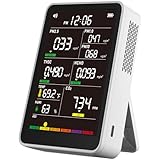
Overview: The MORPTRA Professional Monitor targets users seeking comprehensive detection with immediate alerting capabilities. This 16-in-1 device continuously tracks PM1.0/2.5/10, CO2, TVOC, HCHO, temperature, and humidity with seven distinct AQI alarm buzzers for different pollutants. The high-precision sensor system updates every three seconds, providing near real-time data on a clear color display. With 4-5 hours of battery life and versatile mounting options, it adapts to homes, cars, nurseries, and even outdoor camping scenarios.
What Makes It Stand Out: The seven-category AQI beep alarm system is uniquely comprehensive, audibly alerting you to specific pollutant threats rather than a generic warning. The one-button start and double-click silence function demonstrate thoughtful UX design for daily use. The HD color display enhances readability while adding aesthetic appeal. Its versatility shines through multiple carry scenarios, making it equally suitable for plant grow rooms, pet areas, and vehicle monitoring.
Value for Money: Priced at $139.99, this monitor competes directly with professional-grade units. The inclusion of HCHO (formaldehyde) detection adds value for new home or furniture owners. While battery life is modest at 4-5 hours, the fast-charging capability mitigates this limitation. The 12-month warranty is standard but less impressive than competitors offering extended coverage. For professional applications or multi-scenario use, the price is justified.
Strengths and Weaknesses: Strengths: Comprehensive 16-metric detection; specific pollutant alarms; rapid 3-second updates; intuitive one-button controls; portable design; includes formaldehyde sensor.
Weaknesses: Short battery life; no WiFi/app connectivity; limited warranty; unknown brand history; may require frequent charging for continuous use.
Bottom Line: Ideal for professionals, plant enthusiasts, and users needing portable, comprehensive monitoring with immediate audible alerts. The MORPTRA monitor sacrifices smart features and battery longevity for sensor diversity and portability. Choose it for specific applications rather than whole-home, always-on monitoring.
5. 18-in-1 Smart Air Quality Monitor - Indoor WiFi Air Quality Detector with Dual Chip, Real-Time for AQI, CO2, PM2.5, PM1.0, PM10, TVOC, HCHO, Time Display, Temperature & Humidity with Aler (White-B2)

Overview: The Bcetasy 18-in-1 Smart Monitor bridges the gap between comprehensive detection and smart home integration at an aggressive price point. This WiFi-enabled device tracks AQI, CO2, PM1.0/2.5/10, TVOC, HCHO, temperature, humidity, time, and date—essentially a complete air quality laboratory. The dual-chip architecture ensures responsive performance while WiFi connectivity enables remote monitoring via Smart Life or Tuya Smart apps. Additional smart features include auto-brightness, screen-off monitoring, and wall-mounting capability.
What Makes It Stand Out: The WiFi integration with popular smart home platforms at this price is remarkable, offering remote monitoring and historical data tracking typically reserved for premium devices. The dual-chip system mirrors professional-grade processing, separating sensor data analysis from UI management. Auto-brightness and screen-off monitoring demonstrate attention to user experience, while wall-mounting options provide installation flexibility. The skin-friendly surface and refined texture give it a premium feel despite the budget positioning.
Value for Money: At $79.99, this monitor delivers arguably the best feature-to-price ratio in the category. You’re getting 18 metrics, dual-chip processing, WiFi connectivity, and app support for less than half the price of comparable smart monitors. The requirement for 2.4GHz WiFi and potential WiFi 6+ compatibility issues are minor concessions. For tech-savvy users wanting comprehensive smart monitoring without breaking the bank, this is unmatched.
Strengths and Weaknesses: Strengths: Exceptional price for WiFi-enabled 18-metric detection; dual-chip processing; app-based remote monitoring; auto-brightness; wall-mountable; includes formaldehyde detection.
Weaknesses: App reliability concerns with lesser-known brands; WiFi 6+ compatibility issues; no battery option mentioned; limited brand history; potential long-term support questions.
Bottom Line: The definitive choice for budget-conscious buyers wanting maximum features and smart integration. The Bcetasy monitor democratizes comprehensive air quality monitoring, making it accessible to average consumers. While brand longevity remains a question mark, the feature set and price make it a compelling risk for those prioritizing capability over established reputation. Perfect for first-time smart home air quality monitors.
6. Temtop Smart Air Quality Monitor - Indoor Air Quality Meter with PM2.5, AQI, Temperature and Humidity Detector for Home, Office or School, App Connectivity, OTA Updates, 60-Day Battery Life

Overview: The Temtop Smart Air Quality Monitor positions itself as an accessible entry point into indoor air quality management, tracking PM2.5, AQI, temperature, and humidity. Designed for homes, offices, and classrooms, it combines essential monitoring capabilities with modern connectivity features at a budget-friendly price point.
What Makes It Stand Out: Its exceptional 60-day battery life dramatically reduces maintenance overhead compared to competitors requiring weekly charging. The device offers OTA (Over-The-Air) updates, ensuring your monitor stays current with the latest firmware improvements. The USA-designed display presents color-coded air quality indicators and audible alerts, while app connectivity provides remote monitoring and notifications for proactive air quality management.
Value for Money: At $39.99, this monitor delivers remarkable value. The extended battery life alone saves approximately $10-15 annually in replacement batteries compared to 30-day models. While it lacks advanced sensors like CO2 detection found in premium units, it covers the most critical pollutants affecting respiratory health. For casual users seeking basic awareness without subscription fees, it undercuts most app-enabled alternatives by 30-50%.
Strengths and Weaknesses: Strengths include outstanding battery longevity, intuitive color-coded feedback, portable design, and reliable app integration. The OTA update capability future-proofs your investment. However, it only monitors PM2.5 (not PM10), lacks CO2 and VOC detection, and the sensor accuracy, while adequate, doesn’t match industrial-grade specifications. The app experience, while functional, offers limited historical data analysis.
Bottom Line: This is an ideal starter air quality monitor for budget-conscious consumers prioritizing convenience and essential functionality. The 60-day battery and thoughtful design make it perfect for families wanting simple, reliable air quality awareness without technical complexity.
7. BREATHE Airmonitor Plus: Smart Air Quality Monitor Indoor - 8-in-1 CO2 Meter, Formaldehyde Detector, VOC Meter, PM1/2.5/10, Temperature & Humidity - Air Quality Tester for Home with App

Overview: The BREATHE Airmonitor Plus represents the premium tier of consumer air quality monitoring with its comprehensive 8-in-1 detection system. It measures PM1, PM2.5, PM10, CO2, TVOC, formaldehyde, temperature, and humidity, providing a complete environmental profile for health-conscious households and professionals.
What Makes It Stand Out: High-precision laser particulate sensors and NDIR CO2 detection deliver laboratory-grade accuracy in a consumer device. The built-in calibration tools for CO₂, VOCs, and formaldehyde ensure long-term reliability—a feature rarely seen outside professional equipment. Its dedicated CO2 monitoring helps optimize ventilation for cognitive performance and sleep quality, while the Breathe Tech App provides detailed trend analysis and remote alerts.
Value for Money: At $129.99, this monitor commands a premium but justifies it through sensor quality and breadth. Competing professional units with similar accuracy cost $200-400. For families with asthma sufferers, newborns, or home-office workers managing ventilation, the investment pays dividends in health outcomes. The calibration capability extends usable lifespan beyond standard consumer monitors, improving long-term value.
Strengths and Weaknesses: Strengths include unmatched sensor comprehensiveness, medical-grade accuracy, effective calibration features, and robust app integration. The CO2 and formaldehyde detection address critical indoor pollutants often ignored by cheaper models. Weaknesses include the steep price barrier for casual users, complexity requiring technical comfort during setup, and no battery operation—it’s AC-powered only, limiting portability.
Bottom Line: For serious air quality management where accuracy and completeness matter, this is the gold standard. Health-compromised individuals and productivity-focused professionals will find the premium worthwhile, while casual users may find it excessive.
8. Professional 15-in-1 Air Quality Monitor with Smartphone APP - Dual Chip - Sensors Detect CO2, PM2.5/PM10, HCHO, TVOC | Real-Time Alerts & Custom Thresholds | for Home, Car, Office, Plants, Pets
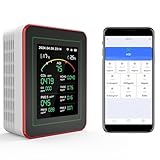
Overview: This Professional 15-in-1 monitor bridges the gap between basic consumer devices and expensive professional equipment. It detects CO2, PM2.5, PM10, formaldehyde (HCHO), TVOCs, humidity, temperature, and air pressure, offering one of the most comprehensive sensor arrays in its price class for homes, cars, offices, and specialized applications like plant care.
What Makes It Stand Out: The innovative dual-chip architecture separates sensor data processing from user interface management, delivering faster response times and improved accuracy. The high-definition color LED display provides at-a-glance assessments with color-coded alerts, while the smartphone app enables remote monitoring with cloud-stored data. Custom threshold settings allow personalized alerts for specific environments.
Value for Money: At $69.99, this monitor delivers exceptional value, packing $150+ worth of sensors into a mid-tier price point. The dual-chip system typically appears in devices costing twice as much. For users needing multi-room monitoring or wanting to track air quality in various locations (home, car, office), its portability and comprehensive detection eliminate the need for multiple specialized devices.
Strengths and Weaknesses: Major strengths include the extensive 15-in-1 detection capability, innovative dual-chip precision, versatile power options (wired/wireless), and robust app with cloud storage. The portable design supports true multi-environment use. However, with so many sensors, battery life is shorter (likely 5-7 days) than simpler models. The abundance of data may overwhelm casual users, and the brand lacks the established reputation of Temtop or Awair.
Bottom Line: This is the value champion for feature-hungry users wanting professional-grade monitoring without the professional price tag. The dual-chip innovation and comprehensive detection make it ideal for tech-savvy families and small business owners needing detailed environmental data.
9. Temtop PM2.5 Monitor P600, Essential Air Particle Meter PM2.5 PM10 Air Quality Tester for Indoor/Outdoor Air Pollution Detection, Particle-Centric Detector w/Data Histogram Display
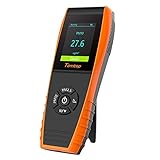
Overview: The Temtop P600 takes a specialized approach, focusing exclusively on particulate matter detection (PM2.5 and PM10) with professional-grade precision. This laser-based particle meter serves users whose primary concern is airborne dust, pollen, smoke, and pollution rather than gas-phase contaminants like CO2 or VOCs.
What Makes It Stand Out: The second-generation laser sensor delivers industrial-grade accuracy with over 20,000 hours lifespan, far exceeding consumer monitor standards. Temtop’s proprietary particle swarm optimization algorithm enhances measurement stability, particularly during rapid air quality changes. The histogram display stores 12 hours of data, providing trend analysis rarely found in focused particle detectors.
Value for Money: Priced at $64.79, the P600 occupies a middle ground between basic monitors and professional equipment. For users specifically tracking particulates—whether managing allergies, monitoring wildfire smoke, or assessing HVAC filtration effectiveness—it offers better accuracy than generalist monitors at similar prices. However, those needing gas detection must purchase additional devices, potentially negating cost savings.
Strengths and Weaknesses: Strengths include exceptional particulate measurement accuracy, robust data logging with visual histograms, durable industrial-grade sensor, and simple handheld portability. The back stand enables both mobile and stationary use. The primary weakness is narrow scope—no CO2, VOC, humidity, or temperature monitoring limits holistic air quality assessment. The lack of app connectivity restricts remote monitoring, and the monochrome display feels dated compared to competitors.
Bottom Line: Choose the P600 if particulate matter is your sole or primary concern. Allergy sufferers, asthmatics, and those in wildfire-prone regions will appreciate its specialized accuracy. For comprehensive air quality management, pair it with a gas detector or opt for a more versatile all-in-one unit.
10. 2CO9TB Smart WiFi Air Quality Monitor, Air Dust Pollutants PM2.5 PM1.0 PM10 and Thermometer with Temperature and Humidity Alarm

Overview: The 2CO9TB monitor disrupts the market with an ultra-affordable $22.99 price tag while delivering surprising functionality including PM1.0, PM2.5, PM10 detection plus temperature and humidity monitoring. This 9-in-1 device targets budget-conscious consumers wanting basic smart home integration without financial commitment.
What Makes It Stand Out: Unprecedented price point combined with legitimate WiFi connectivity and app support featuring one-year historical data storage—capabilities typically reserved for $60+ devices. The 2.8-inch color LCD display offers brightness adjustment and sleep timer settings. PM1.0 detection, rare in budget monitors, provides early warning of ultrafine particles. Temperature alarm settings add basic automation potential.
Value for Money: At $22.99, this monitor redefines entry-level expectations, costing less than a dinner out while delivering core functionality. It enables users to test whether air quality monitoring matters to them before investing in premium equipment. The feature set matches devices costing 3x more, though build quality and sensor accuracy are commensurately lower. For renters, dorm rooms, or secondary monitoring locations, it’s practically disposable.
Strengths and Weaknesses: Strengths include unbeatable price, WiFi connectivity, comprehensive particle detection (including PM1.0), extensive app features, and portability with USB-C charging. However, unknown brand reliability raises longevity concerns, sensor accuracy is unverified against professional standards, and customer support is unproven. The 2.4GHz-only WiFi limitation may frustrate some users, and the rechargeable battery life is unspecified and likely short.
Bottom Line: This is the perfect impulse-buy air quality monitor for curious beginners or as a secondary device. While not a replacement for medical-grade monitoring, it provides genuine utility at a price that defies expectations. Manage expectations around accuracy and longevity, but enjoy the remarkable value.
Understanding the Invisible Threat: Wildfire PM2.5
When wildfires consume everything in their path, they create a complex chemical cocktail that differs significantly from typical urban pollution. The PM2.5 particles generated by burning forests and structures contain higher concentrations of organic carbon, polycyclic aromatic hydrocarbons, and heavy metals that become more toxic as they travel and react with sunlight. These particles are also smaller and more irregularly shaped than vehicle emissions, making them harder for basic sensors to quantify accurately.
What makes wildfire PM2.5 uniquely dangerous is its persistence and penetration. Unlike larger PM10 particles that settle quickly, PM2.5 can remain airborne for weeks and travel hundreds of miles. It rides air currents through the tiniest cracks in your home’s envelope—around electrical outlets, through HVAC systems, even between doorframes. A monitor that only updates every 15 minutes might miss the critical moment when a wind shift dumps a massive concentration into your neighborhood in seconds.
What Makes Wildfire Smoke Different from Other Pollutants
Wildfire smoke carries a distinct particulate fingerprint that challenges standard air quality algorithms. The carbon-to-sulfur ratio is dramatically different from traffic pollution, and the presence of levoglucosan—a molecular marker for burning cellulose—creates unique optical properties. Advanced monitors use multi-wavelength laser analysis to differentiate these signatures, while basic models may misinterpret wildfire smoke as ordinary dust, giving you a false sense of security when the actual toxicity is far worse.
The hygroscopic nature of wildfire particles also means they absorb moisture and swell inside your lungs, increasing their damage potential. This is why monitors that only measure particle count rather than mass concentration can be misleading. A million tiny, dry particles might register as “moderate” while a smaller number of moisture-laden wildfire particles represents a severe health hazard. Understanding this distinction is crucial when evaluating sensor specifications.
How Modern Air Quality Monitors Detect Microscopic Danger
The technology inside today’s monitors resembles miniature chemistry labs more than simple smoke detectors. At the heart of most reliable devices, a tiny fan pulls air through a sensing chamber at a precise flow rate. Inside, particles pass through a laser beam, scattering light in patterns that reveal their size, shape, and composition. Photodetectors capture this scattering signature up to thousands of times per second, building a real-time particle size distribution map.
But detection is only half the battle. The processor must then convert this raw optical data into meaningful concentrations, accounting for humidity, temperature, and cross-sensitivity to other pollutants. This is where firmware algorithms become critical. A monitor calibrated for Beijing’s coal dust may underreport California wildfire smoke by 40% if the manufacturer hasn’t updated its particle refractive index database. The best devices use machine learning models trained on thousands of wildfire events to recognize the unique scattering signature of burning pine, eucalyptus, or synthetic materials.
The Science Behind Laser Scattering Technology
Laser scattering sounds straightforward—shine a light, count the shadows—but the physics gets complex fast. The Mie scattering theory that powers these sensors assumes perfectly spherical particles, which wildfire PM2.5 definitely is not. Irregular, fractal-like soot aggregates scatter light unpredictably, requiring sophisticated correction factors. High-end monitors use dual-angle detection, measuring both forward and side scattering to reconstruct particle shape.
The laser wavelength matters enormously. A 650nm red laser might miss ultrafine particles below 0.3 microns, while a 405nm violet laser can detect particles as small as 0.1 microns—critical for capturing the most dangerous, deeply penetrating fraction of wildfire smoke. Some advanced units even employ multiple lasers of different wavelengths, creating a particle characterization system that rivals professional-grade nephelometers costing ten times as much.
Electrochemical vs. Optical Sensors: What You Need to Know
While optical sensors dominate PM2.5 detection, they rarely work alone. Electrochemical sensors handle gases like carbon monoxide and nitrogen dioxide—common companions to wildfire smoke. These sensors use chemical reactions that generate electrical currents proportional to gas concentration. The problem? They’re consumable. The electrolyte dries out, especially in the low-humidity conditions that often accompany wildfire season, leading to drift and false negatives after 18-24 months.
Optical PM2.5 sensors also degrade but differently. The laser diode dims, and the mirror surfaces in the scattering chamber accumulate microscopic debris. However, this drift is more predictable and can be auto-corrected with periodic zero-point calibrations using HEPA-filtered air. When evaluating monitors, look for devices that explicitly mention automatic baseline calibration cycles—typically performed every 24 hours when particle counts drop to near-zero. This feature separates durable tools from disposable gadgets.
Key Features That Separate Reliable Monitors from Gadgets
A sleek app interface might win design awards, but it’s meaningless if the underlying sensor can’t distinguish smoke from steam. The first feature to scrutinize is the data refresh rate. During a fast-moving wildfire, PM2.5 levels can spike from “good” to “hazardous” in under five minutes. Monitors that average data over 10-minute intervals smooth away these critical spikes, showing you a comfortable “moderate” reading while you’re breathing emergency-level air.
Look for devices that offer configurable averaging. The best monitors let you toggle between 1-minute, 5-minute, and 1-hour averages, so you can spot trends without losing granularity. Even more valuable is the spike detection algorithm that triggers instant alerts when the rate of change exceeds normal thresholds—your first warning that a plume has arrived before it saturates the sensor.
Real-Time Data Refresh Rates: Why Seconds Matter
The difference between a 30-second and 5-minute refresh rate isn’t just convenience—it’s respiratory protection. When the Tubbs Fire jumped a highway in 2017, residents with slow-updating monitors didn’t realize their air had become lethal until they started coughing. Those with real-time data saw the spike immediately, sealed their homes, and activated purifiers.
True real-time monitoring requires more than fast sensors; it demands robust data pipelines. The monitor must process raw counts, apply correction algorithms, and push the data to your phone via Wi-Fi or Bluetooth without lag. Some devices claim “real-time” but batch process data every two minutes to conserve battery. For wildfire season, hardwired power with continuous transmission is non-negotiable. Check the technical specs for “maximum latency”—anything over 60 seconds is too slow for emergency response.
Multi-Pollutant Detection: Beyond Just PM2.5
Focusing solely on PM2.5 during wildfires is like checking only your car’s speed while ignoring the fuel gauge. Wildfire smoke contains carbon monoxide (CO), volatile organic compounds (VOCs), and nitrogen dioxide (NO2) that correlate with particulate levels but have different health impacts. CO binds to hemoglobin, reducing oxygen transport. VOCs cause eye irritation and headaches. NO2 triggers asthma attacks.
A comprehensive monitor should detect at least PM2.5, CO, and VOCs. The VOC sensor is particularly crucial—it’s typically a metal-oxide semiconductor that responds to the aromatic hydrocarbons in wood smoke. When VOCs spike but PM2.5 hasn’t yet, you’re detecting the leading edge of a smoke plume. This early warning gives you 15-30 minutes to prepare before visible haze arrives. Some monitors also include NO2 sensors, valuable if you live near roads where wildfire smoke mixes with traffic emissions, creating secondary pollutants.
Accuracy Matters: Certifications and Calibration Standards
The air quality monitor market is the Wild West of consumer electronics, with no mandatory accuracy standards. A device can claim to measure PM2.5 with ±5% precision while actually being ±50% inaccurate. This is where third-party certifications become your only reliable guide. The MCERTS certification (UK) and CARB approval (California) require devices to undergo testing against reference-grade monitors under real-world conditions, including wildfire smoke simulations.
Look for monitors that publish their correlation coefficient (R²) against federal reference methods. An R² above 0.85 indicates strong agreement with professional stations. Be wary of devices that only test against other consumer monitors—that’s circular validation, not scientific accuracy. Also check if the manufacturer participates in the Air Quality Sensor Performance Evaluation Center (AQ-SPEC) program, which independently tests sensors in challenging environments like California’s Central Valley during wildfire season.
Understanding the Difference Between Precision and Accuracy
Precision is repeatability; accuracy is truth. A monitor that consistently reads 25 µg/m³ when the real level is 50 µg/m³ is precise but dangerously inaccurate. This happens when manufacturers calibrate sensors using Arizona test dust (a standardized powder) instead of real combustion particles. The refractive index difference means the optical sensor misinterprets the light scattering, systematically underreporting wildfire smoke.
The best manufacturers use polydisperse calibration aerosols that mimic wildfire smoke’s size distribution and composition. They also implement field calibration factors that users can adjust based on local conditions. If you live in a wildfire-prone area, choose a monitor that lets you apply a “smoke correction factor”—typically a 1.2-1.5x multiplier that accounts for wildfire particles’ higher light absorption. Without this feature, you’re flying blind during the exact event you bought the device for.
Smart Connectivity: From Your Living Room to Your Phone
A monitor that only displays data on its own screen is a glorified digital poster. True smart connectivity means seamless data flow to wherever you are—work, vacation, or evacuation shelter. Wi-Fi connectivity is essential, but implementation quality varies wildly. Some devices require a 2.4GHz network (problematic if you’ve upgraded to mesh Wi-Fi), while others support 5GHz and even thread networks for better reliability during power fluctuations common during fire season.
The app experience defines the monitor’s utility. Look for customizable alert thresholds that go beyond the EPA’s generic AQI categories. You should be able to set a “personal limit” at 35 µg/m³ if you have asthma, even if the EPA considers 55 µg/m³ “moderate.” The best apps also provide trend arrows showing whether air quality is improving or deteriorating, helping you decide whether to open windows for ventilation or batten down the hatches.
Wi-Fi vs. Bluetooth: Which Connection Works Best for You
Bluetooth-only monitors might save $50, but they require you to be within 30 feet to check readings—useless when you’re at work wondering if you should rush home to protect pets. Wi-Fi enables remote monitoring, but introduces security considerations. Ensure the device uses TLS 1.3 encryption for data transmission and stores minimal personal information. Some monitors upload data to international servers with weak privacy laws; others keep everything local with end-to-end encryption.
For evacuation scenarios, cellular backup is a game-changer. A few premium monitors include LTE modules that continue broadcasting data even when Wi-Fi fails. This lets you check your home’s air quality from a hotel room 50 miles away, determining if it’s safe to return. If cellular isn’t an option, look for monitors with local data logging that store weeks of readings on-device, uploading automatically when connection restores. This prevents data loss during network outages when you need historical trends most.
Third-Party Integration: IFTTT, Alexa, and Google Home
During a wildfire emergency, you don’t want to fumble with phone apps. Voice integration lets you ask, “Alexa, what’s the indoor PM2.5?” while sealing windows with duct tape. More powerful is IFTTT (If This Then That) integration, which can automate your entire home response. Create applets that turn on all air purifiers when PM2.5 exceeds 50 µg/m³, or flash smart lights red when levels reach “hazardous.”
Advanced integrations include SmartThings and Home Assistant, allowing complex logic like “If outdoor PM2.5 is high AND indoor VOCs are rising, close smart vents and activate HVAC recirculation mode.” Some monitors even expose API endpoints for custom programming—imagine a script that texts your entire family when air quality degrades, or automatically orders replacement filters when sensor efficiency drops. This ecosystem thinking transforms a sensor into a central nervous system for home health.
Decoding Your Data: AQI, µg/m³, and What Those Numbers Mean
The Air Quality Index (AQI) was designed for outdoor regulatory compliance, not personal health decisions. Its breakpoints—0-50 “good,” 51-100 “moderate”—are based on 24-hour averages, making it useless for acute wildfire spikes. A monitor that only shows AQI is hiding critical information. You need raw mass concentration in micrograms per cubic meter (µg/m³) to make informed decisions.
During the Camp Fire, Paradise residents saw AQI readings of “999”—the maximum the scale allows—while actual PM2.5 concentrations exceeded 1,000 µg/m³. A monitor showing µg/m³ would display the real number, making clear that evacuation was mandatory. Learn the WHO guidelines as your personal standard: 15 µg/m³ annual average, 25 µg/m³ 24-hour average. For sensitive individuals, consider 10 µg/m³ your ceiling during wildfire season.
Local vs. Regional Data: Why Your Home Reading Differs from the News
Your local news station reports air quality from a federal monitoring station 20 miles away, positioned on a rooftop away from direct sources. Your monitor sits in your living room, detecting PM2.5 from your frying pan, your neighbor’s fireplace, and that smoke plume hugging your street due to microclimates. This isn’t a bug—it’s the point.
During the 2020 wildfires, Portland’s official AQI station read 250 (“very unhealthy”) while monitors in hillside neighborhoods trapped under inversion layers recorded 600+ µg/m³. The smoke was literally pooling in valleys while official sensors on ridges missed it. Your home monitor reveals these hyperlocal variations, showing why your asthmatic child is wheezing despite “moderate” regional reports. Use both data sources: regional trends for planning, local readings for immediate action.
Strategic Placement: Where to Position Your Monitor for Maximum Effectiveness
A monitor in the wrong location is worse than no monitor—it gives false confidence. The ideal placement is breathing zone height (3-6 feet), away from direct pollution sources like kitchens or bathrooms. Avoid corners where air stagnates; instead, position it at least 3 feet from walls in a central location. For multi-story homes, place monitors on the level where you spend the most time, but understand that PM2.5 levels can vary by 50% between floors due to stack effect.
During active smoke events, move your monitor periodically to map your home’s vulnerability. Check levels near windows, doors, and HVAC returns. You might discover that your bedroom stays clean while the garage is seeping smoke into your kitchen, indicating a specific sealing problem. Some monitors include portable mode with battery power, turning them into diagnostic tools for identifying infiltration paths.
Single-Room vs. Whole-Home Monitoring Solutions
One monitor protects one room, but wildfire smoke doesn’t respect room boundaries. Whole-home solutions use distributed sensor networks—multiple small sensors that feed data to a central hub. This architecture reveals gradients: maybe your basement stays clean while your attic traps smoke, suggesting you should seal attic access and run purifiers upstairs.
For apartments or smaller homes, a single, centrally located monitor with good air circulation may suffice. Place it near your HVAC return to capture blended air from all rooms. But if you have a home office where you spend 8 hours a day, consider a dedicated monitor there. The cost of a second device is trivial compared to lost productivity from smoke-induced brain fog, which studies show begins at just 20 µg/m³.
Battery Backup and Portability: Staying Informed During Evacuations
When authorities issue mandatory evacuation orders, your monitor becomes a tool for deciding when it’s safe to return. Battery backup isn’t a luxury—it’s essential. Look for devices with 8+ hours of battery life and USB-C charging that works with car adapters and power banks. The monitor should automatically switch to battery mode during outages without dropping Wi-Fi, continuing to log data even when you’re not there.
Portability features extend beyond battery. A compact, rugged design with a protective case lets you take it to hotels, shelters, or friends’ homes. Some monitors include GPS tagging, so your app shows air quality by location, building a personal map of safe zones. During the 2021 Bootleg Fire, evacuees used portable monitors to compare air quality across multiple shelter options, choosing the cleanest location for vulnerable family members.
Long-Term Investment: Maintenance, Sensor Lifespan, and Hidden Costs
That $150 monitor seems affordable until you learn the PM2.5 sensor needs replacement every two years at $80, and annual calibration costs another $50. Factor these expenses into your purchase decision. Total cost of ownership over five years can make a $300 monitor with 5-year sensor life cheaper than a budget option with annual replacements.
Sensor lifespan varies by technology. Laser diodes typically last 10,000-20,000 hours (3-5 years of continuous use). Electrochemical gas sensors last 18-24 months before electrolyte depletion. Metal-oxide VOC sensors can drift after two years. Reputable manufacturers publish these lifespans and sell replacement modules you can swap yourself. Avoid devices where the entire unit must be sent back for service—that’s a recipe for being unprotected during the next fire season.
When to Replace Sensors and Recalibrate Your Device
Your monitor won’t flash a “sensor dead” warning. Instead, readings will slowly drift, showing 12 µg/m³ when a co-located reference monitor reads 35 µg/m³. Perform spot checks twice a year using a known source: burn a piece of paper outdoors (safely) and compare your outdoor reading to a nearby official station. If your monitor consistently reads 30% low, it’s time for maintenance.
Some monitors include self-diagnostic modes that compare sensor response to internal references. These can detect a dying laser or contaminated optics, alerting you before accuracy degrades critically. For professional-grade confidence, invest in a calibration chamber—a sealed box with a HEPA filter and a way to introduce test aerosols. Run this quarterly to generate calibration curves you can apply manually. It’s overkill for most, but if you have severe respiratory disease, it’s cheaper than a hospital visit.
Privacy and Data Security: Who Else Sees Your Air Quality Information
Your air quality data reveals when you’re home, when you cook, when you sleep, and even when you vacuum. It’s a behavioral fingerprint. Many free apps sell aggregated data to insurance companies or marketers. Before buying, read the privacy policy—not just the summary. Check if data is anonymized, how long it’s retained, and whether you can delete it permanently.
Opt for monitors with local processing that send data directly to your phone via Bluetooth, never touching the cloud. If you want remote access, choose services with end-to-end encryption and transparent data handling. Some open-source monitors let you host data on your own server, completely bypassing third parties. During wildfire evacuations, be cautious about sharing real-time indoor air quality on social media—burglars can infer you’re not home. Use delayed posting or aggregate data sharing instead.
Frequently Asked Questions
Can these monitors detect the difference between wildfire smoke and regular pollution?
Advanced monitors with multi-wavelength lasers and VOC sensors can identify wildfire smoke’s unique chemical signature. Wildfire particles have different optical properties and are accompanied by specific gases like acrolein and formaldehyde. Basic monitors cannot distinguish sources, but show elevated PM2.5 and VOCs simultaneously, which strongly suggests smoke. For definitive identification, look for devices that provide a “smoke index” or “combustion source probability” in their app.
How quickly do monitors respond to sudden smoke events?
Quality monitors with true real-time processing respond within 10-30 seconds of smoke entering the sensing chamber. However, the air in your room takes time to mix, so you might not see elevated readings for 2-5 minutes depending on airflow. The most useful feature is rate-of-change alerts that trigger when PM2.5 increases by more than 10 µg/m³ per minute, giving you early warning before absolute levels become dangerous. Avoid monitors that average data over 5+ minute intervals during fire season.
Are consumer monitors as accurate as government stations?
No, and they don’t need to be. Federal stations cost $50,000+ and use federal reference methods like TEOM or BAM, with accuracy within ±5%. Consumer monitors aim for ±15-20% accuracy, which is sufficient for personal decision-making. The key is consistency—your monitor should reliably show trends and relative changes. Use it to answer “is air quality getting better or worse?” rather than obsessing over exact µg/m³ values. For absolute accuracy, cross-reference with nearby official stations weekly.
Do I need one monitor per room?
Start with one centrally located monitor on your main living level. If readings stay low during smoke events, your home is well-sealed and one device suffices. If you notice spikes in certain areas, add targeted monitors. Bedrooms are the second priority since you spend 8 hours there breathing unmonitored air. A three-bedroom home typically needs 2-3 monitors: living area, master bedroom, and one portable unit for diagnostics. Whole-home systems with 4-6 sensors provide the best coverage but cost more upfront.
Can monitors help decide when to evacuate?
Absolutely. Set a personal evacuation threshold in your app—many families use 150 µg/m³ sustained for 2+ hours. When indoor levels exceed this despite sealed windows and running purifiers, it indicates your home cannot maintain safe air. Monitors with outdoor/indoor comparison modes are crucial here. If outdoor AQI is 400 but your indoor monitor shows 25 µg/m³, staying put is smart. If indoor climbs to 100 µg/m³ while outdoor is 150, your defenses are failing and it’s time to leave.
How do I know if my sensor is still accurate?
Perform a simple monthly check: on a clear day, compare your outdoor reading to the nearest official station. They should be within 30%. Also test with a known source—light a candle 10 feet away for 30 seconds, then check if your monitor registers a spike. No spike means degraded sensitivity. Many monitors include self-test diagnostics in their app; run these quarterly. If you notice drift, check if the laser window is clean and the inlet fan is unobstructed. Persistent inaccuracy after cleaning indicates sensor replacement is needed.
Will these work during power outages?
Only if they have battery backup. Most plug-in monitors die with the grid. Choose models with built-in rechargeable batteries providing 8-12 hours of runtime. For extended outages, connect them to a UPS (uninterruptible power supply) sized for low-wattage electronics—a 300VA UPS can run a monitor for 2-3 days. Portable monitors with USB-C charging can run off power banks. During outages, disable Wi-Fi and use Bluetooth to conserve power while maintaining local data logging.
Can data be shared with neighbors/community?
Yes, and you should. Many monitors integrate with platforms like PurpleAir or OpenAQ, creating dense sensor networks that reveal hyperlocal patterns invisible to official stations. This community data helps everyone make better decisions. However, use privacy settings wisely—share only outdoor readings from a sensor placed outside, not indoor data that reveals your habits. During emergencies, community dashboards let you identify clean air shelters, safe evacuation routes, and which neighborhoods are hardest hit.
What’s the difference between $50 and $300 monitors?
The $50 monitor likely uses a single low-cost laser sensor with basic firmware, no gas detection, and minimal calibration. It’s better than nothing but may miss wildfire-specific particles. The $300 device includes multi-wavelength detection, CO/VOC sensors, professional-grade calibration, secure data handling, and smart home integration. Over five years, the expensive monitor’s longer sensor lifespan and better accuracy make it more cost-effective. For wildfire-prone areas, budget at least $200 for a monitor with smoke-specific features.
Do monitors help with indoor air purification decisions?
They’re essential. Use your monitor to test purifier effectiveness: measure PM2.5 before and after running the purifier for 30 minutes. If levels don’t drop by at least 50%, your purifier is undersized or malfunctioning. Monitors also reveal when to switch purifier modes—auto mode often reacts too slowly to wildfire spikes. Manually set purifiers to high when your monitor shows PM2.5 crossing 35 µg/m³. For homes with multiple purifiers, a portable monitor helps identify which units are actually cleaning air versus just making noise.