There’s something undeniably captivating about the warm, amber glow of Edison bulbs. Those exposed filaments that harken back to the dawn of electric light have become interior design staples, turning ordinary fixtures into statement pieces. But here’s the thing—traditional incandescent Edison bulbs are energy vampires, and their lifespan is shorter than a New Year’s resolution. Enter smart Edison bulbs: the brilliant fusion of vintage aesthetics and cutting-edge technology that lets you keep that coveted retro vibe while enjoying modern conveniences like voice control, scheduling, and million-color spectrums. These aren’t your grandmother’s light bulbs; they’re sophisticated IoT devices dressed in steampunk clothing.
Whether you’re a smart home enthusiast looking to expand your ecosystem or a design purist who refuses to compromise on atmosphere, understanding what separates exceptional smart Edison bulbs from mediocre imposters is crucial. This guide dives deep into the technical specifications, design nuances, and practical considerations that will transform you from a casual buyer into an informed connoisseur of intelligent vintage lighting.
Top 10 Smart Edison Bulbs
Detailed Product Reviews
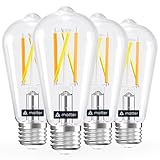
1. Linkind Matter Smart Light Bulb, ST19 (ST58) Smart Edison Bulbs, 2700K-6500K E26 LED Bulb 8W 60W, 800LM Edison Light Bulb, Work with Alexa, Google Home, Apple Home, SmartThings, 2.4GHz WiFi, 4-Pack
Overview:
The Linkind Matter Smart Light Bulb represents a forward-thinking approach to smart home lighting. This four-pack of Edison-style ST19 bulbs delivers 800 lumens of tunable white light (2700K-6500K) while consuming just 8W. Designed for universal compatibility, these bulbs work across all major smart home ecosystems through the Matter protocol, eliminating the fragmentation that typically plagues smart lighting.
What Makes It Stand Out:
Matter certification is the defining feature here, ensuring seamless integration with Apple Home, Alexa, Google Home, and SmartThings without requiring multiple apps. The simple QR code setup process streamlines installation, while the AiDot app offers deep customization for users wanting advanced control beyond basic voice commands. This universal approach future-proofs your smart home investment.
Value for Money:
At $9.50 per bulb, these are competitively priced for Matter-enabled devices. Non-Matter alternatives might save $1-2 per bulb but sacrifice cross-platform flexibility. For households with mixed smart home ecosystems, this eliminates the need to buy different bulb brands for different platforms, ultimately saving money and reducing complexity.
Strengths and Weaknesses:
Strengths include broad Matter compatibility, easy setup, reliable tunable white performance, and robust scheduling options. The 1-100% dimming range provides excellent ambiance control. Weaknesses include 2.4GHz WiFi limitation (no 5GHz support), incompatibility with physical dimmer switches, and lack of a physical remote control found in Linkind’s non-Matter variants.
Bottom Line:
These bulbs are ideal for tech-savvy homeowners invested in the Matter ecosystem or planning future smart home expansion. The universal compatibility justifies the slight premium over platform-specific alternatives.
2. Linkind E26 Smart Edison Bulbs, 2700K-6500K Tunable WiFi Edison Bulbs with Remote Control, 8W 60W Equivalent Dimmable ST19 (ST58) Vintage Light Bulbs 800lm, Compatible with Alexa & Google Home, 4-Pack

Overview:
Linkind’s E26 Smart Edison Bulbs blend vintage aesthetics with modern convenience in this four-pack offering. These 8W bulbs produce 800 lumens of tunable white light (2700K-6500K) and include a pre-paired remote control for versatile operation. Compatible with Alexa and Google Home, they target users wanting both app-based and physical control options in a classic filament design.
What Makes It Stand Out:
The included remote control sets this apart from most smart bulbs. Pre-paired and ready to use, it provides instant control without WiFi or apps—a lifesaver when internet is down or for guests. The magnetic backing attaches conveniently to refrigerators or metal surfaces, ensuring it’s always within reach while maintaining the vintage bulb aesthetic.
Value for Money:
At $9.50 per bulb, the value proposition is strong considering the bonus remote. Competitors typically charge extra for physical controllers or require separate hub purchases. For Alexa/Google-centric homes, this matches the per-bulb cost of the Matter version while adding hardware flexibility that enhances everyday usability.
Strengths and Weaknesses:
Strengths include the versatile remote control, no-hub requirement, full tunable/dimmable range, and intuitive AiDot app features like scheduling and grouping. The 85% energy savings over halogen bulbs is substantial. Weaknesses include limited ecosystem support (no Apple Home or SmartThings), lack of Matter certification, 2.4GHz-only connectivity, and incompatibility with wall dimmers.
Bottom Line:
Perfect for users who want smart features but appreciate physical remote access. The remote adds tangible value, making this a practical choice for households prioritizing convenience over universal platform support.
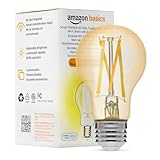
3. Amazon Basics A19 Smart Filament LED Bulb, Tunable White, 2.4 GHz Wi-Fi, Works with Alexa Only, 1-Pack
Overview:
The Amazon Basics A19 Smart Filament LED Bulb offers an entry-level smart lighting solution exclusively for Alexa ecosystems. This single-pack bulb features a classic filament design with tunable white light ranging from warm 2200K to cool 6500K. Consuming minimal power, it provides straightforward smart control without complexity, targeting Amazon-centric households.
What Makes It Stand Out:
Zero-touch setup is the defining feature—screw in the bulb, and the Alexa app automatically detects it. This eliminates the frustrating pairing processes common with other brands. The “Works with Alexa Only” approach ensures seamless integration for dedicated Amazon households, removing compatibility guesswork and simplifying the user experience.
Value for Money:
At $8.51 for a single bulb, it’s an affordable trial option but expensive for whole-home deployment. While the per-bulb cost seems low, outfitting multiple rooms becomes costly compared to multi-pack alternatives. The value exists solely for Alexa-exclusive users who need just one or two smart bulbs, not for comprehensive lighting upgrades.
Strengths and Weaknesses:
Strengths include dead-simple Alexa integration, wide tunable white range, remote app control, and group control for room-based management. The filament design adds vintage charm. Major weaknesses are the Alexa-only limitation (no Google, Apple, or SmartThings), single-pack packaging inefficiency, lack of physical remote, and 2.4GHz-only WiFi.
Bottom Line:
Only recommended for committed Alexa users needing minimal smart lighting. Its ecosystem lock-in is too restrictive for most modern smart homes. Consider multi-platform alternatives unless you’re deeply invested in Amazon’s ecosystem.
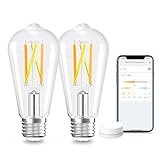
4. Linkind Smart Edison Bulbs, 2700K-6500K Tunable WiFi Edison Bulbs with Remote Control, 8W 60W Equivalent Dimmable ST19(ST58) Vintage Light Bulbs 800lm, Compatible with Alexa & Google Home, 2-Pack
Overview:
This two-pack of Linkind Smart Edison Bulbs delivers the same remote-controlled convenience as its four-pack sibling but in a smaller quantity. These vintage-style ST19 bulbs offer 800 lumens of tunable white light (2700K-6500K) with full dimming capabilities, targeting users with fewer fixtures to upgrade who still want physical control options.
What Makes It Stand Out:
The pre-paired remote control remains the headline feature, providing WiFi-independent operation. Its magnetic backing offers convenient storage on metal surfaces. The ability to control bulbs without internet or apps distinguishes Linkind’s approach from remote-less competitors, making it practical for everyday scenarios where app-only control would be cumbersome.
Value for Money:
At $14 per bulb, this two-pack carries a 47% price premium over the four-pack version. While the features are identical, the economics strongly favor buying the larger pack unless you absolutely need only two bulbs. The remote adds value, but not enough to justify the steep per-unit cost increase for most buyers.
Strengths and Weaknesses:
Strengths mirror the four-pack: versatile control options, no-hub design, comprehensive scheduling via AiDot app, and energy efficiency. The tunable range is excellent for ambiance customization. Weaknesses include the poor small-pack value proposition, limited ecosystem support (Alexa/Google only), 2.4GHz WiFi limitation, and incompatibility with wall dimmers.
Bottom Line:
Buy only if you need exactly two bulbs. Otherwise, the four-pack offers substantially better value. The remote control feature is genuinely useful, but not worth paying nearly 50% more per bulb.
5. Feit Electric Smart ST21 Light Bulb, 60W Eq, Dimmable, Spiral Filament Edison Style. WiFi Enabled, Works with Alexa/Google Home, Millions of Colors, 15,000-Hr. Lifetime, ST2160RGBWFILAG/RP/3, 3 Pack

Overview:
Feit Electric’s Smart ST21 bulbs represent the premium tier of Edison-style smart lighting. This three-pack combines vintage spiral filament aesthetics with full RGBW color capability and tunable white light (2200K-6500K). With a 15,000-hour lifespan, these bulbs target users wanting both style and vibrant color options for ambiance and entertainment.
What Makes It Stand Out:
Full-spectrum RGBW lighting is the killer feature—millions of colors plus quality tunable white in one Edison bulb. The distinctive spiral filament design offers superior vintage authenticity compared to standard LED filaments. Voice control via Alexa and Google Home integrates smoothly, while the Feit Electric app enables scene creation and scheduling that syncs with daily routines.
Value for Money:
At $17.65 per bulb, this is premium pricing, but justified by RGB capability and durability. Color-changing Edison bulbs typically command $15-20 each, making this competitively priced for the feature set. The 15,000-hour lifespan reduces replacement frequency, adding long-term value that offsets the higher upfront cost.
Strengths and Weaknesses:
Strengths include vibrant color options, authentic vintage design, robust app features, long lifespan, and no-hub requirement. The dimming and color accuracy are excellent for both everyday use and special occasions. Weaknesses are the highest per-bulb cost in this roundup, lack of Matter support, absence of physical remote, 2.4GHz-only connectivity, and limited to Alexa/Google ecosystems.
Bottom Line:
The best choice for those wanting color-changing capability in Edison form factor. If you only need white light, cheaper alternatives exist. For ambiance and entertainment lighting, the premium is worthwhile.
6. MOES Matter WiFi ST64 Edison Smart Bulbs, Color Changing Light Bulb, 16 Million RGB Colors & Tunable White, Works with Apple Home, Alexa, Google Home, E26 Dimmable 5W (40W Equivalent), 2-Pack
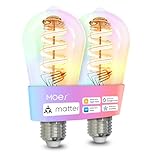
Overview: The MOES Matter WiFi ST64 Edison Smart Bulbs deliver vintage aesthetics with modern smart home integration. These 5W bulbs produce 40W equivalent brightness while offering 16 million colors and tunable whites from 2700K-6500K. Designed for Matter certification, they promise seamless interoperability across major smart home platforms including Apple Home, Alexa, and Google Home.
What Makes It Stand Out: Matter certification is the headline feature, allowing unified control through a single app rather than juggling multiple platforms. The bulbs work without a hub when using the MOES app, though competing platforms require one. Voice control works across all three major assistants, and the scheduling features enable automation for security and convenience. The ST64 Edison style provides a classic filament look that enhances decorative fixtures.
Value for Money: At $37.99 for a two-pack ($19 per bulb), these sit in the mid-range for Matter-certified smart bulbs. The 40W equivalent output is modest for the price, but the Matter integration and 2-year warranty add value. Compared to non-Matter alternatives, you’re paying a slight premium for future-proof interoperability.
Strengths and Weaknesses: Strengths include Matter certification, broad platform support, energy efficiency, scheduling capabilities, and a solid warranty. Weaknesses are the lower brightness (only 40W equivalent), mandatory hub requirement for Apple/Alexa/Google integration, 2.4GHz Wi-Fi limitation, and incompatibility with physical dimmer switches.
Bottom Line: These bulbs are ideal for users invested in the Matter ecosystem who prioritize interoperability over maximum brightness. The vintage design suits exposed fixtures, but the hub requirement and modest output may limit appeal for some buyers.
7. Cync GE Smart LED Light Bulb, ST19 Edison Style, Room Decor Aesthetic, Color Changing WiFi Light, 60W Equivalent, Works with Amazon Alexa and Google Home (Pack of 2)

Overview: The Cync GE Smart LED Light Bulb merges classic Edison styling with contemporary smart functionality. These ST19 bulbs deliver 60W equivalent brightness and millions of colors through the Cync app powered by Savant. Designed for straightforward Wi-Fi connectivity, they target users wanting reliable performance from a trusted brand without hub complexity.
What Makes It Stand Out: TrueImage technology in the Cync app lets you preview colors on your phone before applying them to your room. The Savant-powered platform provides robust scheduling, out-of-home control, and scene creation. These bulbs connect directly to 2.4GHz Wi-Fi without requiring a hub, simplifying setup. The ST19 vintage aesthetic makes them suitable for pendant lights and exposed fixtures where style matters.
Value for Money: At $44.99 for two ($22.50 per bulb), these command a premium price. You’re paying for the GE brand reputation and Savant’s sophisticated app experience. While feature-rich, the lack of Matter certification and Apple Home support limits long-term value compared to newer standards.
Strengths and Weaknesses: Strengths include hub-free operation, TrueImage technology, reliable scheduling, strong brand backing, and 60W equivalent brightness. Weaknesses are no Matter support, limited to Alexa and Google only, higher per-bulb cost, and the two-pack offering less flexibility for larger installations.
Bottom Line: These bulbs suit Alexa and Google users prioritizing brand reliability and app sophistication. However, Matter-certified alternatives offer better future-proofing and platform flexibility at similar or lower prices, making these harder to recommend for new smart home adopters.
8. OREiN Smart Edison Light Bulbs, 2.4 Ghz Wi-Fi ST19(58) Vintage Light Bulbs E26, 800LM Dimmable via app, 2700-6500K Tunable, Smart LED Filament Bulb Works with Alexa/Google Home, 60W Equivalent 4Pack

Overview: OREiN’s Smart Edison Light Bulbs offer a budget-friendly entry into smart lighting with a four-pack of ST19 vintage-style bulbs. Delivering 800 lumens (60W equivalent) with tunable white from 2700K-6500K, these bulbs provide app-based dimming and voice control through Alexa, Google, and Siri shortcuts without requiring a hub.
What Makes It Stand Out: The four-pack configuration at under $40 delivers exceptional per-bulb value. Group control via the AiDot app allows simultaneous management of multiple bulbs, while scheduling and vacation modes enhance security. The bulbs promise significant energy savings—up to 90% compared to incandescent—and boast a 25,000-hour lifespan (22.8 years at 3 hours daily).
Value for Money: At $39.99 for four ($10 per bulb), this is among the most economical smart bulb options available. The 60W equivalent brightness and tunable white range match premium competitors at a fraction of the cost, making it ideal for large-scale deployments.
Strengths and Weaknesses: Strengths include exceptional pricing, 60W equivalent output, tunable white range, no hub requirement, energy efficiency, and long lifespan. Weaknesses involve lack of Matter certification, potential size compatibility issues (5.59" length), incompatibility with physical dimmer switches, possible flicker, and reliance on the less-known AiDot ecosystem.
Bottom Line: Perfect for budget-conscious buyers needing multiple bulbs, these deliver core smart features without frills. The value proposition is undeniable for Alexa/Google users, though Matter seekers and those with tight fixtures should consider alternatives.
9. OREiN Matter Smart Light Bulb, ST19(58) Smart Edison Bulbs with Remote Control Work with Apple Home, Alexa, Google Home, SmartThings, 800lm 2700K-6500K Smart Filament Bulb E26 Base 6Pack

Overview: OREiN’s Matter Smart Light Bulb six-pack brings vintage Edison aesthetics to the modern Matter ecosystem. These ST19 bulbs produce 800 lumens with tunable whites from 2700K-6500K and work across Apple Home, Alexa, Google Home, and SmartThings. Matter certification ensures seamless interoperability and enhanced security across platforms.
What Makes It Stand Out: Matter support enables local network control even during internet outages—a significant reliability advantage. The six-pack offering drives per-bulb cost below $10, making it the most affordable Matter-certified option available. Standardized security protocols with OTA updates protect against vulnerabilities. Multiple setup methods include QR code scanning across major platforms.
Value for Money: At $54.99 for six ($9.16 per bulb), this represents exceptional value for Matter-certified bulbs. The per-unit cost undercuts most competitors by 50% or more while delivering 60W equivalent brightness and full platform compatibility, making whole-home smart lighting affordable.
Strengths and Weaknesses: Strengths include Matter certification, unbeatable per-bulb pricing, six-pack convenience, offline LAN functionality, robust security, and broad platform support. Weaknesses are the requirement for a Matter-compatible hub, potential size fitting issues (5.04" length), lack of RGB color options (tunable white only), and incompatibility with physical dimmers.
Bottom Line: An outstanding value for Matter ecosystem adopters, especially for larger homes. The six-pack makes comprehensive smart lighting economical, though the tunable-white-only limitation and hub requirement should be noted. Ideal for users prioritizing interoperability and security.
10. WiZ Connected 60W ST19 Tunable White Filament LED Smart Light Bulbs - Connects to Your Wi-Fi - E26 Smart Bulb - Control with Voice or App + Activate with Motion - Matter Compatible - 1 Pack

Overview: The WiZ Connected ST19 bulb offers a unique blend of vintage filament design and innovative motion-sensing technology without requiring external sensors. This 60W equivalent tunable white bulb connects via 2.4GHz Wi-Fi and supports Matter certification for broad compatibility. The single-pack option provides an accessible entry point for testing smart lighting.
What Makes It Stand Out: SpaceSense technology uses Wi-Fi signals between two or more WiZ bulbs to detect motion, turning lights on/off automatically—no additional hardware required. Human-centric lighting options optimize color temperature for activities, while multiple control methods include app, voice (Alexa, Google, Siri Shortcuts), and existing wall switches. The WiZ remote offers alternative control without phone dependency.
Value for Money: At $15.99 for a single bulb, the per-unit cost is reasonable for a Matter-compatible bulb with unique features. However, bulk packs from competitors offer better value for whole-home installations. The SpaceSense feature requires multiple bulbs to function, increasing total investment.
Strengths and Weaknesses: Strengths include innovative SpaceSense motion detection, Matter compatibility, human-centric lighting, easy setup, multiple control options, and single-pack availability for trials. Weaknesses are the single-bulb limitation, SpaceSense requiring at least two bulbs, reliance on WiZ ecosystem for full features, 2.4GHz-only connectivity, and lack of RGB color support.
Bottom Line: An excellent choice for curious smart home adopters or existing WiZ users wanting motion sensing without sensors. The SpaceSense feature is genuinely innovative, but buyers should plan for multiple bulbs to leverage it fully. Matter support ensures future compatibility.
Understanding the Smart Edison Bulb Revolution
What Defines a Smart Edison Bulb?
A smart Edison bulb maintains the distinctive filament visibility and vintage bulb shape (ST64, A19, G25) while embedding LED technology, wireless connectivity, and microprocessors. Unlike standard LED Edison bulbs that simply illuminate, these connect to your home network to enable remote control, automation, and integration with broader smart home platforms. The “smart” designation means each bulb contains a small computer chip that communicates via Wi-Fi, Bluetooth, or Zigbee protocols, translating your smartphone commands into precise lighting adjustments.
The Technology Behind the Vintage Glow
The magic lies in LED filament technology. Manufacturers arrange tiny LED chips in series on transparent substrates that mimic traditional carbon filaments. When paired with smart drivers, these filaments can dim smoothly, shift color temperatures from cool daylight to warm amber, and even produce millions of colors in RGBW models. The best examples use high-color-rendering-index (CRI) LEDs that make your space look natural and vibrant, not artificially tinted.
Key Connectivity Standards Decoded
Wi-Fi Enabled Bulbs: Independence and Power
Wi-Fi smart Edison bulbs connect directly to your router, eliminating the need for a separate hub. This makes them ideal for renters or those starting their smart home journey. They typically offer the fastest response times and work anywhere your Wi-Fi reaches. However, they consume slightly more standby power and can clutter your network with dozens of devices. Look for bulbs supporting 2.4GHz bands (most common in smart home devices) and check if they offer firmware updates for security patches.
Bluetooth Mesh Networks: Simplicity and Reliability
Bluetooth bulbs connect directly to your phone, making setup straightforward. Recent Bluetooth Mesh implementations allow bulbs to communicate with each other, extending range and enabling whole-room control without a hub. The downside? You can’t control them remotely when you’re away from home unless you add a compatible gateway. They’re perfect for single-room installations like a cozy reading nook or intimate dining area.
Zigbee and Z-Wave: The Hub-Based Ecosystems
These low-power mesh protocols require a central hub (like SmartThings, Hubitat, or Philips Hue Bridge) but reward you with rock-solid reliability and minimal network congestion. Zigbee bulbs typically respond faster than Wi-Fi alternatives and create a self-healing mesh network where each device strengthens the whole system. If you’re building a comprehensive smart home, this route offers superior scalability.
Brightness and Lumens: Beyond Wattage Equivalence
Understanding True Light Output
Forget everything you knew about 60-watt equivalents. Smart Edison bulbs vary wildly in brightness, typically ranging from 400 to 800 lumens. A 500-lumen bulb creates a moody, atmospheric glow perfect for accent lighting, while 700+ lumens can genuinely illuminate a workspace. Check the lumens rating, not the wattage equivalence, and consider your fixture’s purpose. A pendant over a kitchen island needs more punch than a wall sconce meant for ambiance.
The Dimming Curve Challenge
Incandescent bulbs dim on a smooth, warm curve that deepens in color as they darken. Many cheap smart LEDs fail to replicate this, dimming to 10% then abruptly cutting off. Premium smart Edison bulbs offer “deep dimming” down to 1% and maintain warm amber tones throughout the range. This is achieved through advanced PWM (pulse-width modulation) drivers and firmware that mimics incandescent behavior.
Color Temperature: The Heart of Vintage Appeal
Warmth That Feels Authentic
The sweet spot for vintage aesthetics lies between 1800K and 2700K. At 1800K, you get that candlelit, ultra-warm glow that makes Edison bulbs famous. The best smart models offer a wide tunable white range—from energizing 5000K daylight for task lighting down to 1800K for evening relaxation. Some even include “filament visibility” modes that illuminate the LED filaments separately from the main light output, creating a mesmerizing visual effect even at low brightness.
Full Color Spectrum: When You Want More Than White
RGBW smart Edison bulbs add a party trick: millions of colors while maintaining vintage looks when set to white. The key is whether the colors look saturated and true or washed out. Look for bulbs with dedicated white LEDs separate from RGB diodes—this prevents the muddy, pastel colors that plague cheaper models. When off, they should look identical to traditional Edison bulbs; when on, they should transform your space dramatically.
Energy Efficiency and Environmental Impact
The Numbers That Matter
A traditional 60-watt incandescent Edison bulb uses—you guessed it—60 watts. A comparable smart LED Edison bulb uses 6-9 watts while producing the same or greater light output. That’s an 85% energy reduction. Over a 15,000-hour lifespan, you’ll save approximately $150 per bulb in electricity costs compared to incandescent. Factor in the smart features that prevent lights from being left on accidentally, and the savings multiply.
Vampire Power Draw
Smart bulbs draw small amounts of power when off to maintain connectivity—typically 0.5-1 watt. While minimal, this “vampire draw” adds up across 20+ bulbs. Zigbee and Bluetooth models tend to be more efficient than Wi-Fi. Some premium bulbs offer “vacation mode” that reduces standby power when you’re away for extended periods.
Lifespan and Durability: What Manufacturers Won’t Tell You
Decoding Hour Ratings
Most smart Edison bulbs are rated for 15,000-25,000 hours, but this number comes with caveats. The rating usually refers to when the LED output drops to 70% of original brightness (L70), not complete failure. More importantly, the smart components—the Wi-Fi chip, capacitor, and driver—often fail before the LEDs themselves. Look for bulbs with separate driver and LED warranties, and check user reviews for longevity complaints about connectivity dropouts.
Heat Management in Enclosed Fixtures
Edison bulbs beg to be shown off, often in enclosed fixtures that trap heat. Excessive heat degrades LED drivers and shortens lifespan dramatically. Premium bulbs use ceramic bodies, aluminum heat sinks, and thermal throttling that reduces brightness when temperatures climb. Always check the “suitable for enclosed fixtures” rating if that’s your intended use.
Smart Home Ecosystem Compatibility
The Big Three: Alexa, Google, and HomeKit
Amazon Alexa and Google Assistant offer the broadest compatibility, controlling most Wi-Fi and Zigbee bulbs natively. Apple HomeKit requires stricter security standards (Thread compatibility is becoming key), limiting options but rewarding users with privacy-focused local control and seamless Siri integration. Check for the “Works with” badges, but dig deeper—some integrations are basic (on/off) while others support full color control and scenes.
Cross-Platform Compatibility
The holy grail is Matter certification. This new standard promises interoperability across all major platforms, future-proofing your investment. As of 2024, Matter-enabled smart Edison bulbs are hitting the market, offering local network control that works even when your internet is down. This is a game-changer for reliability and response speed.
Voice Control and Automation Deep Dive
Setting Up Natural Voice Commands
Beyond “turn on the living room light,” smart bulbs enable sophisticated commands: “set the dining room to movie night,” “make the bedroom lights look like a sunset,” or “sync the kitchen lights to my wake-up alarm.” The magic happens in routine creation—programming multi-step actions triggered by time, location, or other device states. Pro tip: name your bulbs logically and create room groups before setting up voice commands to avoid confusion.
Geofencing and Presence Detection
The coolest smart home trick? Lights that turn on automatically when you arrive home and off when you leave. This uses your phone’s location (geofencing) or motion sensors. Advanced implementations use presence detection via Wi-Fi signal strength or dedicated sensors, preventing the “lights out while I’m still home” problem that plagues basic geofencing.
App Features That Separate Good from Great
Scheduling and Circadian Rhythms
Basic apps offer on/off timers. Excellent apps provide circadian rhythm programming that gradually shifts color temperature throughout the day—cool and bright in the morning, warm and dim in the evening. This supports natural sleep-wake cycles and has been shown to improve sleep quality. Look for apps that integrate with your local sunrise/sunset times automatically.
Scene Creation and Light Recipes
The best apps let you create scenes by adjusting multiple bulbs simultaneously, saving the exact brightness and color settings. Advanced features include “light recipes” that slowly transition over hours—perfect for dinner parties that flow from cocktails to dining to after-digestifs. Some apps even offer community-shared scenes or AI-generated lighting based on your mood or activity.
Installation and Setup Best Practices
Pairing Without Frustration
Smart bulb setup should take under two minutes. The process typically involves screwing in the bulb, turning it on, and using the app to detect and pair. Where people stumble is with 5GHz Wi-Fi networks (most bulbs only use 2.4GHz) and dual-band routers that combine networks under one name. Temporarily disabling 5GHz or moving far from the router to force 2.4GHz connection solves most pairing issues.
Firmware Updates and Security
During setup, immediately check for firmware updates. These patches fix bugs, improve connectivity, and close security vulnerabilities. Set your app to auto-update if available. For Wi-Fi bulbs, change default passwords if the app allows, and ensure your home network uses WPA3 encryption. Remember: each smart bulb is a network device that could theoretically be hacked.
Design Variations and Filament Styles
Classic Filament Patterns
The most authentic designs replicate traditional “squirrel cage” filaments—spiraled LED filaments that mimic carbon filament layouts. Others offer “hairpin” or “loop” designs for different visual textures. The filament density affects light distribution; sparse filaments create dramatic shadows while dense ones provide more even illumination. Consider your fixture’s transparency and viewing angle when choosing.
Bulb Shapes and Base Types
ST64 (standard tubular) remains the iconic Edison shape, but smart versions come in globe (G25), candle (C35), and oversized (A21) variants. Check your fixture’s maximum bulb dimensions—smart bulbs run slightly larger due to internal electronics. Most use E26/E27 medium bases, but candelabra (E12) options exist for chandeliers. Never force a bulb that doesn’t fit easily; the glass is often thinner than traditional bulbs.
Price vs. Value: Making Smart Investments
The True Cost of Ownership
A $10 non-smart LED Edison bulb seems cheap compared to a $30 smart version. But factor in the cost of a smart switch ($25-50) plus electrician installation, and the smart bulb becomes cost-effective for single-fixture control. For multi-bulb fixtures like chandeliers, smart bulbs offer individual control impossible with a single switch. Calculate cost-per-lumen and cost-per-feature rather than sticker price alone.
When to Splurge vs. Save
Splurge on bulbs for primary living spaces where you’ll use advanced features daily. Save on guest bedrooms or closets where basic on/off functionality suffices. Premium brands justify their cost through superior app experiences, better color accuracy, and longer component warranties. Budget brands often cut corners on dimming smoothness and have apps that feel like afterthoughts.
Common Pitfalls and How to Avoid Them
The Buzzing and Flickering Problem
Incompatible dimmer switches are the #1 cause of smart bulb issues. Smart bulbs have built-in dimming circuits that conflict with traditional wall dimmers, causing flicker, buzzing, or premature failure. Always use standard on/off switches with smart bulbs. If you must keep a dimmer, bypass it or set it to maximum and use voice/app control exclusively.
Network Congestion and Stability
Wi-Fi bulbs can overwhelm routers that limit device connections (many ISP-provided routers cap at 32 devices). If you plan more than 15-20 smart bulbs, invest in a mesh Wi-Fi system or switch to Zigbee. Symptoms of network stress include bulbs randomly going offline, slow response times, and failed commands. A dedicated 2.4GHz IoT network can isolate the problem.
Future-Proofing Your Vintage Smart Lighting
Matter and Thread: The Next Generation
The Matter standard is revolutionizing smart home interoperability. Bulbs with Thread radios create a mesh network that’s faster and more reliable than Bluetooth but doesn’t require a central hub. They maintain local control even during internet outages and pair seamlessly with multiple platforms simultaneously. Buying Thread-enabled bulbs today ensures compatibility with tomorrow’s smart home tech.
AI and Adaptive Lighting
Emerging bulbs use onboard sensors (ambient light, occupancy) and AI to learn your preferences, automatically adjusting throughout the day. Some integrate with health apps to optimize lighting for vitamin D synthesis or migraine prevention. While still nascent, this technology promises bulbs that anticipate your needs rather than just responding to commands.
Frequently Asked Questions
1. Can I use smart Edison bulbs in any fixture?
Most work in standard medium-base fixtures, but check for enclosed fixture ratings and maximum wattage limits. The electronics generate heat, so enclosed fixtures require bulbs specifically designed for limited airflow.
2. Will smart Edison bulbs work with my existing wall dimmer?
No—this is the most common mistake. Smart bulbs have internal dimming circuits that conflict with traditional dimmers, causing flicker or failure. Use standard on/off switches and control dimming through the app or voice commands.
3. Do I need a hub for smart Edison bulbs?
It depends on the connectivity. Wi-Fi and Bluetooth bulbs work hub-free, while Zigbee/Z-Wave models require one. Hub-based systems offer better reliability for large installations but add cost and complexity.
4. How do I reset a smart Edison bulb that won’t connect?
Most use a cycling method: turn the bulb on/off 5-10 times in quick succession until it flashes. Consult your specific model’s manual—reset sequences vary. If that fails, check your router’s 2.4GHz band and temporarily disable 5GHz during setup.
5. Can smart Edison bulbs produce true warm white like incandescents?
Quality models reaching 1800K-2000K come remarkably close, especially those with high CRI (90+). The best ones also shift warmer as they dim, mimicking incandescent behavior. Read reviews focusing on color accuracy before buying.
6. What happens to smart bulbs when the power goes out?
They’ll return to their default state (usually on at full brightness) when power restores. Most apps let you change this behavior to “last state” or “off.” Some premium models slowly fade back on to avoid jarring bright flashes.
7. Are smart Edison bulbs secure from hacking?
They’re as secure as your Wi-Fi network. Use WPA3 encryption, strong passwords, and keep firmware updated. Zigbee and Thread bulbs are generally more secure as they don’t directly connect to the internet. Avoid bulbs from unknown brands with no stated security policies.
8. Why is my smart Edison bulb buzzing?
Buzzing usually indicates a cheap driver, incompatible dimmer switch, or voltage fluctuation. High-quality bulbs use better components that remain silent. If buzzing occurs, first replace the wall switch with a standard on/off model.
9. Can I set up smart Edison bulbs without a smartphone?
Some offer web interfaces or can be controlled via smart speakers after initial setup, but you’ll need a smartphone for the initial pairing and firmware updates. Seniors or tech-averse users might prefer a hub-based system with physical remote controls.
10. How long do smart Edison bulbs really last?
The LED filaments may last 15,000-25,000 hours, but the smart electronics often fail first—typically 3-7 years with regular use. Warranties covering 2-3 years are standard; longer warranties suggest manufacturer confidence in component quality.