Tired of watching your energy bills climb higher each month while your old water heater quietly guzzles electricity or gas in the basement? You’re not alone. Traditional water heaters are among the biggest energy vampires in modern homes, accounting for up to 18% of your total utility costs while operating on outdated timers and primitive thermostats. The smart home revolution has finally reached this overlooked appliance, and the impact on your wallet can be dramatic. Today’s intelligent water heaters don’t just heat water—they learn your family’s patterns, adapt to your schedule, and communicate with your entire home ecosystem to deliver hot water precisely when needed while slashing waste. Understanding what separates genuinely transformative smart water heaters from gimmicky connected devices is the key to unlocking serious savings.
Top 10 Smart Water Heaters for Energy Bills
Detailed Product Reviews
1. Smart Water Heater Timer: Optimize Hot Water Usage - Compatible with Alexa - Installs in Minutes, No Plumbing Required. Compatible with Electric Water Heaters.

Overview: The Smart Water Heater Timer brings intelligent automation to electric water heaters, offering Alexa compatibility and sophisticated scheduling capabilities. This device installs without plumbing modifications, making it accessible for DIY homeowners seeking to optimize their hot water usage. Designed for storage-style water heaters, it promises both convenience and energy savings through smart technology integration.
What Makes It Stand Out: The adaptive learning feature automatically recognizes your hot water usage patterns, eliminating manual programming. Its UL safety certification ensures reliable operation, while the comprehensive reporting system provides real-time data on tank temperature and hot water availability. The ability to track daily, weekly, and monthly usage patterns sets it apart from basic timers.
Value for Money: At $164, this timer sits in the mid-range category. While significantly more expensive than mechanical timers ($30-50), it offers IoT connectivity and learning capabilities that justify the premium. Compared to the Aquanta version, it’s more affordable but lacks the leak sensor. The potential 10-15% reduction in water heating costs can deliver payback within 18-24 months for average households.
Strengths and Weaknesses: Strengths include intelligent scheduling, remote smartphone control, detailed energy analytics, and easy installation. The UL certification provides peace of mind. Weaknesses are its electric-only compatibility, reliance on WiFi connectivity, and price point that may deter budget-conscious buyers. The learning algorithm requires several weeks to optimize.
Bottom Line: An excellent choice for electric water heater owners wanting hassle-free smart automation without plumbing work. The learning feature and energy tracking make it ideal for tech-savvy homeowners prioritizing convenience and long-term savings.
2. Aquanta Digital Water Heater Timer. WiFi Smart Water Heater Controller. Reduce Electricity Waste. Installs in Minutes, No Plumbing Required. for Electric Water Heater, Leak Sensor Included

Overview: The Aquanta Digital Water Heater Timer represents the premium tier of smart water heater controllers for electric models. With WiFi connectivity and comprehensive control options, this device targets homeowners serious about energy management. The included leak sensor adds a crucial safety dimension, addressing one of the most common and costly water heater failures.
What Makes It Stand Out: Beyond standard scheduling and remote control, the integrated leak sensor provides proactive protection against water damage. The Aquanta brand focuses specifically on water heater optimization, offering various control modes that balance energy savings with comfort. The system’s ability to meter hot water availability helps prevent unexpected cold showers.
Value for Money: Priced at $189, this is the most expensive electric water heater timer in the comparison. The $25 premium over Product 1 solely buys the leak sensor functionality. For homeowners with water heaters located indoors or near valuable possessions, this investment could prevent thousands in damage. However, those with heaters in garages or basements may find less value in this feature.
Strengths and Weaknesses: Strengths include the leak detection capability, UL safety certification, robust analytics, and schedule learning. The specialized focus on water heaters ensures optimized performance. Weaknesses are the high price point, electric-only limitation, and that the core features mirror cheaper alternatives. Installation requires comfort with electrical wiring.
Bottom Line: Worth the premium for electric water heater owners seeking maximum protection and efficiency. The leak sensor makes it particularly valuable for installations inside living spaces where water damage poses significant risk.
3. Smart Water Heater Timer: Optimize Hot Water Usage - Compatible with Alexa - Installs in Minutes, No Plumbing Required. Compatible with Gas Water Heaters. Leak Sensor Included.
Overview: This Smart Water Heater Timer breaks new ground by offering intelligent control specifically for gas water heaters—a rarity in the smart home market. At $189, it provides gas heater owners with the same scheduling convenience and energy tracking previously limited to electric models. The inclusion of a leak sensor adds valuable protection for gas-powered systems.
What Makes It Stand Out: Compatibility with gas water heaters is its defining feature, filling a significant gap in smart home automation. The device maintains all the intelligent scheduling, remote access, and usage tracking capabilities of its electric counterpart. The leak sensor is especially critical for gas heaters, where water damage can corrode burners and gas lines.
Value for Money: While pricey at $189, it faces little direct competition for gas water heater automation. Traditional gas heater timers are rare and lack smart features. The energy savings potential—though slightly less than electric due to gas’s lower cost—still offers reasonable payback. The leak sensor provides insurance against costly repairs.
Strengths and Weaknesses: Strengths include unique gas heater compatibility, comprehensive smart features, leak protection, and UL certification. The learning algorithm adapts to household patterns. Weaknesses are the premium price, limited market alternatives for comparison, and potential complexity in gas system integration. WiFi dependency may concern some users.
Bottom Line: A specialized but valuable solution for gas water heater owners wanting smart automation. If you have a gas heater and crave remote control and energy tracking, this is essentially your only option—and it delivers robust functionality despite the high price.
4. YIFAN Smart Water Heater Switch, 20A Water Heater Timer with Energy Monitoring, Manual Adjustment Countdown, Compatible with Amazon Echo and Google Home, Neutral Wire Required, 2.4GHz WiFi Only

Overview: The YIFAN Smart Water Heater Switch offers a budget-friendly alternative to dedicated water heater timers, functioning as a heavy-duty 20A smart switch with energy monitoring capabilities. At just $27.68, it provides core smart control for high-power appliances including water heaters, air conditioners, and commercial equipment. The device requires a neutral wire and operates on 2.4GHz WiFi networks.
What Makes It Stand Out: The 20A/4400W capacity handles virtually any residential water heater, while built-in energy monitoring provides real-time consumption data absent in many premium timers. Multiple control methods—including app, voice, and manual countdown adjustment (10-90 minutes)—offer exceptional flexibility. The child lock and family sharing features enhance household safety and convenience.
Value for Money: Exceptional value. At under $30, it costs 85% less than dedicated water heater timers while providing comparable on/off control plus energy monitoring. The manual adjustment feature works without internet, addressing connectivity concerns. For users primarily wanting remote control and scheduling, this delivers 90% of functionality at a fraction of the cost.
Strengths and Weaknesses: Strengths include unbeatable price, energy monitoring, heavy-duty capacity, manual backup control, and versatile scheduling. The child lock and usage history tracking are welcome additions. Weaknesses include requiring a neutral wire (challenging in older homes), 2.4GHz WiFi limitation, and lack of advanced water heater-specific features like temperature reporting or leak detection.
Bottom Line: The best budget choice for smart water heater control. If you can handle the wiring requirements and don’t need leak detection or learning algorithms, this switch delivers remarkable functionality and energy insights at an unbeatable price.
5. BSEED Smart Water Heater Switch,Work with Amazon Alexa,Google Assistant,WiFi Touch Switch with Smart Life APP Control and Timing Function,20A Black Water Heater Switch Suitable for Bedroom,Bathroom

Overview: The BSEED Smart Water Heater Switch positions itself as the entry-level smart control solution for water heaters and other high-power appliances. Priced at an incredibly low $11.99, it provides fundamental smart switch functionality including app control, voice commands, and scheduling. The 20A capacity suits most water heaters, though it lacks advanced features found in pricier alternatives.
What Makes It Stand Out: The sub-$12 price point makes smart water heater control accessible to virtually any homeowner. It covers the essentials: remote on/off via Smart Life app, voice control through Alexa/Google Assistant, and basic scheduling. The group control feature allows multiple switches to be managed simultaneously, useful for whole-home automation.
Value for Money: Unbeatable price-to-basic-function ratio. At $11.99, it’s 90% cheaper than dedicated water heater timers and still provides core smart control. While lacking energy monitoring or leak detection, it accomplishes the primary goal of automated scheduling. The cost is so low that the energy savings from basic scheduling alone could provide payback within months.
Strengths and Weaknesses: Strengths include extreme affordability, simple installation, voice control, remote access, and scheduling. The 20A rating handles most heaters. Weaknesses are no energy monitoring, basic functionality only, neutral wire requirement, 2.4GHz WiFi limitation, and absence of safety features like leak detection. Build quality may reflect the low price.
Bottom Line: Perfect for budget-conscious homeowners wanting basic smart control without frills. If you simply need to schedule your water heater and control it remotely, this delivers essential functionality at a price that’s hard to justify not trying.
6. DDAYBF Tankless Water Heater Electric 110V, 3000W Under Sink Instant On Demand Hot Water Heater, Portable Mini Water Heaters with Digital Display for Kitchen Bathroom RV (Mini White, M)

Overview: The DDAYBF 3000W tankless water heater delivers instant hot water at 110V for point-of-use applications. This compact unit mounts under sinks or in tight spaces, providing 55°C (131°F) water within 3-5 seconds. Designed for kitchens, bathrooms, RVs, and apartments, it replaces bulky tank heaters while offering digital temperature monitoring and multiple safety protections.
What Makes It Stand Out: This unit excels with its comprehensive safety suite including IPX4 waterproofing, leakage protection, dry-burn prevention, and auto-shutoff. The dual Celsius/Fahrenheit toggle (hold power button) caters perfectly to North American users. Its 99% thermal efficiency rating significantly outperforms traditional tanks, while the 24-month warranty demonstrates manufacturer confidence. The wall-mounted design maximizes space efficiency without sacrificing performance.
Value for Money: At $58.89, this heater offers exceptional value for budget-conscious buyers needing reliable point-of-use hot water. The 2-year warranty and 24/7 support surpass competitors in this price range. Compared to tank alternatives costing $150+, the energy savings alone justify the investment within months. However, users must factor in potential electrical upgrades (32A breaker, 13AWG wiring) which add installation costs.
Strengths and Weaknesses: Pros: Rapid heating (3-5 seconds), excellent safety protections, space-saving design, high energy efficiency, dual temperature display modes, generous warranty.
Cons: Requires dedicated 32A circuit and specific wiring (not included), limited to single fixture use, 131°F max temperature may be insufficient for some applications, installation demands electrical expertise.
Bottom Line: The DDAYBF is an excellent choice for RV owners, renters, or homeowners needing instant hot water at a specific sink. While electrical requirements demand careful planning, its safety features, efficiency, and warranty make it a smart investment for point-of-use applications. Not suitable for whole-house use, but perfect for targeted needs.
7. Tankless Electric Water Heater 110V 3000W, Instant Hot Water System with LED Digital Display, Compact On Demand Under Sink Heater for Kitchen Bathroom RV
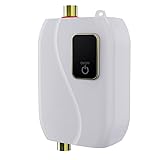
Overview: This 3000W 110V tankless electric heater provides on-demand hot water up to 131°F (55°C) with 0.5 GPM flow rate. The slim ABS housing with LED display fits discreetly under sinks in kitchens, bathrooms, RVs, and apartments. Designed exclusively for point-of-use applications, it heats water in seconds without preheating, offering energy-efficient operation for single-fixture scenarios.
What Makes It Stand Out: The unit’s 98% thermal efficiency and advanced safety features—including water-electricity separation, IPX4 rating, and auto power-off—ensure reliable operation. Installation flexibility with standard 1/2-inch NPT connections and pre-drilled holes simplifies DIY setup. The vertical-only installation design prevents common E2 errors, while the temperature unit toggle (6-second hold) accommodates US and Canadian preferences seamlessly.
Value for Money: Priced at $49.99, this is one of the most affordable tankless options available. The cost savings versus Product 6 are notable, though you sacrifice some warranty coverage details. For renters or temporary installations, the low investment risk is appealing. Energy savings from eliminating standby heat loss recover the purchase price within a year for typical users. Factor in required electrical infrastructure (32A breaker, ≥2.5mm² wire) for true cost assessment.
Strengths and Weaknesses: Pros: Extremely budget-friendly, compact elegant design, robust safety protections, easy DIY installation, energy efficient, clear LED display.
Cons: Vertical installation only (limits placement), not suitable for showers, unclear warranty terms, requires same electrical upgrades as competitors, ABS housing less durable than metal alternatives.
Bottom Line: An ideal entry-level tankless heater for single-sink applications where budget is paramount. Perfect for RVs, workshops, or rental properties needing instant hot water without major investment. Ensure your electrical panel can support the 32A requirement before purchasing. Excellent value for targeted, low-flow needs.
8. Westinghouse 14kW 240V Smart WiFi Tankless Water Heater Electric, Compatible with Alexa & Google Home, ETL Certified, IPX4, Gray - Upgrade (APOLO-2.0)
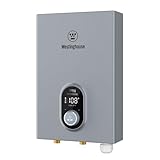
Overview: The Westinghouse APOLO-2.0 is a 14kW 240V whole-house tankless water heater delivering up to 3.38 GPM—enough for a shower and sink simultaneously. This smart unit integrates with Alexa and Google Home for voice control and app-based temperature adjustments from 86°F to 140°F. ETL certification and four-layer safety protection ensure reliable, code-compliant operation for modern homes.
What Makes It Stand Out: Smart home integration sets this unit apart, allowing remote temperature control and monitoring via WiFi. The precise 1° increment adjustments and real-time LED display provide unmatched user control. Its compact 14.2" × 9.5" × 3.5" design saves substantial space versus tank heaters. The 4-layer safety system (leakage, overheat, dry-fire, high voltage) with separate water-electricity pathways prevents scaling and corrosion, extending lifespan significantly.
Value for Money: At $299.99, this premium heater justifies its price through smart features, higher capacity, and brand reputation. Comparable non-smart units cost $250+, making the $50 premium for WiFi control and ETL certification reasonable. The ability to handle multiple fixtures eliminates need for multiple point-of-use heaters, creating additional savings. Professional installation is recommended, adding $150-300 to total investment.
Strengths and Weaknesses: Pros: Whole-house capability (3.38 GPM), smart home integration, precise temperature control, ETL certified, excellent safety features, space-saving design, durable construction.
Cons: Requires 60A breaker and 6 AWG wiring (significant electrical work), 240V only (not 110V), professional installation recommended, higher upfront cost, app connectivity may have learning curve.
Bottom Line: Best suited for homeowners seeking modern convenience and whole-house hot water. The smart features and safety certifications justify the premium price. Ensure your electrical service can handle 59A draw and budget for professional installation. Excellent long-term investment for energy savings and home automation integration.
9. APUS Tankless Water Heater Propane Gas, Up to 4.42 GPM, Indoor Hot Water Heater, 95,000 BTU on Demand Instant Hot Water Heaters with Smart Digital Display, Space Gray

Overview: This propane-powered tankless water heater delivers 95,000 BTU heating capacity with an impressive 4.42 GPM flow rate—enough for two showers plus a sink simultaneously. The indoor-rated unit features smart CPU technology maintaining temperature within ±1°F accuracy across 95-140°F range. Compact at 20.55" × 13.27" × 5.91", it operates quietly at 40dB while providing whole-house hot water for homes without electric service adequate for electric tankless.
What Makes It Stand Out: The 0.66 GPM low-flow activation technology ensures hot water even with minimal demand, preventing cold-water sandwiches. Oxygen-free copper heat exchangers with segmented combustion achieve 85%+ thermal efficiency—30% better than conventional tanks. The intuitive LED touchscreen and smart sensor array maintain precise temperatures during peak usage. At 4.42 GPM, it outperforms most electric units in its price class for multi-fixture homes.
Value for Money: At $249.99, this propane heater competes favorably with electric units requiring expensive service upgrades. For homes lacking 200A+ electrical service, it’s significantly cheaper than panel replacement. Propane operating costs vary regionally but often undercut electric rates. The 2-year warranty matches industry standards. Factor in venting requirements and propane infrastructure when calculating total installation cost.
Strengths and Weaknesses: Pros: High flow rate (4.42 GPM), precise temperature control (±1°F), low-flow activation, excellent efficiency (85%+), quiet operation (40dB), compact design, comprehensive safety shutdown.
Cons: Requires propane supply and venting, indoor installation only, higher operating costs in some regions, professional installation necessary, not suitable for all-electric homes.
Bottom Line: Ideal for rural homes, cabins, or properties with inadequate electrical service for electric tankless. The high flow rate and precise temperature control make it perfect for families needing multiple simultaneous hot water sources. Ensure proper venting and propane access before purchasing. Outstanding performance value for propane-compatible installations.
10. PROZRTED HBS24-12Z Faucet Control Smart Instant Hot Water Recirculating Pump System – Compatible with Tanked and Tankless Water Heaters, Super Energy Saving

Overview: The PROZRTED HBS24-12Z is a smart recirculating pump system that delivers hot water to faucets within 2-3 minutes from a cold start, eliminating water waste while waiting. NSF-certified for drinking water safety, it works with both tank and tankless heaters. The system includes temperature sensors, supports up to five remote controls, and features three adjustable speeds with smart memory retention after power cycles.
What Makes It Stand Out: NSF certification distinguishes this pump from competitors, ensuring safe drinking water contact. The dual temperature sensors enable precise comfort-level programming, while compatibility with smart WiFi plugs allows advanced automation. Smart mode maintains instant availability, energy-saving mode reduces temperature during idle periods, and manual mode maximizes efficiency. The high flow rate (6 GPM) and 39.3ft lift capability accommodate larger homes.
Value for Money: At $168.99, this system pays for itself through water conservation (saving thousands of gallons annually) and reduced energy waste. Compatible with existing heaters, it avoids replacement costs while delivering tankless-like convenience. Compared to $300+ dedicated recirculation systems, it offers premium features at mid-range pricing. DIY installation is feasible for handy homeowners, saving $200+ in plumber fees.
Strengths and Weaknesses: Pros: NSF certified, versatile compatibility (tank/tankless), smart modes save energy, supports multiple remotes, high flow capacity, DIY-friendly installation, retains settings after power loss.
Cons: Requires 2-3 minute wait vs true instant heaters, adds complexity to plumbing system, may increase energy costs if not properly programmed, remote controls sold separately, pump noise may be noticeable.
Bottom Line: Perfect for homeowners wanting instant hot water without replacing their existing water heater. The NSF certification and smart features justify the price premium over basic recirculation pumps. Most cost-effective when paired with tank heaters to eliminate standby losses. Program carefully to avoid unnecessary energy consumption. Excellent water-saving investment for eco-conscious households.
What Makes a Water Heater “Smart”?
A smart water heater transcends basic WiFi connectivity. True intelligence lies in predictive algorithms, adaptive learning, and proactive energy management. These appliances continuously analyze your hot water usage patterns, local energy rates, and even weather forecasts to optimize heating cycles. Unlike conventional units that blindly maintain a set temperature 24/7, smart models distinguish between your 6:30 AM shower routine and the 2:00 AM period when everyone is asleep.
Core Intelligence Features
Machine learning capabilities allow the system to recognize weekdays versus weekends, holidays, and seasonal changes. Advanced models integrate with occupancy sensors and smartphone location data to activate “vacation mode” automatically when the house is empty. The most sophisticated units participate in utility demand-response programs, temporarily reducing consumption during peak grid load in exchange for bill credits.
Connectivity Standards Matter
Look for devices supporting multiple protocols: WiFi for remote app control, Zigbee or Z-Wave for local smart hub integration, and cellular backup for critical alerts. The best systems offer open API access, ensuring compatibility with future smart home platforms rather than locking you into a proprietary ecosystem that might become obsolete.
How Smart Water Heaters Slash Your Energy Bills
The financial impact comes from eliminating standby heat loss and optimizing heating schedules around time-of-use electricity rates. Traditional tank heaters waste energy reheating the same water repeatedly throughout the day. Smart systems reduce this waste by up to 34% through intelligent scheduling alone.
Demand-Based Heating Strategies
By preheating water only during off-peak hours when electricity costs 30-50% less, then storing it in ultra-insulated tanks, these units game your utility’s pricing structure. Tankless smart models take this further by heating water instantaneously at precisely the required temperature, eliminating storage losses entirely while modulating burner output to match flow rate.
Real-Time Rate Optimization
Units connected to utility APIs can automatically adjust operation based on real-time pricing signals. During price spikes, they might temporarily lower temperature setpoints or switch to heat pump mode exclusively, deferring heavy heating to cheaper periods. This dynamic responsiveness translates to 20-40% reductions in water heating costs beyond what standard high-efficiency models achieve.
Key Features That Define Top-Tier Smart Water Heaters
Not all “smart” labels are created equal. Focus on capabilities that directly impact performance and savings rather than flashy but superficial app features.
Adaptive Learning Algorithms
The system should require minimal manual programming. After 2-3 weeks of monitoring your household’s hot water draws, it should automatically generate optimized heating schedules. Manual override should be intuitive but unnecessary for daily operation.
Granular Temperature Control
Precision matters. Look for units allowing 1-degree increments rather than broad “low-medium-high” settings. Some advanced models offer multi-zone temperature management, delivering 120°F water to bathrooms for safety while providing 140°F to dishwashers for sanitization.
Leak Detection and Prevention
Intelligent leak sensors should monitor not just the tank but all connected plumbing. Automatic shutoff valves that cut water supply upon detecting moisture can prevent thousands in water damage. The best systems differentiate between minor condensation and catastrophic failures, sending appropriate alerts.
Understanding Different Smart Water Heater Types
Your home’s infrastructure and hot water demands dictate which technology fits best. Each category offers distinct smart capabilities and savings potential.
Smart Tank-Style Electric Heaters
These retrofitted classics combine traditional storage with intelligent controls. Their advantage lies in thermal mass—heating during super off-peak hours (midnight to 6 AM) and coasting through peak pricing periods. Look for models with ultra-thick foam insulation (R-24 or higher) and dual heating elements that smart controllers can stage independently.
Smart Tankless Water Heaters
On-demand units excel at eliminating standby losses but present unique challenges. Their smart features focus on modulation algorithms that adjust gas valve position and fan speed in real-time based on incoming water temperature and desired flow rate. This prevents the cold-water sandwich effect and maximizes combustion efficiency across varying demand levels.
Smart Heat Pump Water Heaters
The efficiency champions extract heat from ambient air, using 60-70% less electricity than conventional electric models. Their smart systems optimize when to run the heat pump versus backup resistance elements, factoring in room temperature, humidity, and noise considerations (some switch to quiet mode during sleeping hours).
Sizing Your Smart Water Heater Correctly
Oversizing wastes money on unnecessary capacity; undersizing creates frustration. Smart features can only optimize what’s properly matched to your home.
Calculating Peak Demand
Add up simultaneous usage scenarios: shower (2.5 GPM), dishwasher (1.5 GPM), and washing machine (2.0 GPM) running together equals 6 GPM peak demand. For tank models, calculate first-hour rating (FHR) needed—typically 70-80% of total tank capacity plus recovery rate.
Smart Sizing Advantages
Intelligent systems can stretch a smaller unit’s effective capacity through predictive preheating and temperature stratification management. Some models use machine learning to ensure the tank is fully heated just before your family’s typical back-to-back shower sequence, effectively delivering 15-20% more usable hot water from the same tank size.
Installation: What You Need to Know Before You Buy
Smart water heaters often have specific requirements that can add hidden costs if overlooked during planning.
Electrical and Communication Infrastructure
Heat pump and high-efficiency electric models may require 240V circuits with 30-40 amp capacity—more than your old unit. Ensure your electrical panel has space and capacity. For connectivity, verify strong WiFi signal reaches the installation location; otherwise, budget for a mesh network extender or Ethernet run.
Venting and Condensate Management
Smart gas tankless units need specific venting materials (typically Category III stainless steel) and produce acidic condensate requiring neutralization before drainage. Heat pump models extract moisture from air, generating condensate that needs a drain or pump. These requirements can add $300-800 to installation costs.
Professional vs. DIY Installation
While the “smart” components are plug-and-play, the plumbing and electrical work demands licensed professionals for warranty validation. Many manufacturers require certified installation to activate advanced smart features or participate in utility rebate programs.
The True Cost of Ownership: Beyond the Price Tag
A $1,500 smart water heater can cost less over its lifetime than a $800 conventional model when you factor in all variables.
Energy Savings Payback Period
Calculate payback by dividing the price premium over a standard unit by annual energy savings. With typical savings of $200-400 annually, a $600 premium pays for itself in 1.5-3 years. Factor in utility rebates ($300-1,000 in many regions) and the payback can drop to under one year.
Maintenance Cost Differences
Smart diagnostics reduce unnecessary service calls by pinpointing exact issues. Predictive maintenance alerts for anode rod replacement or scale buildup prevent premature tank failure. Some manufacturers offer extended warranties (10-12 years vs. 6 years) for smart models due to their self-protective capabilities.
Resale Value Impact
Energy-efficient smart appliances increasingly appear on home listings as selling points. A smart water heater can boost home value by $1,000-2,000, particularly in eco-conscious markets or areas with high utility costs.
Smart Home Integration: Creating a Connected Ecosystem
Standalone smart water heaters deliver savings, but integration multiplies benefits across your entire home.
Hub-Centric vs. Cloud-Centric Architectures
Hub-based systems (SmartThings, Hubitat) process data locally, maintaining functionality during internet outages. Cloud-reliant systems offer more sophisticated analytics but become dumb appliances when connectivity fails. The sweet spot is hybrid architecture with local control and cloud enhancement.
Cross-Device Automation Scenarios
Imagine your water heater receiving signals from your smart thermostat: when the AC runs full-blast on a hot afternoon, the water heater switches to heat pump mode, leveraging the cool air produced by the AC to heat water more efficiently. Or it coordinates with solar panel inverters, ramping up heating when excess solar generation would otherwise be sent to the grid at low credit rates.
Energy Monitoring and Usage Analytics
Data transparency separates gimmicky apps from genuinely useful tools. The interface should provide actionable insights, not just pretty graphs.
Granular Usage Breakdown
Top-tier systems identify consumption by fixture or appliance using pressure signature analysis. They can tell you that your teenager’s 20-minute showers cost $0.85 while your dishwasher cycle uses $0.12, enabling targeted behavior changes.
Bill Forecasting and Rate Optimization
Advanced analytics predict your monthly water heating cost based on current usage patterns and upcoming rate changes. They simulate scenarios: “Switching to a time-of-use plan would save $28/month based on your usage profile.” Some integrate directly with utility APIs to auto-enroll you in optimal rate programs.
Maintenance and Longevity: Protecting Your Investment
Smart features should extend appliance life, not just reduce energy use. Proper maintenance unlocks the full 15-20 year potential of premium units.
Automated Self-Cleaning Cycles
Scale buildup kills efficiency. Smart systems in hard water areas can initiate periodic high-temperature cycles or reverse-flow flushing to dissolve mineral deposits automatically. They track water hardness based on your location and adjust cleaning frequency accordingly.
Proactive Component Monitoring
Temperature sensors throughout the unit detect failing heating elements or deteriorating insulation before catastrophic failure. Anomaly detection algorithms notice subtle changes—like a 3% increase in heating time—and alert you to emerging issues while they’re still inexpensive fixes.
Common Mistakes to Avoid When Buying
Even savvy homeowners fall into traps that negate potential savings when selecting smart water heating solutions.
Overvaluing App Aesthetics Over Functionality
A sleek app interface means nothing if the underlying algorithms are crude. Prioritize units that publish their machine learning methodologies and have third-party verified savings data. Read professional reviews focusing on actual energy reduction, not just connectivity features.
Ignoring Local Utility Program Compatibility
That $1,200 rebate requires specific features—often OpenADR 2.0 compliance for demand response. Verify your chosen model qualifies for local incentives before purchase. Some utilities maintain approved equipment lists; buying off-list disqualifies you from significant savings.
Underestimating Bandwidth Requirements
Units that upload high-frequency sensor data can consume 5-10 GB monthly. In rural areas with limited internet or data caps, this can create unexpected costs or throttling. Check if the system offers data compression settings or local storage options.
Rebates and Incentives: Maximizing Your Savings
The sticker price rarely reflects your actual investment after layering available incentives.
Federal and State Tax Credits
The US Energy Efficient Home Improvement Credit covers 30% of costs up to $2,000 for heat pump water heaters. Many states offer additional credits of $300-800. Keep all receipts and Manufacturer’s Certification Statements for tax filing.
Utility Company Programs
Beyond rebates, some utilities offer bill credits of $5-15 monthly for enrolling in demand response programs. Others provide free installation or discounted electricity rates for smart water heater owners. Check Database of State Incentives for Renewables & Efficiency (DSIRE) for comprehensive listings.
Manufacturer Promotions
Brands often run stackable promotions: $200 instant rebate plus a $100 prepaid card for registering the smart app. Time purchases around major holidays or Earth Day for maximum promotional overlap.
The Environmental Impact of Going Smart
Your wallet isn’t the only beneficiary—smart water heaters significantly reduce household carbon footprints.
Grid Decarbonization Participation
By shifting heating to off-peak hours, you’re often using excess renewable energy that would otherwise be curtailed. Your water heater becomes a virtual battery, storing clean energy as hot water. Over a year, this can offset 1,000-2,000 pounds of CO2 compared to on-demand heating.
Lifecycle Efficiency Gains
Longer lifespans mean fewer units manufactured and disposed of in landfills. Smart diagnostics prevent premature replacement by addressing issues early. When paired with renewable energy systems, heat pump models can achieve near-zero operational emissions.
Future-Proofing Your Purchase
Technology evolves rapidly. Ensure your investment remains relevant for its full 15-year lifespan.
Firmware Update Policies
Choose manufacturers committing to at least 10 years of software support. Open-source platforms offer community-driven updates long after official support ends. Avoid brands with histories of abandoning smart products after 3-4 years.
Modular Hardware Architecture
Some premium units feature replaceable communication modules. When WiFi 6E becomes obsolete, you swap a $50 module rather than replacing the entire $1,500 appliance. Look for units with USB-C or standard Ethernet ports for future connectivity upgrades.
Emerging Standard Compatibility
Matter/Thread protocol support ensures seamless integration with next-generation smart home ecosystems. UL 3791 certification for grid interoperability future-proofs your unit for upcoming utility programs. These standards are still rolling out but will be critical within 5 years.
Frequently Asked Questions
How much can I realistically expect to save on my energy bills with a smart water heater?
Most households see 25-40% reductions in water heating costs, translating to $200-450 annually depending on local rates and usage patterns. Homes on time-of-use electricity plans or with high peak pricing achieve the fastest payback, often within 18-24 months after incentives.
Do smart water heaters work during power outages?
The water heating function requires electricity, so no hot water is produced during outages. However, some smart gas tankless models with battery backup can operate essential controls. Smart features like leak detection and shutoff may continue for 24-48 hours on internal batteries, protecting your home even without grid power.
Will a smart water heater increase my internet data usage?
Expect 3-8 GB monthly for systems uploading detailed analytics. Most allow you to adjust data frequency—hourly summaries vs. real-time streaming. Local-hub-based systems use negligible data since processing happens on-site. Check if your model offers “vacation data mode” that minimizes uploads when you’re away.
Can I install a smart water heater myself to save money?
DIY installation typically voids warranties and may violate local codes. Most manufacturers require licensed professional installation to activate smart features and qualify for rebates. The complexity of electrical, plumbing, and communication setup makes professional installation worth the $500-1,200 cost.
How do smart water heaters protect against Legionella bacteria?
Advanced models run periodic high-temperature pasteurization cycles (160°F) through the tank and pipes, killing bacteria without maintaining scalding temperatures continuously. They monitor for conditions conducive to bacterial growth and alert you if the system hasn’t reached sanitizing temperatures within a safe timeframe.
Are smart water heaters vulnerable to hacking?
Reputable manufacturers use bank-level encryption (AES-256) and secure boot processes. Disable remote access features you don’t use, enable two-factor authentication, and ensure firmware auto-updates are active. Hub-based systems are inherently more secure since they’re not directly internet-facing.
What happens if the smart features fail? Does the heater still work?
Quality units fail gracefully, reverting to standard operation with basic thermostat control. However, some budget models become inoperable if their control board fails. Verify “dumb mode” functionality before purchase and read reviews about reliability during server outages.
How long do smart water heaters typically last?
With proper maintenance, 12-15 years for tank models and 20+ years for tankless—similar to conventional units. Smart diagnostics often extend lifespan by 2-3 years through early problem detection. The smart module itself may need replacement after 8-10 years as technology evolves.
Can smart water heaters integrate with solar panels?
Absolutely. The best models communicate directly with solar inverters or home energy management systems, ramping up heating when solar production exceeds home consumption. This “solar soaking” maximizes self-consumption of free solar energy rather than exporting it to the grid at low rates.
Do I need a smart home hub for my smart water heater to work?
No, most connect directly to WiFi and operate via proprietary apps. However, hub integration unlocks advanced automation and local control benefits. If you’re building a comprehensive smart home, prioritize hub-compatible models using open standards like Zigbee or Matter for maximum flexibility.