The tangled web of cords snaking across your desk isn’t just an eyesore; it’s a silent productivity killer and a potential safety hazard lurking in your home office. As our workspaces become increasingly populated with laptops, monitors, printers, lamps, and a dozen other gadgets, the humble power strip has evolved far beyond its basic surge-protecting origins. Today, smart power strips represent the intelligent solution to taming the chaos, offering control, efficiency, and organization that yesterday’s basic strips could only dream of. They transform a simple power source into a strategic tool for a calmer, more efficient, and even eco-conscious workspace.
Imagine powering down your entire workstation – computer, monitor, speakers, even that perpetually charging phone dock – with a single voice command as you head to bed, or automatically cutting phantom power to your printer the moment you stop using it. Smart power strips do more than just add outlets; they introduce automation, monitoring, and remote management into the heart of your daily workflow. Choosing the right one isn’t about finding the strip with the most outlets, but identifying the intelligent features that seamlessly integrate with your specific home office habits and needs, turning power management from a chore into a silent partner for your productivity.
Top 10 Smart Power Strips
Detailed Product Reviews
1. Kasa Smart Plug Power Strip HS300, Surge Protector with 6 Individually Controlled Smart Outlets and 3 USB Ports, Works with Alexa & Google Home, No Hub Required
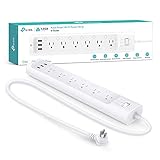
Overview: The Kasa HS300 is a premium 6-outlet smart power strip with integrated surge protection, designed for comprehensive home or office device management. It combines individual outlet control, USB charging, and energy monitoring via the Kasa app, eliminating the need for a separate hub. What Makes It Stand Out: Its standout feature is per-outlet energy monitoring, allowing precise tracking of power consumption for each device—rare in this category. The six independently controllable outlets, three USB ports, and compatibility with Alexa, Google Assistant, and Microsoft Cortana offer exceptional flexibility. ETL-certified surge protection adds essential safety. Value for Money: Priced higher than basic models, it justifies cost through robust energy insights and full voice assistant support. Competitors often lack per-device monitoring, making this ideal for cost-conscious users seeking detailed usage data to reduce bills. Strengths and Weaknesses: Strengths: Granular energy tracking, versatile voice control, reliable surge protection, no hub needed. Weaknesses: Requires 2.4GHz Wi-Fi only; no Matter support limits future smart home integration; bulkier design than competitors. Bottom Line: A top-tier choice for energy-aware users needing detailed consumption data and broad voice assistant compatibility. Despite its premium price, the HS300 delivers unmatched monitoring and control, earning strong recommendation for tech-savvy households.
2. kasa smart Plug Power Strip KP303, Surge Protector with 3 Individually Controlled Smart Outlets and 2 USB Ports, Works with Alexa & Google Home, No Hub Required , White
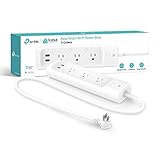
Overview: Kasa’s KP303 offers a compact solution for smaller spaces, featuring three individually controlled smart outlets, two USB ports, and essential surge protection. It targets users needing smart control without overwhelming complexity. What Makes It Stand Out: Its streamlined design focuses on core functionality: scheduling/timers for energy savings, seamless Kasa app integration, and reliable ETL-certified surge protection. The compact size fits tight spaces like desks or nightstands better than bulkier strips. Value for Money: At a mid-range price, it provides excellent value for minimal setups. While fewer outlets than competitors, it excels in simplicity and reliability. Cheaper alternatives often lack scheduling precision or consistent app performance, justifying its cost for focused use cases. Strengths and Weaknesses: Strengths: Intuitive scheduling, space-saving design, dependable surge protection, no hub required. Weaknesses: Limited to three controllable outlets; no energy monitoring; USB ports lack fast-charging specs; Alexa/Google only (no Matter). Bottom Line: Ideal for dorms, desks, or travel where space is limited. Though less feature-rich than larger models, its reliable scheduling and compact form make it a smart buy for basic smart plug needs—highly recommended for minimalist setups.
3. Amazon Basics Smart Plug Power Strip with 6 Individually Controlled Outlets and 3 USB Ports (2 USB-A and 1 USB-C), WiFi, Works with Alexa Only, 2.4 GHz, No Hub Required, White

Overview: This budget-friendly Amazon Basics strip delivers six individually controlled outlets and three USB ports (including USB-C), prioritizing Alexa integration and straightforward setup for cost-conscious users. What Makes It Stand Out: Ultra-simple Alexa app setup and Alexa-only voice control distinguish it—perfect for Echo-centric homes. The inclusion of USB-C is a thoughtful touch for modern devices, and grouping outlets streamlines routine management. Value for Money: It’s the most affordable option here, ideal for users deeply invested in Alexa. However, the Alexa-only limitation reduces versatility compared to multi-platform rivals. Savings are significant, but you sacrifice broader compatibility and advanced features like energy monitoring. Strengths and Weaknesses: Strengths: Low cost, USB-C port, easy Alexa integration, outlet grouping. Weaknesses: Alexa-exclusive (no Google/Apple support); no energy monitoring; build quality feels less durable; limited smart features beyond basic scheduling. Bottom Line: A solid entry-level pick only for Alexa die-hards seeking basic smart control on a budget. Avoid if you use other assistants or want energy insights—recommended sparingly for simple, cost-driven deployments.
4. Smart Power Strip, Yozisital Surge Protector with 6 Smart Outlets and 4 USB Ports, 5FT Flat Plug Extension Cord for Home Office

Overview: The Yozisital strip merges 12 ports (6 smart AC outlets, 2 regular AC, 4 USB) with Smart Life app control, targeting users needing maximum connectivity in home offices or entertainment centers. What Makes It Stand Out: Its 12-in-1 versatility—especially dual USB-C ports—accommodates diverse devices. The Smart Life app enables scheduling and remote control, while the flat plug design aids furniture placement. However, it’s limited to 2.4GHz Wi-Fi only. Value for Money: Competitive pricing for port density, but the Smart Life app (less polished than Kasa) and lack of energy monitoring reduce value. Best for those prioritizing port quantity over analytics, though similar-priced Kasa models offer superior software. Strengths and Weaknesses: Strengths: High port count (including dual USB-C), flat plug, affordable. Weaknesses: Clunky Smart Life app; no energy monitoring; inconsistent Wi-Fi pairing; regular outlets aren’t smart-controlled; no surge protection specs beyond basic claims. Bottom Line: A functional choice for port-hungry setups where app experience isn’t critical. However, reliability concerns and missing energy features make it less compelling—consider only if port density outweighs smart functionality.
5. Tapo Smart Wi-Fi Power Strip - Matter Compatible, Energy Monitoring, Surge Protection, 6 Individually Controlled Outlets & 3 USB Ports, Works with Alexa, Google Assistant, Siri & Bixby - Tapo P316M

Overview: Tapo’s P316M is a future-proof smart strip featuring Matter compatibility, per-outlet energy monitoring, and a space-saving slim design, targeting integrated smart home ecosystems. What Makes It Stand Out: Matter certification ensures seamless cross-platform control (Alexa, Google, Apple Home, Samsung), a rare advantage. Per-outlet energy tracking, overload prevention, and a flush-fit plug for tight spaces elevate it beyond competitors. Value for Money: Priced mid-to-high, it justifies cost with Matter support and detailed energy analytics—critical for multi-assistant households. While Kasa lacks Matter, this strip offers broader compatibility and smarter safety features at a reasonable premium. Strengths and Weaknesses: Strengths: Matter compatibility, per-outlet energy monitoring, overload prevention, slim design, universal assistant support. Weaknesses: Shorter 3-foot cord; USB ports lack high-speed specs; initial Matter setup can be technical. Bottom Line: The standout for future-ready smart homes. Matter support and energy insights make it worth the investment—highly recommended for users invested in diverse ecosystems seeking longevity and precise control.
6. Anker Power Strip with 2100J Surge Protector, Outlet Extender, 5ft Extension Cord with Multiple Outlets, 12 AC, 2 USB A,1 USB C Port for 20W, Home Office, Dorm Room Essentials, TUV Listed

Overview: The Anker 351 Power Strip delivers robust power management for home or office setups, featuring 12 AC outlets, 2 USB-A ports, and a 20W USB-C port alongside 2100J surge protection. Its 5-foot cord and optimized spacing cater to modern device clusters near desks or bedsides.
What Makes It Stand Out: With an industry-leading 2100J surge rating and an 8-point safety system—including fire resistance and overload protection—it prioritizes device security. The USB-C port charges iPhones from 0–50% in 26 minutes, while spaced outlets accommodate bulky adapters without blocking adjacent ports.
Value for Money: Priced competitively against basic power strips, its premium surge protection ($200k connected equipment warranty) and versatile port configuration justify the cost for users needing reliable, high-capacity charging in compact spaces like dorms or workstations.
Strengths and Weaknesses: Strengths: Exceptional surge protection; spacious outlet layout; fast USB-C charging; TÜV safety certification. Weaknesses: Lacks smart features (voice/app control); USB-A ports offer standard 5W charging; no mounting hardware beyond screws.
Bottom Line: Ideal for safety-conscious users prioritizing surge protection and physical layout over smart capabilities; a dependable, no-frills solution for powering multiple devices securely.
7. GHome Smart Plug Outlet Extender, Smart Power Strip Surge Protector with 3 Individually Controlled WiFi Outlets and 3 USB Ports, Smart Plugs That Works with Alexa Google Home, 15A/1800W, Black

Overview: This 9-in-1 smart strip blends surge protection with voice/app control, offering 3 individually controllable smart outlets, 3 always-on outlets, and 3 USB ports (5V/3A). Designed for space-constrained areas, it mounts to walls and integrates with Alexa/Google Home via 2.4GHz Wi-Fi.
What Makes It Stand Out: The hybrid design—combining always-on ports for critical devices (e.g., routers) with individually controllable smart outlets—ensures flexibility. Wall-mountability and FCC-certified multi-layer safety (surge/short-circuit/fire protection) enhance practicality for cluttered spaces.
Value for Money: At mid-range pricing, it outperforms single-outlet smart plugs by managing multiple devices simultaneously. The inclusion of always-on ports and USB charging adds utility, though budget users might find basic strips cheaper if smart features aren’t essential.
Strengths and Weaknesses: Strengths: Always-on outlets for essentials; wall-mount design saves space; robust safety certifications; individual outlet control. Weaknesses: Limited to 2.4GHz Wi-Fi; USB ports lack fast-charging specs; app reliability varies in large homes.
Bottom Line: A versatile choice for smart-home beginners needing targeted control over non-essential devices while keeping critical electronics powered—ideal for desks or entertainment centers.
8. GHome Smart Power Strip 15A, 2.4G WiFi Smart plugs that work with Alexa & Google Home, Surge Protector Flat Plug with 6 APP Control WiFi outlets, FCC Listed, 7.18 ft flat extension cord, No Hub Needed

Overview: This 6-outlet smart strip features a 7.18-foot flat cord, 3 USB ports (including 30W USB-C), and full app/voice control via Alexa or Google Assistant. It supports scheduling, energy monitoring, and grouping—all without a hub—making it suitable for offices or bedrooms.
What Makes It Stand Out: Energy monitoring via the GHome app is rare at this price, letting users track consumption to cut bills. The 30W USB-C fast charging, 6 individually controllable outlets, and flat plug design (for tight spaces) differentiate it from competitors.
Value for Money: Despite lacking always-on ports, its energy-tracking feature and 6 smart outlets offer strong value for eco-conscious users. The 30W charging and scheduling tools justify a slight premium over basic smart strips for long-term savings.
Strengths and Weaknesses: Strengths: Real-time energy monitoring; 30W fast charging; flexible scheduling; flat plug for tight spaces. Weaknesses: No dedicated always-on outlets; 2.4GHz Wi-Fi dependency; USB ports share 5V/3A total output.
Bottom Line: Best for tech-savvy users prioritizing energy efficiency and granular control—skip if you need always-on ports for security devices or routers.
9. Smart Strip KCG-7MVR Energy Saving Surge Protector with Autoswitching Technology, 7 Outlet

Overview: A minimalist 7-outlet surge protector with unique autoswitching tech: 1 “control” outlet triggers 4 “switched” outlets to power off when a master device (e.g., TV) sleeps, saving energy. Includes 2 always-on ports and a right-angle flat plug.
What Makes It Stand Out: Its autoswitching feature eliminates vampire power drain—perfect for home theaters or workstations. The user-adjustable sensitivity screw ensures compatibility with diverse devices, while the flat plug fits behind furniture effortlessly.
Value for Money: Budget-friendly for energy savers, but lacks smart features or USB ports. It’s ideal for users seeking passive efficiency without app/voice control, though smart strips offer more active management at higher prices.
Strengths and Weaknesses: Strengths: Effective energy savings via autoswitching; compact flat plug; adjustable sensitivity; reset button for surges. Weaknesses: No USB ports; limited to 7 outlets; no remote/app control; basic surge protection (unspecified joules).
Bottom Line: A niche pick for eco-focused users with simple setups—opt for this if you prioritize automatic energy savings over smart functionality.
10. POWSAV 6 Ft WiFi Surge Protector - 8 Outlet Extension Cord with 4 Smart & 4 Always On Outlets, 4 USB Ports, Alexa & Google Home Compatible, Black

Overview: This hybrid strip merges 4 app-controlled smart outlets with 4 always-on outlets, plus 4 USB ports and 1680J surge protection. Compatible with Alexa/Google, it uses the Smart Life app for scheduling and group control via 2.4GHz Wi-Fi.
What Makes It Stand Out: The balanced 4/4 outlet split caters perfectly to mixed-use scenarios (e.g., smart lamps + always-on router). USB ports deliver 5V/4.8A shared output, while ETL certification and a 30-day return policy enhance trust.
Value for Money: Competitive pricing for 8 total outlets and dual-mode functionality. The always-on USB ports (unlike some competitors) ensure constant device charging, though the Smart Life app’s interface lags behind dedicated brands.
Strengths and Weaknesses: Strengths: Equal smart/always-on outlets; USB ports always active; strong surge rating; ETL certified. Weaknesses: Smart Life app can be glitchy; no energy monitoring; USB ports lack fast-charging labels.
Bottom Line: A practical, affordable entry into smart power management for users needing both automated control and uninterrupted power—skip if advanced energy tracking is essential.
Understanding the Smart Power Strip Revolution
The shift from basic power strips to smart alternatives marks a significant leap in how we interact with everyday office infrastructure. These aren’t just passive conduits for electricity anymore; they’re active participants in managing energy flow, enhancing convenience, and improving workspace organization. Understanding this evolution is the first step towards leveraging their full potential for a truly optimized home office environment.
Why “Smart” Matters Beyond Basic Power
Gone are the days when a power strip’s sole job was providing extra plugs and minimal surge protection. Smart power strips integrate connectivity (like Wi-Fi or Bluetooth) and onboard intelligence, enabling features that directly address modern home office pain points: energy waste from idle devices, the frustration of manually switching off multiple peripherals, and the visual clutter of unmanaged cables. They transform a necessary utility into a tool for efficiency and control.
The Phantom Load Problem in Your Workspace
Many home office devices – chargers, printers, monitors, even some lamps – continue to draw small amounts of power even when switched off, a phenomenon known as “vampire” or “phantom” load. Individually insignificant, these constant drains add up significantly on your energy bill over time and contribute unnecessarily to your carbon footprint. Smart power strips, particularly those with scheduling or usage monitoring, are powerful weapons in the fight against this hidden energy drain.
Core Connectivity Options Explained
Not all smart strips connect the same way. Understanding the primary connectivity methods – Wi-Fi (for direct internet/app control), Bluetooth (for shorter-range, phone-based control), and hub-dependent protocols like Zigbee or Z-Wave (often used in broader smart home ecosystems) – is crucial. Your existing smart home setup and desired level of remote access (inside or outside your home network) will heavily influence which connectivity type best suits your needs.
Essential Features to Prioritize for Your Home Office
Selecting the ideal smart power strip requires moving beyond outlet count. The specific features that deliver the most value depend entirely on how you use your home office and what frustrations you aim to solve. Focusing on these key functional areas ensures you invest in capabilities that will genuinely enhance your daily routine.
USB Charging Capabilities: More Than Just Convenience
Dedicated, high-amperage USB-A and increasingly USB-C ports built directly into the strip eliminate the need for bulky individual chargers. Look for ports that offer sufficient power (ideally 2.4A or higher per port, or USB-PD for faster laptop/device charging) to handle multiple devices simultaneously without slowdowns, streamlining your desk setup significantly.
Individual Outlet Control vs. Group Management
This is a fundamental choice. Strips with per-outlet control allow you to schedule or remotely switch each socket independently – perfect for turning off a printer while keeping a router powered. Group control (often 2-4 zones) offers a balance, letting you manage clusters of related devices (e.g., computer + monitor + speakers) with one command, which is often sufficient and more budget-friendly.
Energy Monitoring: Seeing Your Power Consumption
Real-time and historical energy usage data, displayed in apps or voice assistant responses, is invaluable. It reveals exactly which devices are energy hogs, quantifies phantom load savings, and provides tangible feedback on the impact of your automation schedules. This feature transforms abstract energy saving into concrete, actionable insights for your home office.
Scheduling and Automation: Hands-Off Efficiency
The true power lies in automation. Robust scheduling lets you define precise on/off times for outlets (e.g., powering down non-essential gear overnight). Integration with smart home platforms (like Google Home, Apple HomeKit, or Amazon Alexa) enables powerful automations – “Goodnight” routines that kill office power, or triggers based on your phone’s location or motion sensors detecting you’ve left the room.
Voice Control Compatibility: Command Without Lifting a Finger
Seamless integration with major voice assistants (Alexa, Google Assistant, Siri via HomeKit) adds a layer of effortless control. Simply saying “Hey Google, turn off the printer strip” is infinitely faster than digging through a phone app, especially when you’re in the flow of work and need to quickly power down a peripheral.
Design and Physical Considerations for Desk Harmony
The physical form factor and layout of your smart power strip play a surprisingly large role in maintaining a clean, functional workspace. It’s not just about fitting under your desk; it’s about how easily you can plug in your specific mix of bulky adapters and slender cords without creating a new mess.
Outlet Spacing: Accommodating Bulky Adapters
Transformer blocks for laptops, monitors, and other devices are notoriously large. Strips with widely spaced outlets, or strategically rotated outlets, prevent one bulky adapter from blocking adjacent sockets. Measure your largest adapters before choosing to ensure the strip’s physical layout works with your actual gear.
Cable Length and Management Features
The cord connecting the strip to the wall outlet needs sufficient reach to position the strip optimally under or behind your desk without strain. Look for strips that include built-in cable ties, wraps, or channels to neatly secure the main power cord and manage the web of device cables emanating from the strip itself, contributing significantly to a tidier appearance.
Form Factor: Low Profile vs. Tower Designs
Consider your available space. Low-profile strips tuck discreetly under desks or behind furniture. Tower or vertical designs can be more visible but often offer better outlet access and spacing, especially when placed on the floor beside a desk. Choose the shape that integrates best with your specific desk setup and minimizes visual clutter.
Safety and Reliability: Non-Negotiable Foundations
While smart features are exciting, the core function of a power strip – safely delivering electricity – remains paramount. Cutting corners here risks equipment damage or fire. Prioritizing robust safety certifications and understanding key protective elements is essential for peace of mind in your home office.
Understanding Surge Protection Ratings (Joules)
Surge protection is critical for safeguarding expensive electronics. The joule rating indicates how much energy the strip can absorb from a power spike before failing. For a home office filled with sensitive gear, aim for a minimum of 1000 joules, with 2000+ joules offering significantly better and longer-lasting protection against damaging surges.
Overload Protection: Preventing Circuit Trips
A quality strip includes automatic circuit breakers that trip if the total load exceeds safe limits (usually 15 amps for standard US circuits). This prevents overheating and potential fire hazards. Ensure the strip clearly indicates its maximum load capacity and that your total connected device wattage stays well below this threshold.
Essential Safety Certifications (UL, ETL, etc.)
Never compromise on safety certifications. Look for marks from independent testing laboratories like Underwriters Laboratories (UL), Intertek (ETL), or CSA Group. These verify the product meets rigorous electrical safety standards. Avoid strips lacking these certifications, as they pose significant safety risks regardless of their smart features.
Integration and Ecosystem Compatibility
Your smart power strip shouldn’t exist in isolation. Its value multiplies when it works harmoniously with the other smart devices and platforms you already use or plan to adopt in your home. Considering ecosystem fit upfront prevents frustration and unlocks more powerful automation scenarios.
Major Smart Home Platform Support
Identify which smart home ecosystem you primarily use (Google Home, Apple HomeKit, Amazon Alexa, Samsung SmartThings). Ensure the power strip explicitly lists compatibility with your chosen platform. This guarantees seamless voice control, routine integration, and presence within your main smart home app for unified management.
App Experience and Reliability
The companion smartphone app is your primary interface for setup, scheduling, and monitoring. Prioritize strips known for stable, intuitive apps with responsive controls and clear energy data presentation. A buggy or confusing app will quickly negate the convenience benefits of the smart features. Check recent user reviews specifically mentioning app performance.
Future-Proofing with Matter Support
Matter is a new, unifying smart home standard designed to improve compatibility and reliability across different brands and platforms. While adoption is still growing, strips supporting Matter (often alongside Wi-Fi) offer the best assurance of long-term compatibility as the smart home landscape evolves, reducing the risk of your device becoming obsolete.
Maximizing Organization and Workspace Flow
The ultimate goal of a smart power strip in the home office is to contribute to a calmer, more focused, and visually clean environment. It’s not just about power; it’s about creating a workspace that actively supports your productivity by minimizing distractions and physical clutter.
Creating Dedicated Power Zones
Leverage individual or grouped outlet control to define functional zones: a “Workstation Zone” (computer, monitor, desk lamp), a “Peripheral Zone” (printer, scanner), and a “Charging Zone” (phones, tablets). This logical grouping makes managing power intuitive and reinforces a sense of order, allowing you to power down entire non-essential sections instantly.
Reducing Visual Clutter Through Smart Layout
Strategically placing the strip (using its cable management features) and utilizing well-spaced outlets inherently reduces the chaotic tangle of cords. A strip that accommodates your adapters without blocking ports means fewer extension cords or additional strips, which are often the root cause of messy cable piles under desks.
Automating the End-of-Day Shutdown
One of the most impactful automations is a simple “Goodnight” or “Office Closed” routine. Program your strip to automatically power down all non-essential home office equipment (monitors, printers, speakers, chargers) at a set time or triggered by a voice command when you finish work. This ensures phantom loads are eliminated consistently without any manual effort, promoting both energy savings and a clear separation between work and personal time.
Frequently Asked Questions
Frequently Asked Questions
What’s the primary advantage of a smart power strip over a basic one for a home office? Smart strips offer remote control, scheduling, energy monitoring, and automation to eliminate phantom loads, enhance convenience, and significantly improve organization compared to passive basic strips.
How do I determine the right number of outlets I need? Count all devices requiring power (including bulky adapters), then add 1-2 extras for future additions. Prioritize strips where the physical spacing accommodates your largest adapters without blocking adjacent outlets.
Can smart power strips really save me money on my electricity bill? Yes, primarily by eliminating phantom loads from idle devices and enabling scheduled shutdowns. Energy monitoring features help quantify these savings by showing exactly how much power your office consumes.
Are smart power strips safe for sensitive electronics like computers and monitors? Absolutely, if they have a robust surge protection rating (1000+ joules, ideally 2000+) and essential safety certifications (UL, ETL). This protects your valuable gear from damaging power surges.
Do I need a hub for a smart power strip to work? It depends. Wi-Fi strips connect directly to your router and don’t need a hub. Strips using Zigbee or Z-Wave do require a compatible smart home hub (like Samsung SmartThings or Apple TV/HomePod for HomeKit) to function and connect to your network.
How important is energy monitoring for a home office setup? Very important for understanding consumption patterns, identifying energy-wasting devices, and verifying the savings from your automation efforts. It turns abstract energy saving into concrete, measurable results.
Can I control a smart power strip when I’m not at home? Yes, Wi-Fi enabled strips allow remote control and monitoring via their smartphone app from anywhere with an internet connection, letting you check status or turn devices on/off remotely.
What should I do if an outlet on my smart strip stops working? First, check the strip’s circuit breaker to see if it tripped due to overload. If reset doesn’t work, consult the manual for troubleshooting. Persistent issues likely require contacting the manufacturer, especially if under warranty.
Will voice control work if my internet goes out? Typically, no. Voice control via assistants like Alexa or Google Assistant requires an active internet connection for cloud processing. Some Bluetooth strips might offer limited local voice control, but Wi-Fi dependent features will be unavailable offline.
How often should I replace my smart power strip? Replace it immediately if it shows physical damage, burns, or frequent tripping. Otherwise, consider replacing it every 3-5 years, or sooner if surge protection capabilities degrade (indicated by status lights on some models) or if it no longer meets your evolving office needs.