Picture this: you open your latest electricity bill and feel that familiar sinking sensation as your eyes scan the total. Month after month, those numbers stubbornly refuse to budge, no matter how diligently you unplug chargers or nag family members about lights left on. What if the solution wasn’t hidden in some complex home automation system, but right there on your walls, in the very switches you use dozens of times a day? Smart wall switches represent one of the most accessible, impactful, and often overlooked tools for taking control of your home’s energy consumption. They transform mundane, manual actions into intelligent, automated energy-saving opportunities without demanding major lifestyle changes or breaking the bank.
Gone are the days when “smart home” meant expensive, complicated setups reserved for tech enthusiasts. Today’s smart wall switches blend seamlessly into your existing electrical infrastructure, offering intuitive control that actively works to reduce wasted energy. Unlike plugging smart plugs into outlets, these devices replace your standard switches at the source, providing granular control over lighting and plugged-in devices where the power flows. The beauty lies in their simplicity: they learn your habits, adapt to your schedule, and eliminate the energy drain caused by human forgetfulness. This isn’t about futuristic gimmicks; it’s about practical, measurable reductions in your monthly utility costs through smarter, more conscious energy use – starting with the switches you interact with daily.
Top 10 Smart Wall Switches
Detailed Product Reviews
1. Kasa Smart Light Switch HS200, Single Pole, Needs Neutral Wire, 2.4GHz Wi-Fi Light Switch Works with Google Home, UL Certified, No Hub Required, White

Overview:
The Kasa HS200 is a single-pole smart light switch requiring a neutral wire, designed for seamless integration into modern smart homes. It connects directly to 2.4GHz Wi-Fi without a hub, offering app and voice control via Google Home or Alexa. Installation is user-guided through the Kasa app, though professional help is advised for wiring novices.
What Makes It Stand Out:
Dual compatibility with Google Assistant and Alexa sets it apart from brand-locked competitors. The app’s intuitive scheduling—including randomized “Away Mode” for security—and real-time status monitoring provide robust automation. UL certification and Silicon Valley engineering reinforce trust, appealing to safety-conscious users.
Value for Money:
Priced moderately higher than basic switches, it justifies cost through versatility and reliability. While cheaper Alexa-only options exist, the HS200’s cross-platform support eliminates ecosystem limitations, making it a smarter long-term investment for multi-assistant households.
Strengths and Weaknesses:
Strengths: Reliable app control, excellent scheduling features, strong security certifications, no hub needed.
Weaknesses: Requires neutral wire (excluding older homes), 2.4GHz Wi-Fi only, no physical toggle after smart setup.
Bottom Line:
Ideal for tech-savvy users with compatible wiring seeking flexible, hub-free automation. Its dual-voice support and security features make it a top-tier choice despite the neutral-wire limitation.
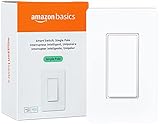
2. Amazon Basics Smart Light Switch, Single Pole, Works with Alexa Only, Voice Control, Schedule, 2.4 GHz Wi-Fi, No Hub Required, Easy to Install, White
Overview:
This Amazon Basics switch delivers essential smart functionality at an entry-level price, designed exclusively for Alexa integration. It installs via step-by-step video guides, requires a neutral wire and 2.4GHz Wi-Fi, and enables voice control and scheduling without a hub—streamlining upgrades for Alexa-centric homes.
What Makes It Stand Out:
Its tight integration with Alexa routines simplifies scheduling (e.g., sunrise/sunset triggers), and the guided installation lowers barriers for beginners. As a budget Amazon product, it leverages the Alexa ecosystem’s ubiquity, avoiding app fragmentation.
Value for Money:
The lowest-priced option here, it’s perfect for Alexa households prioritizing cost over flexibility. However, lacking Google/Home compatibility limits future-proofing, making it less valuable for multi-platform users despite its affordability.
Strengths and Weaknesses:
Strengths: Extremely affordable, effortless Alexa pairing, simple scheduling, no hub required.
Weaknesses: Alexa-only (no Google/Home support), basic app functionality, minimal third-party integrations.
Bottom Line:
A solid budget pick for dedicated Alexa users wanting basic voice control and scheduling, but avoid if you use Google Assistant or plan to expand your smart home ecosystem.
3. Kasa Smart Light Switch HS200P3, Single Pole, Needs Neutral Wire, 2.4GHz Wi-Fi Light Switch Compatible with Alexa and Google Home, UL Certified, No Hub Required, 3 Count -Pack of 1 , White

Overview:
This Kasa HS200P3 pack includes three identical single-pole smart switches, mirroring the HS200’s core features: neutral-wire dependency, 2.4GHz Wi-Fi, and dual compatibility with Alexa and Google. It targets whole-home installations, with app-guided setup ensuring consistency across multiple units.
What Makes It Stand Out:
The multi-pack format offers significant savings for outfitting multiple rooms, while retaining all HS200 strengths—like randomized “Away Mode” scheduling and real-time monitoring. Kasa’s established app ecosystem ensures unified control, avoiding fragmented management.
Value for Money:
Buying in bulk reduces per-unit cost by ~25% versus individual HS200s, making whole-home automation far more economical. For households needing multiple switches, this pack delivers exceptional value without sacrificing features or reliability.
Strengths and Weaknesses:
Strengths: Cost-effective for multi-room setups, consistent performance, robust scheduling, no hub needed.
Weaknesses: Still requires neutral wiring per switch, identical limitations to single-unit HS200.
Bottom Line:
The optimal choice for comprehensive home automation with Kasa, offering substantial savings and seamless scalability—ideal for new constructions or whole-house retrofits with compatible wiring.
4. Kasa Smart Switch 2-Gang HS200-2, Single Pole,Neutral Wire Required, 2.4GHz Wi-Fi Light Switch Compatible with Alexa and Google Home, UL Certified, No Hub Required, White

Overview:
The Kasa HS200-2 is a dual-circuit smart switch consolidating two traditional switches into one sleek panel. It requires a neutral wire and 2.4GHz Wi-Fi, supporting independent control of two lights via app or voice (Alexa/Google), with guided installation simplifying complex setups.
What Makes It Stand Out:
The 2-gang design eliminates clunky dual-switch installations, offering a clean aesthetic while controlling separate circuits. Advanced scheduling—like “Away Mode” per channel—and Samsung SmartThings compatibility broaden its smart-home appeal beyond basic models.
Value for Money:
Though pricier than single switches, it replaces two units at a marginal cost increase. The space-saving design and dual-circuit management justify the premium, especially for entries or rooms with paired lighting.
Strengths and Weaknesses:
Strengths: Elegant single-panel dual control, per-switch scheduling, SmartThings support, no hub needed.
Weaknesses: Higher cost, neutral wire essential for both circuits, limited to 2.4GHz Wi-Fi.
Bottom Line:
A premium solution for modernizing multi-light zones efficiently. Best for users prioritizing aesthetics and unified control in spaces like foyers or kitchens with two-light setups.
5. GHome Smart Switches for Lights, WiFi Smart Light Switch Works with Alexa and Google Home, Single-Pole, Neutral Wire Required, 2.4Ghz WiFi Light Switch with APP Control, No Hub Required, UL FCC Listed

Overview:
GHome’s switch offers Alexa/Google compatibility and app control via its proprietary GHome app, requiring a neutral wire and 2.4GHz Wi-Fi. It emphasizes safety with UL/FCC certification and supports 1800W loads, targeting users seeking certified, no-hub automation.
What Makes It Stand Out:
Group control in the GHome app allows managing multiple switches simultaneously—a rarity in budget models. The sunrise/sunset scheduling automation and included jumper wires (for complex wiring) cater to practical installation needs.
Value for Money:
Competitively priced, it matches Kasa’s features but lacks brand recognition. While the app is functional, GHome’s ecosystem is less polished than Kasa’s, making it a budget alternative for those prioritizing group control over app maturity.
Strengths and Weaknesses:
Strengths: Group control feature, UL/FCC certified, sunrise/sunset scheduling, high 1800W rating.
Weaknesses: Niche app (less intuitive than Kasa), limited user community, jumper wires complicate smart bulb use.
Bottom Line:
A viable economical option for group lighting management with solid safety credentials, but Kasa remains preferable for seamless daily use due to superior app refinement.
6. TP-Link Tapo Smart Light Switch, Single Pole, Neutral Wire Required, 2.4GHz Wi-Fi Light Switch Compatible with Alexa and Google Home, UL Certified, No Hub Required, White, Tapo S500(4-Pack)

Overview:
This 4-pack of Tapo S500 smart switches replaces standard wall switches, requiring a neutral wire and 2.4GHz Wi-Fi. Designed for hassle-free integration into existing lighting circuits, it offers core smart functionality without a hub, targeting budget-conscious users seeking multi-room automation.
What Makes It Stand Out:
The standout feature is the 4-pack value, ideal for outfitting multiple rooms affordably. App-guided installation simplifies setup, while UL certification and a 2-year warranty ensure safety and reliability. The “Away Mode” with randomized scheduling effectively deters intruders, and direct compatibility with Alexa and Google Home eliminates hub dependency.
Value for Money:
Priced competitively for a quartet, it delivers exceptional value for whole-home basic automation. While lacking Matter support, it undercuts single-switch alternatives and rivals more expensive multi-packs. The included warranty and Tapo’s 8-million-user trust further justify the cost for essential smart lighting.
Strengths and Weaknesses:
Strengths: Affordable 4-pack; intuitive app setup; reliable voice control; robust Away Mode; strong safety certifications.
Weaknesses: No Matter protocol support; requires neutral wire (excludes older homes); 2.4GHz Wi-Fi only; limited ecosystem integration beyond Alexa/Google.
Bottom Line:
An outstanding budget-friendly entry for multi-room smart lighting, provided your home has neutral wires. Its value, ease of use, and core features make it ideal for beginners, though tech-forward users may prefer Matter-enabled alternatives.
7. Leviton Decora Smart Switch, Wi-Fi 2nd Gen, Neutral Wire Required, Works with Matter, My Leviton, Alexa, Google Assistant, Apple Home/Siri & Wired or Wire-Free 3-Way, D215S-1RW, White

Overview:
Leviton’s Decora Smart Switch merges premium build quality with cutting-edge Matter protocol support. Requiring a neutral wire, it offers seamless integration across Apple Home, Alexa, Google, and SmartThings ecosystems, positioning itself as a future-proof hub for sophisticated smart homes.
What Makes It Stand Out:
Its broadest differentiator is Matter compatibility (via firmware update), enabling unified control across virtually all major platforms—including Apple Home/Siri natively. The “Most Connected” claim is validated by support for Sonos and Resideo, while wire-free 3-way functionality adds unique installation flexibility absent in competitors.
Value for Money:
Priced higher than basic models, it justifies cost through unparalleled ecosystem compatibility and Matter readiness. For users invested in Apple Home or multi-platform setups, the long-term value outweighs initial expense. The robust Decora design also ensures durability, reducing replacement needs.
Strengths and Weaknesses:
Strengths: Industry-leading Matter/ecosystem support; elegant Decora styling; wire-free 3-way capability; reliable “lived-in” scheduling; strong brand trust.
Weaknesses: Premium pricing; neutral wire essential; app interface less intuitive than Kasa/Tapo; no physical dimming option.
Bottom Line:
The top choice for tech-savvy users prioritizing cross-platform harmony and future-proofing. Despite the higher cost, its Matter integration and broad compatibility deliver unmatched versatility for complex smart homes.
8. Kasa Smart Light Switch HS200-LA, Light Almond, Single Pole,Neutral Wire Required, 2.4GHz Wi-Fi Light Switch Compatible with Alexa and Google Home, UL Certified, No Hub Required

Overview:
Kasa’s HS200-LA offers a stylish Light Almond finish alongside reliable smart switching. Requiring a neutral wire and 2.4GHz Wi-Fi, it delivers core automation features through the user-friendly Kasa app, targeting homeowners seeking subtle aesthetics and straightforward functionality.
What Makes It Stand Out:
The Light Almond color option provides rare aesthetic versatility for smart switches, blending seamlessly with warm décors. Kasa’s app-guided installation is exceptionally clear, and the switch shares Tapo’s robust Away Mode for security. Direct Alexa/Google compatibility without a hub ensures wide accessibility.
Value for Money:
Competitively priced for a single switch, it offers solid value with its unique color and Kasa’s polished app experience. While lacking Matter support, it matches Tapo’s reliability at a similar cost, making it ideal for users prioritizing design integration over protocol futurism.
Strengths and Weaknesses:
Strengths: Attractive Light Almond finish; intuitive Kasa app; dependable voice control; effective Away Mode; UL safety certified.
Weaknesses: No Matter or Apple Home support; neutral wire mandatory; limited to 2.4GHz Wi-Fi; fewer ecosystem partnerships than Leviton.
Bottom Line:
A stylish, no-nonsense smart switch perfect for decor-focused installations. Choose it for its aesthetic appeal and Kasa’s refined app, but opt for Matter-enabled models if cross-platform control is critical.
9. Kasa Matter Smart Light Switch: Voice Control w/Siri, Alexa & Google Assistant, UL Certified, Timer & Schedule, Easy Guided Install, Neutral Wire Required, Single Pole, 2.4GHz Wi-Fi, 3-Pack

Overview:
Kasa’s Matter-enabled 3-pack revolutionizes multi-switch setups with cross-platform unity. Requiring neutral wires, these switches leverage Matter over Wi-Fi for seamless control via Apple Home, Alexa, Google, or SmartThings—eliminating traditional ecosystem silos even offline via LAN.
What Makes It Stand Out:
Matter compatibility is the game-changer, enabling true multi-admin control (e.g., Siri and Alexa simultaneously) and offline functionality. The 3-pack offers exceptional value for whole-home Matter adoption, while Kasa’s guided install simplifies Matter onboarding—a rarity in entry-level Matter hardware.
Value for Money:
This 3-pack presents the most affordable path to a Matter-based smart lighting system. Compared to single Matter switches elsewhere, it drastically reduces per-unit cost while delivering future-proof protocol benefits. The included UL certification and Kasa app reliability further enhance its worth.
Strengths and Weaknesses:
Strengths: Affordable Matter adoption (3-pack); cross-platform harmony; offline LAN control; effortless app-guided Matter setup; robust Away Mode.
Weaknesses: Neutral wire dependency; no physical dimming; Matter setup may confuse absolute beginners; limited to single-pole installations.
Bottom Line:
The smartest buy for Matter newcomers seeking an economical, scalable smart lighting foundation. Its protocol leadership and 3-pack pricing make it indispensable for forward-thinking home automation.
10. Kasa Smart Dimmer Switch HS220, Single Pole, Needs Neutral Wire, 2.4GHz Wi-Fi Light Switch Works with Alexa and Google Home, UL Certified, No Hub Required, 1 Pack

Overview:
Kasa’s HS220 dimmer switch elevates basic on/off control with adjustable brightness, requiring a neutral wire and 2.4GHz Wi-Fi. It combines Kasa’s signature app simplicity with specialized dimming features, catering to ambiance-focused users like parents or home theater enthusiasts.
What Makes It Stand Out:
The “Gentle Off” feature—fading lights to mimic natural sleep patterns—is its emotional standout, especially for children’s rooms. Beyond standard scheduling and Away Mode, it offers precise dimming via app, voice, or physical switch taps, differentiating it from non-dimming competitors.
Value for Money:
Priced moderately for a dimmer, it delivers strong value with unique sleep-friendly functionality. While cheaper non-dimming switches exist, the HS220 justifies its cost for dimming-specific needs. Kasa’s reliable app and UL certification ensure no compromises on safety or usability.
Strengths and Weaknesses:
Strengths: Gentle Off sleep aid; intuitive dimming control; responsive voice/app integration; solid Away Mode; compact design.
Weaknesses: No Matter or Apple Home support; neutral wire required; dimming range may not suit all bulbs; single-pack limits multi-room value.
Bottom Line:
The premier choice for smart dimming where ambiance matters. Its Gentle Off feature is unmatched for family homes, though non-dimming users might prefer more ecosystem-flexible alternatives.
Understanding the Energy-Saving Power of Smart Switches
How Standard Switches Contribute to Energy Waste
Traditional wall switches are simple on/off mechanisms with no intelligence. They rely entirely on user action, leading to significant energy waste when lights or devices are left running unnecessarily in unoccupied rooms, during daylight hours, or even when the homeowner is away. This “vampire energy” or “standby power” from connected devices adds up silently over time, contributing directly to higher bills without providing any useful service.
The Core Mechanism: Automation and Awareness
Smart switches combat this waste through two fundamental strategies: automation and user awareness. They allow you to schedule lights and devices to turn off automatically during predictable non-use periods (like work hours or bedtime). Simultaneously, they provide real-time energy monitoring data through companion apps, making invisible energy consumption visible and understandable. This combination of taking action for you and showing you where energy goes empowers smarter decisions.
Beyond Simple Scheduling: Intelligent Triggers
While basic scheduling is valuable, advanced energy savings come from intelligent triggers. Occupancy and vacancy sensing uses motion detection to automatically turn lights off when a room is empty. Geofencing leverages your smartphone’s location to adjust settings as you leave or approach home. Integrating with other smart home systems (like thermostats or security cameras) allows for even more sophisticated energy-saving routines based on multiple conditions.
Essential Features to Prioritize for Maximum Savings
Accurate Energy Monitoring Capabilities
Not all smart switches provide detailed energy usage data. Look for models that offer real-time wattage measurement and historical consumption tracking (daily, weekly, monthly) within the app. This granular data is crucial for identifying specific energy hogs and quantifying the actual savings generated by your automation efforts, moving beyond guesswork to proven results.
Robust Scheduling and Routine Flexibility
The ability to create complex, multi-condition schedules is vital. Avoid switches limited to simple on/off timers. Seek options supporting sunrise/sunset triggers, multiple daily schedules, randomize functions for security (which also saves energy by avoiding predictable patterns), and the capacity to link actions to other smart home events for context-aware energy management.
Reliable Occupancy and Vacancy Sensing
For true hands-off savings in frequently used rooms (bathrooms, closets, hallways), built-in motion or presence detection is key. Ensure the sensing technology is adjustable for sensitivity and timeout duration to prevent lights turning off prematurely or failing to activate. Vacancy sensing (requiring a manual on, but auto-off) is often preferred over occupancy sensing (auto-on and auto-off) for privacy and to avoid lights triggering unnecessarily.
Dimming Functionality for Compatible Loads
If controlling incandescent, halogen, or compatible LED lighting, dimmable smart switches offer significant additional savings. Reducing light levels by even 25% can cut energy consumption for those fixtures by nearly 20%, while also extending bulb lifespan. Verify the switch explicitly supports dimming your specific bulb types to avoid flickering or compatibility issues.
Installation and Compatibility Considerations
Verifying Your Electrical Box Setup
Smart switches require a neutral wire in most cases for continuous power. Older homes (pre-1990s) often lack neutral wires at the switch box. Carefully inspect your existing switch wiring before purchasing. Some switches offer neutral-free operation, but these can have limitations (like not working with very low-wattage LEDs or requiring specific load types) and may not support all features like energy monitoring.
Matching Load Types and Wattage Limits
Crucially, ensure the smart switch is rated for the specific type of load it will control: standard incandescent, halogen, dimmable LED, non-dimmable LED, or even inductive loads like ceiling fan motors. Exceeding the maximum wattage rating can cause switch failure or safety hazards. Pay special attention to low-wattage LED compatibility, as many older smart switches struggle with modern, efficient bulbs.
Understanding Physical Space Constraints
Smart switches are physically larger than standard switches due to internal electronics. Measure the depth and width of your existing electrical box. Older, shallow boxes common in renovations might not accommodate bulkier smart switches, potentially requiring box replacement – a factor to consider during planning.
Maximizing Your Investment: Usage Strategies
Strategic Room Targeting for Impact
Focus initial installations on high-impact areas: rooms with long potential “on” times (like living rooms, kitchens), frequently forgotten spaces (guest rooms, hallways, closets), and areas with high-wattage lighting (recessed can lights, chandeliers). Prioritizing these yields the most noticeable savings before expanding to the whole house.
Leveraging Away Mode Effectively
“Home/Away” or “Geofencing” modes are powerful for energy savings when the house is empty. Configure the system to turn off all non-essential lights and potentially unplug devices (via smart plugs controlled by the switch routine) when the last person leaves. Ensure reliability by setting appropriate geofence radii to avoid premature triggering.
Analyzing Data to Refine Habits
Don’t just set it and forget it. Regularly review the energy usage reports in your app. Identify unexpected spikes or periods of high consumption. Use this data to adjust schedules, fine-tune occupancy settings, or even recognize inefficient appliances you might not have considered. This turns passive automation into active energy management.
Addressing Common Concerns and Challenges
Ensuring Reliability for Essential Lighting
Critical areas like stairwells or primary bathrooms need fail-safe operation. Consider switches with physical toggle functionality that works even if Wi-Fi is down (bypassing smart features but maintaining basic operation). Avoid placing sole reliance on smart switches for safety-critical lighting without a reliable manual override.
Managing Wi-Fi Dependency and Network Load
Smart switches add devices to your home network. Ensure your Wi-Fi router is robust enough to handle the load, especially in larger homes. Consider a dual-band router and placing switches on the 2.4GHz band (required for most). Power outages can temporarily disconnect switches; understand how your model reconnects automatically upon power restoration.
Privacy and Data Security Implications
Smart switches collect data on your presence and usage patterns. Research the manufacturer’s privacy policy: what data is collected, how it’s stored, and if it’s shared. Opt for brands with strong security practices (regular firmware updates, local control options where possible) and use strong, unique passwords for your smart home account.
Calculating Potential Cost Savings
Estimating Baseline Energy Consumption
Start by identifying the wattage of the lights or devices controlled by the switch. Multiply wattage by hours used per day, then by days per month, and divide by 1000 to get kilowatt-hours (kWh) used monthly. Multiply kWh by your utility’s cost per kWh (found on your bill) to determine current monthly cost for that circuit.
Modeling Impact of Automation
Calculate potential savings by estimating reduced usage: e.g., if occupancy sensing cuts bathroom light runtime by 2 hours daily (60W bulb), that’s 3.6 kWh saved monthly. At $0.15/kWh, that’s $0.54 saved monthly, or $6.48 annually per switch. While seemingly small per switch, whole-home implementation compounds significantly.
Factoring in Switch Cost vs. Long-Term Payback
Consider the purchase price of the switch. Using the example above ($6.48 annual savings), a $25 switch pays for itself in under 4 years, with years of pure savings following. Higher-wattage circuits (like garages with multiple fixtures) or optimizing HVAC auxiliary devices yield faster payback periods. The non-monetary benefit of convenience is an added bonus.
Troubleshooting and Optimization Tips
Resolving Flickering or Incompatible LED Issues
Flickering is usually a load compatibility problem. Try: 1) Ensuring the total connected LED wattage meets the switch’s minimum requirement (often 5-10W), 2) Using a compatible “dummy load” resistor (check switch specs), or 3) Replacing problematic bulbs with known compatible brands/models listed by the switch manufacturer. Never exceed maximum wattage.
Improving Motion Sensor Accuracy
If sensors trigger too easily or not enough: 1) Adjust the sensitivity setting within the app, 2) Reposition the switch if possible (avoiding direct heat sources or vents), 3) Fine-tune the timeout duration, 4) Ensure the sensor lens is clean and unobstructed. Remember, placement within the room affects detection coverage.
Optimizing Schedules Based on Seasonal Changes
Sunrise and sunset times shift significantly throughout the year. Schedules based purely on clock time become inefficient. Prioritize switches and apps that natively support sunrise/sunset triggers adjusted for your location, or manually update seasonal schedules a few times a year for optimal daylight harvesting and evening lighting.
Frequently Asked Questions
Frequently Asked Questions
How difficult is it to install a smart wall switch myself? Installation complexity varies. If your switch box has a neutral wire and matches the load type/wattage, it’s often comparable to replacing a standard switch for someone comfortable with basic electrical work (turning off the correct breaker is crucial!). However, if neutral wires are absent, the box is too small, or you’re unsure, hiring a licensed electrician is strongly recommended for safety and code compliance.
Can smart switches really save enough to justify their cost? Absolutely, especially when strategically deployed. Savings come from eliminating wasted runtime (lights left on in empty rooms, overnight). While savings per switch might seem modest monthly ($1-$5+ depending on usage), they accumulate significantly across multiple switches over the switch’s lifespan (often 5-10 years), typically paying for themselves within 1-3 years for high-usage circuits.
Do I need a neutral wire for every smart switch? Most modern smart switches require a neutral wire to power their internal electronics reliably. Older homes may lack neutrals at the switch box. Some switches offer “neutral-free” operation, but these often have limitations (e.g., requiring a minimum load, potential flickering with LEDs, or no energy monitoring). Always verify your wiring before purchasing.
Will smart switches work during a power outage? During a power outage, the switch loses power and its smart features (app control, scheduling, automation) will not function. Many retain physical toggle functionality to turn the light on/off manually once power is restored, but they won’t reconnect to Wi-Fi or resume automation until power is fully back and stable. Battery backups for the whole home are a separate solution.
Can I use smart switches with dimmable LED bulbs? Yes, but compatibility is essential. You need both a dimmable smart switch and dimmable LED bulbs explicitly listed as compatible by the switch manufacturer. Mismatches cause flickering, limited dimming range, or buzzing. Check compatibility lists carefully, as LED technology varies widely.
How do occupancy sensors differ from vacancy sensors? Occupancy sensors turn lights on automatically when motion is detected and off after a set time. Vacancy sensors require you to manually turn the lights on, but turn them off automatically when no motion is detected. Vacancy sensing is often preferred for privacy and avoiding lights turning on unexpectedly in closets or bathrooms.
Is my energy usage data secure with smart switches? Security depends on the manufacturer. Reputable brands use encryption for data in transit and at rest. Look for companies with transparent privacy policies, a history of security updates, and options for local processing (if available). Use strong, unique passwords and enable two-factor authentication on your smart home account.
Can I control multiple switches together for whole-house energy saving? Yes, most smart home platforms allow grouping switches into scenes or routines. You can create an “All Off” scene activated via voice command, app button, or schedule (like “Goodnight” turning off all non-essential lights). Geofencing can trigger whole-house “Away” modes for maximum savings when leaving.
Do smart switches work with all voice assistants? Most major smart switches support integration with popular voice assistants like Amazon Alexa, Google Assistant, and Apple HomeKit/Siri. However, specific features (like energy usage reporting via voice) may vary. Always confirm compatibility with your preferred voice platform before purchasing.
Are smart switches suitable for renters? Renters can often use smart switches, but only with explicit landlord permission. Choose models that are easy to uninstall and revert to the original switch (take pictures of wiring beforehand!). Prioritize switches not requiring permanent modifications. Portable alternatives like smart plugs might be a simpler, permission-friendly option for some energy-saving goals.