The license plate capture game has changed forever. As we roll into 2026, 4K resolution isn’t just a premium upgrade—it’s the new baseline for reliable license plate recognition (LPR) in real-world conditions. Whether you’re securing a commercial facility, managing a residential community, or overseeing law enforcement operations, the difference between a blurry, unusable image and crystal-clear evidence now boils down to understanding what makes these specialized cameras truly effective.
But here’s the reality: not all 4K outdoor cameras are built for the unique challenges of license plate capture. A standard security camera might give you a beautiful 8-megapixel overview of your parking lot, but when that sedan speeds through at 45 mph at 2 AM with headlights blazing, you’ll be left with an overexposed smudge where the plate should be. This guide cuts through the marketing jargon to reveal the engineering principles, optical requirements, and intelligent features that separate legitimate LPR solutions from pretenders.
Top 10 4K Resolution Outdoor Cameras for License Plate Capture
Detailed Product Reviews
1. Amcrest License Plate Recognition (LPR) Camera, 8-32mm Optical Zoom AI IP POE Camera 4MP @ 30fps, 1/1.8" Low-Light Sensor, Active Deterrents, 98ft Nightvision, Bullet IP4M-1072EW-AI

Overview:
The Amcrest IP4M-1072EW-AI is a specialized license plate recognition camera designed for commercial and residential surveillance applications. With its 8-32mm varifocal lens and 4MP sensor, it captures crisp plate details from 26-98 feet away, making it ideal for driveway entrances, parking lots, and perimeter monitoring. The bullet-style housing integrates active deterrent features and robust night vision capabilities.
What Makes It Stand Out:
This camera distinguishes itself through its versatile optical zoom range and large 1/1.8" low-light sensor, delivering superior performance in challenging lighting conditions. The integration of AI-powered IVS, tripwire, and intrusion detection creates a comprehensive security ecosystem. Its red/blue warning LEDs serve as effective active deterrents, while the IP67 metal housing ensures durability in harsh weather. The ability to recognize vehicle type, color, and plate details adds intelligence to standard surveillance.
Value for Money:
At $789.99, this LPR camera sits in the mid-range category, offering professional-grade features without the enterprise price tag of brands like Axis. The optical zoom flexibility eliminates the need for multiple fixed-lens cameras, while the Amcrest ecosystem integration provides cost-effective scalability. For users already invested in compatible Amcrest AI NVRs, the value proposition strengthens considerably.
Strengths and Weaknesses:
Strengths include excellent optical zoom range, superior low-light sensitivity, robust weatherproofing, and integrated active deterrents. The 4MP resolution strikes a good balance between detail and bandwidth. Weaknesses center on software limitations—requiring Microsoft Edge in IE mode for full functionality and limited support for non-Windows platforms. The restricted compatibility with only select Amcrest NVRs for live view may frustrate users seeking broader integration.
Bottom Line:
The Amcrest LPR camera delivers reliable license plate recognition for users committed to the Amcrest ecosystem. Its hardware capabilities impress, but software constraints require technical patience. Best suited for commercial installations where IT support can optimize the browser-based interface.
2. 4K Security Cameras Wireless Outdoor, No Subscription, [2026 NEW] Solar-Powered Home Security Camera System with 360° Auto Tracking, Color Night Vision, 64GB Local Storage, 5G & 2.4G WiFi, Easy Setup
![4K Security Cameras Wireless Outdoor, No Subscription, [2026 NEW] Solar-Powered Home Security Camera System with 360° Auto Tracking, Color Night Vision, 64GB Local Storage, 5G & 2.4G WiFi, Easy Setup](https://m.media-amazon.com/images/I/51b0Rvvb4qL._SL160_.jpg)
Overview:
This 2026 solar-powered security system represents the next generation of wire-free home surveillance. Offering true 4K Ultra HD resolution across multiple cameras without subscription fees, it combines environmental sustainability with premium features. The package includes a 64GB encrypted base station that serves as both storage hub and Wi-Fi extender, supporting up to eight cameras.
What Makes It Stand Out:
The system’s AI cross-camera tracking creates a unified security network, intelligently following motion across multiple views with a single timeline. The sun-tracking solar panels generate 900mAh daily, requiring only two hours of sunlight for continuous operation. Dual-band Wi-Fi connectivity through the base station extends coverage to 985 square feet while reducing network congestion. The 360° pan/tilt auto-tracking eliminates blind spots.
Value for Money:
At $313.49, this system undercuts most 4K wired solutions while eliminating ongoing cloud subscription costs. The included local storage and solar power infrastructure provide exceptional long-term value. Competitors like Arlo or Ring charge monthly fees exceeding this system’s annual cost, making it financially compelling for budget-conscious homeowners seeking premium features.
Strengths and Weaknesses:
Major strengths include zero subscription fees, sustainable solar operation, sharp 4K video, intelligent multi-camera coordination, and straightforward setup. The IP66 weatherproofing and wide temperature range ensure reliability. Weaknesses include dependence on the base station—if it fails, the entire system is compromised. The unknown brand longevity raises questions about long-term software support, and solar performance may vary significantly by geographic location and installation positioning.
Bottom Line:
This solar-powered 4K system delivers outstanding value for homeowners wanting premium surveillance without recurring costs. While brand recognition is limited, the feature set and price point make it a compelling wire-free security solution for most residential applications.
3. Baseus S2 4K Solar Security Cameras Wireless Outdoor - Radar+PIR Detection, AI Face Recognition, Auto Sunlight-Tracking, Color Night Vision, IP67, No Monthly Fee, Local Storage, Featured at CES 2025

Overview:
The Baseus S2 earned CES 2025 recognition for its innovative approach to affordable solar security. This single-camera solution delivers 4K resolution with radar-PIR dual detection and sun-tracking solar technology at a remarkably low price point. Designed for DIY installation, it processes all data locally without cloud dependencies or subscription fees.
What Makes It Stand Out:
The sun-tracking solar panel generates twice the power of fixed panels, working with a 7,800mAh battery for true year-round operation. The radar-PIR dual-sensing system reduces false alarms by 99%, ignoring environmental triggers like swaying branches. AI face recognition (beta) can whitelist up to 10 family members while flagging strangers, vehicles, and pets. Spotlight-activated color night vision only triggers for genuine threats.
Value for Money:
At $89.98, this camera redefines budget security by offering features typically found in $300+ devices. The elimination of subscription fees and inclusion of advanced AI detection creates unprecedented value. While brand recognition lags behind established players, the CES validation and technology stack suggest serious engineering investment at this price tier.
Strengths and Weaknesses:
Strengths include revolutionary sun-tracking solar efficiency, intelligent dual detection, true 4K resolution, and exceptional affordability. The IP67 rating ensures weather resistance. Weaknesses are significant: face recognition remains in beta with variable accuracy, local storage capacity isn’t specified, and the single-camera limitation restricts coverage. The 145° field of view may not suit all installations, and long-term software support is unproven.
Bottom Line:
The Baseus S2 is a technological breakthrough for budget-conscious consumers wanting premium solar surveillance. Its innovative features outweigh beta-status limitations for most residential users. Ideal for covering specific entry points where its strengths shine, though whole-home coverage requires multiple units.
4. Q1700-LE Outdoor 2MP License Plate Capture Camera with 8X Optical Zoom, OptimizedIR, 60fps, and 100m Range for Vehicle Speeds up to 130 km/h

Overview:
The Q1700-LE is a professional-grade license plate capture camera engineered for high-speed, long-range applications. Built for law enforcement, tolling, and commercial security, it captures readable plates at speeds up to 130 km/h from distances of 20-100 meters. The 1080p resolution at 60 fps ensures smooth, detailed footage of fast-moving vehicles.
What Makes It Stand Out:
This camera’s 18-137mm varifocal lens with 8x optical zoom provides exceptional reach, while the ultra-narrow 2.3°-16° field of view minimizes distortion for accurate OCR. OptimizedIR technology with adjustable beam angles delivers consistent plate illumination up to 50 meters at night. The built-in LPR assistant tool and pixel counter enable precise configuration for optimal capture rates in challenging installations.
Value for Money:
At $1,979, this premium investment is justified by specialized capabilities. For highway monitoring, secure facility access, or law enforcement—where reliable high-speed plate capture is essential—its performance justifies the cost. Cheaper alternatives fail at high speeds or long distances, making this cost-effective for mission-critical deployments where accuracy is non-negotiable.
Strengths and Weaknesses:
Strengths include unparalleled high-speed capture, extreme long-range performance, professional IR optimization, and robust Axis build quality. The 60 fps recording ensures no frame is missed. Weaknesses include 2MP resolution limitation for non-LPR use, complex setup requiring technical expertise, and premium pricing that excludes smaller installations. The narrow field of view demands precise positioning, and integration requires professional VMS platforms.
Bottom Line:
The Q1700-LE sets the standard for professional LPR applications demanding high-speed, long-range performance. While overkill for residential use, it’s indispensable for commercial and law enforcement where plate capture accuracy is paramount. The investment delivers reliable, court-admissible evidence.
5. UVC-AI-LPR-B 4K AI LPR Camera, 4K License Plate Recognition with 3X Optical Zoom & IR, Smart Vehicle Detection, IP66, PoE+

Overview:
The UVC-AI-LPR-B bridges the gap between consumer and professional license plate recognition with 4K resolution and AI-powered vehicle detection. This compact PoE+ camera captures plates at speeds up to 90 km/h while offering flexible coverage through its dual-field-of-view design. Built for commercial parking, gated communities, and moderate-speed applications.
What Makes It Stand Out:
The 4K sensor delivers exceptional detail for plate recognition and general surveillance, while AI detection distinguishes between people, vehicles, and animals. The compact 5.1" x 6" x 11.9" design simplifies installation in space-constrained locations. With both wide and telephoto fields of view, it adapts to various mounting distances without requiring lens changes.
Value for Money:
At $1,038.38, this camera positions itself as a mid-tier professional solution. The 4K resolution provides future-proofing over 2MP alternatives, while the AI capabilities reduce false alarms compared to basic motion detection. For applications not requiring extreme speeds or distances, it offers significant savings over the Q1700-LE while delivering superior image quality to budget options.
Strengths and Weaknesses:
Strengths include crisp 4K resolution, intelligent AI classification, compact form factor, and IP66 weather resistance. The PoE+ power simplifies installation. Weaknesses include limited 3x optical zoom restricting long-range use, modest 50-foot IR range, and unspecified storage options. The 90 km/h speed limit may not suit highway applications, and documentation appears sparse for a professional product.
Bottom Line:
The UVC-AI-LPR-B excels for moderate-speed LPR applications where 4K detail adds value. Its compact design and AI features make it ideal for commercial parking and residential gates. While not matching high-end alternatives for speed or range, it delivers professional performance at a reasonable price point for discerning integrators.
6. YOYIRYB 4K Wireless Outdoor Security Camera with Solar Panel – Single Add-on Unit, Requires Base Station, Not for Standalone Use, No WiFi Direct Connection, Supports Up to 8-Camera per Base Station

Overview: The YOYIRYB 4K Wireless Outdoor Security Camera is a specialized add-on unit designed exclusively for existing YOYIRYB base station owners. This solar-powered camera delivers ultra-high-definition surveillance footage but cannot function independently, making it a dedicated expansion component rather than a standalone security solution for new users.
What Makes It Stand Out: The camera’s dual-band WiFi support ensures reliable connectivity, while its 360° auto-tracking with 355° pan and 90° tilt eliminates blind spots across your property. The multi-camera synchronization feature allows viewing four live feeds simultaneously, creating a seamless security network. Its solar panel with 5200mAh battery promises continuous operation with minimal sunlight, and the 64GB built-in local storage eliminates monthly subscription fees entirely.
Value for Money: At $99.99, this add-on unit offers solid value for users already invested in the YOYIRYB ecosystem. While pricier than some standalone competitors, its tight integration, local storage, and solar capability justify the cost for system expansion. However, first-time buyers must factor in the additional base station expense, which significantly increases the total investment.
Strengths and Weaknesses: Strengths include true 4K resolution, solar power convenience, local encrypted storage, and sophisticated multi-camera coordination for up to eight units. Weaknesses are its complete dependence on a base station, lack of WiFi direct connection, and limited appeal to new customers seeking a simple single-camera solution.
Bottom Line: This camera excels as an expansion unit for YOYIRYB systems but proves impractical for standalone use. Only purchase if you own or plan to buy the required base station.
7. 4K Outdoor Security Camera, 8MP 2.4G/5G WiFi &Wired Cameras for Home Security, 360° View Pan Tilt IP Surveillance Camera with Human Detection, Auto Tracking,Two Way Talk, Full Color Night Vision

Overview: The Dosilkc 4K Outdoor Security Camera delivers premium surveillance features at a budget-friendly price point. This versatile camera combines WiFi and wired connectivity options with pan-tilt-zoom functionality, making it suitable for comprehensive property monitoring without breaking the bank while maintaining professional-grade features.
What Makes It Stand Out: Full color night vision technology distinguishes this camera from monochrome competitors, providing vivid details even in low-light conditions. The human tracking AI reduces false alarms by focusing on relevant movement, while two-way audio enables real-time communication with visitors or intruders. Flexible storage options include local microSD cards up to 256GB or cloud recording, accommodating different security needs.
Value for Money: At just $49.99, this camera dramatically undercuts most 4K PTZ competitors while delivering comparable features. The inclusion of both wireless and Ethernet connectivity adds installation flexibility that many pricier models lack. It’s an exceptional entry point into high-resolution security that doesn’t compromise on essential capabilities despite the low cost.
Strengths and Weaknesses: Strengths include affordable 4K resolution, dual connectivity options, color night vision, and intelligent human detection. Weaknesses involve a lesser-known brand reputation, potential cloud storage subscription costs, and the need for continuous power source with no battery or solar backup option.
Bottom Line: This camera offers outstanding value for homeowners seeking 4K surveillance on a budget. The feature set punches well above its price class, making it ideal for cost-conscious buyers prioritizing performance over brand name.
8. Anona Lucio 2.5K Security Camera Outdoor Battery Wireless with Solar Powered, Color Night Vision & 138° FOV, Multi-Object Detection, No Hub Needed, Two-Way Audio, IP67

Overview: The Anona Lucio 2.5K Security Camera prioritizes wire-free convenience and exceptional battery longevity. This solar-powered outdoor camera eliminates charging hassles while providing reliable surveillance with intelligent object detection capabilities, making it ideal for hard-to-reach locations where power access is challenging.
What Makes It Stand Out: The massive 10000mAh battery delivers approximately 260 days of operation on a single charge—a standout figure in the security camera market. The integrated solar panel requires only one hour of daily sunlight for continuous power. Multi-object detection AI identifies humans, vehicles, pets, and packages locally without subscription fees, while the 138° field of view provides broader coverage than many competitors.
Value for Money: Priced at $65.99, the Lucio offers mid-range value offset by its exceptional battery life and solar efficiency. The 8GB eMMC storage holds 50 days of footage without additional costs, making it economical long-term despite the initial investment compared to subscription-based models that charge monthly fees.
Strengths and Weaknesses: Strengths include industry-leading battery capacity, solar reliability, local AI detection, and hub-free operation. Weaknesses are the 2.5K resolution (not true 4K), limited 8GB storage capacity, and 2.4GHz-only WiFi connectivity which may impact streaming quality in congested networks.
Bottom Line: Perfect for users prioritizing maintenance-free operation over maximum resolution. The Lucio excels in convenience and longevity, making it ideal for remote property monitoring.
9. VIKYLIN 4K 8MP PoE IP Dome Camera Outdoor/Indoor,4K PoE Vandal Dome Security Camera with Human Vehicle Detection,2.8mm Lens,98ft Night Vision,Built-in Mic,IK10/IP67,NDAA Compliant(Not PTZ),White
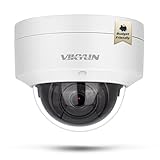
Overview: The VIKYLIN 4K PoE Dome Camera targets professional and security-conscious users requiring robust, reliable surveillance. This vandal-proof, NDAA-compliant camera delivers high-quality footage through Power over Ethernet connectivity, making it ideal for commercial and residential installations demanding compliance and durability without wireless vulnerabilities.
What Makes It Stand Out: The IK10 vandal-proof rating and IP67 weatherproofing ensure survival in harsh environments and intentional damage attempts. H.265+ compression technology reduces storage needs by 83% while maintaining 4K clarity. NDAA compliance meets federal security standards, crucial for government contracts and security-sensitive applications. The 2.8mm lens provides a 112° wide-angle view with 98ft night vision range and built-in mic for audio recording.
Value for Money: At $52.44, this professional-grade camera offers exceptional value for users with existing PoE infrastructure. The price point makes high-end features accessible, though installation costs may increase for those requiring new wiring or NVR systems, which should be factored into the total investment.
Strengths and Weaknesses: Strengths include NDAA compliance, vandal-proof design, efficient H.265+ encoding, wide compatibility with third-party NVRs, and professional build quality. Weaknesses are the lack of PTZ functionality, no wireless option, and requirement for PoE infrastructure, limiting DIY appeal for average homeowners.
Bottom Line: Best suited for business owners and security professionals needing compliant, tamper-resistant surveillance. Homeowners should consider installation complexity before purchasing, as it requires technical networking knowledge.
10. IMILAB EC6 Pro 4K Wired Outdoor Security Camera, 5GHz WiFi Plug-in Outdoor Camera for Home Security w/Spotlight, 360° Rotation, Free Detect & Tracking, Waterproof, 24/7 Local Recording, No Monthly Fee

Overview: The IMILAB EC6 Pro 4K Wired Outdoor Security Camera delivers premium performance with advanced AI capabilities and smooth video capture. This plug-in camera combines true 4K resolution at 25fps with comprehensive detection features, creating a robust security solution for discerning homeowners who prioritize continuous operation and intelligent monitoring.
What Makes It Stand Out: The free AI detection system recognizes people, vehicles, pets, bicycles, and even smoke/fire without subscription fees—a remarkably comprehensive package. The motion-activated spotlight provides active deterrence, while custom voice message upload allows personalized warnings. Dual-band WiFi and Ethernet connectivity ensure flexible installation with stable streaming, and 360° rotation covers entire areas without blind spots.
Value for Money: At $89.99, the EC6 Pro sits at the higher end of consumer cameras but justifies the price through smooth 25fps recording, advanced AI detection, and no required subscriptions. The feature set rivals cameras costing significantly more, making it a smart long-term investment that eliminates ongoing fees.
Strengths and Weaknesses: Strengths include true 4K at 25fps, extensive free AI detection, spotlight deterrence, flexible connectivity, and local recording without fees. Weaknesses include the plug-in power requirement (no battery backup) and higher price point compared to basic 4K models lacking advanced features.
Bottom Line: An excellent choice for users wanting advanced AI features and smooth video without ongoing costs. The plug-in design ensures continuous operation, making it ideal for primary entry points and critical monitoring zones.
Why 4K Resolution Changes the LPR Equation
The leap to 4K isn’t just about having more pixels—it’s about pixel density where it matters most. A license plate typically measures 12 inches wide, and at 100 feet, a 1080p camera delivers roughly 12 pixels per inch (PPI) on that plate. That’s barely enough to differentiate a “B” from an “8.” A true 4K sensor quadruples that density to 48 PPI, transforming guesswork into forensic-grade evidence.
This resolution bump also enables digital zoom without catastrophic quality loss. When your camera’s optical focal length can’t perfectly frame every approach angle, those extra pixels become your safety net. You can crop into the plate region during post-incident review and still extract readable characters, something that’s mathematically impossible with lower-resolution sensors.
Understanding the Unique Challenges of Outdoor License Plate Capture
The Speed Factor
Vehicles don’t pose politely for their photos. At 30 mph, a car covers 44 feet per second. Your camera’s shutter speed must freeze motion faster than a hummingbird’s wings—typically 1/2000th of a second or quicker—to avoid motion blur that turns “ABC123” into an abstract painting. This requirement fundamentally conflicts with the need to gather enough light for night operation, creating one of the central engineering challenges in LPR design.
Lighting Extremes and Headlight Overexposure
Standard cameras designed for general surveillance treat headlights as a nuisance to be managed. LPR cameras must treat them as a primary adversary. A typical headlight beam can exceed 100,000 lumens, completely washing out the reflective surface of a license plate if the camera’s sensor and image processing pipeline aren’t specifically engineered for this scenario. The problem intensifies with modern LED and laser headlights that create pinpoint hotspots rather than diffuse glare.
Weather and Environmental Variables
Rain doesn’t just obscure lenses—it transforms license plates into mirrors that reflect infrared illumination directly back at the camera. Snow accumulation can reduce plate contrast by 70%. Fog refracts light and scatters IR wavelengths differently than visible light. A camera that performs perfectly on a clear Tuesday afternoon might fail catastrophically during a Friday night thunderstorm if its environmental compensation systems are inadequate.
Key Optical Features That Separate Winners from Losers
Purpose-Built LPR Lenses
Forget the varifocal zoom lenses found on general-purpose cameras. Premium LPR systems employ fixed-focal-length lenses with focal lengths specifically matched to installation distance. A 50mm lens at 75 feet delivers optimal plate width in the frame. These lenses feature superior glass quality, multi-layer anti-reflective coatings, and precision apertures that maintain sharpness from edge to edge—critical when plates appear in the corner of the frame.
Manual Iris Control for Consistent Exposure
Auto-iris lenses, standard in most security cameras, constantly adjust to changing light conditions, creating exposure inconsistencies that confuse OCR algorithms. Professional LPR cameras lock the iris at installation, using digital gain and shutter speed adjustments to manage lighting changes. This maintains consistent plate illumination characteristics that machine learning models expect, boosting recognition accuracy from 85% to over 98% in variable conditions.
Optical Filters and IR Pass-Through
The best 4K LPR cameras incorporate dual-filter systems. During daylight, a specialized cut filter blocks infrared light that would otherwise create chromatic aberrations and reduce contrast. At night, this filter mechanically retracts, allowing synchronized infrared illumination to pass through cleanly. The filter transition timing and speed become crucial—too slow, and you lose plates during twilight transitions.
Low-Light Performance: Beyond Basic Infrared
Starlight Sensor Technology
2026’s leading sensors achieve full-color imaging at 0.001 lux—roughly the light of a single candle at 30 feet. For LPR applications, this matters because color recognition helps eliminate false positives. A blue plate from Delaware has different reflectivity characteristics than a white New York plate. Starlight sensors preserve these color cues far longer into dusk than conventional sensors, extending reliable capture windows by 45 minutes during critical transition periods.
Adaptive Infrared Illumination
Static IR illumination creates hot spots on reflective plates and leaves dark shadows in recessed characters. Next-generation systems use pulsed IR with millisecond-level timing adjustments synchronized to the camera’s rolling shutter. They also employ beam-shaping optics that create uniform illumination across the capture zone rather than a circular spotlight pattern. The wavelength matters too—850nm provides better range, while 940nm is nearly invisible to the naked eye, reducing vandalism risk.
Wide Dynamic Range (WDR) and Highlight Compensation
True LPR cameras deploy WDR differently than standard models. Instead of balancing shadows and highlights across the entire scene, they apply localized tone mapping specifically to the plate region. Highlight Compensation (HLC) algorithms detect and mask headlight blooms at the pixel level, effectively “burning in” the plate area to preserve character definition. The best implementations achieve 140dB dynamic range with plate-specific exposure zones.
Intelligent Video Analytics and AI Integration
Edge-Based vs. Cloud-Based Processing
Running OCR on the camera itself (edge processing) reduces latency to under 50ms and eliminates bandwidth costs for streaming raw 4K video. However, cloud-based AI leverages more powerful neural networks that continuously improve through fleet-wide learning. The sweet spot? Hybrid architectures that perform initial plate localization and pre-processing at the edge, then send cropped plate images to the cloud for final character recognition and database matching.
Machine Learning Model Training Data
Generic OCR fails miserably on license plates because fonts, layouts, and reflectivity vary wildly across 50 states and international jurisdictions. Purpose-built LPR cameras run models trained on millions of actual plate images captured in rain, snow, and varying angles. Ask vendors about their training dataset diversity—if they can’t specify how many unique plates their model has seen, you’re buying generic software repackaged as LPR.
False Positive Reduction Through Contextual Analysis
Modern systems don’t just read characters—they validate them. AI cross-references plate format against known state patterns, validates check digits where applicable, and tracks vehicle trajectory to confirm the same plate appears consistently across multiple frames. This contextual filtering reduces false reads by up to 92% compared to character-matching-only systems, preventing “L” from becoming “1” in your database.
Storage and Bandwidth Optimization Strategies
H.266 Codec Implementation
4K at 30fps generates 1.5 Gbps of raw data—utterly unmanageable. While H.265 cut this by 50%, 2026’s H.266 (Versatile Video Coding) achieves another 40% reduction without quality loss. For a 10-camera deployment, this translates to 120 TB less storage annually. Critically, H.266 includes region-of-interest encoding that allocates higher bitrates to the plate area while compressing background sky and pavement more aggressively.
Edge Storage as a Reliability Layer
Cloud dependency creates vulnerability. Leading systems include redundant edge storage—typically 256GB to 1TB of industrial-grade NAND flash—that buffers footage during network outages. When connectivity restores, the system uploads only the plate metadata and associated video clips, not hours of useless footage. This architecture cuts cloud storage costs by 80% while ensuring zero data loss.
Bitrate Budgeting for Multi-Stream Output
Sophisticated LPR cameras output multiple streams simultaneously: a full 4K stream for overview recording, a cropped 1080p stream focused on the plate, and a low-bitrate thumbnail stream for mobile viewing. Proper bitrate allocation might assign 8 Mbps to the 4K stream, 4 Mbps to the plate crop, and only 512 Kbps to the thumbnail. This tiered approach optimizes both quality and bandwidth across different use cases.
Power and Connectivity Infrastructure
Power-over-Ethernet++ (PoE++) Standards
Standard PoE+ delivers 30 watts, insufficient for 4K sensors, motorized IR illuminators, and heaters. PoE++ (IEEE 802.3bt) provides up to 90 watts, enabling single-cable installation. More importantly, it supports power management protocols that prioritize camera operation during brownouts, gracefully shutting down non-essential functions like IR heaters while maintaining core capture capabilities.
5G and Hybrid Cellular Backup
Wired connections fail. Modern LPR cameras include integrated 5G modems with dual-SIM support, automatically failing over to cellular when Ethernet drops. The key is intelligent data throttling—cellular mode streams only plate metadata and low-res verification images, not full 4K video. This keeps monthly data costs under $15 per camera while maintaining 99.9% uptime.
Solar and Battery Hybrid Systems
For remote installations, 2026’s solar LPR systems pair 200W panels with lithium iron phosphate batteries providing 5 days of autonomy. The critical innovation is power-aware operation: during low-light winter months, the camera automatically reduces frame rate from 30fps to 15fps and narrows the detection zone, cutting power consumption by 60% while maintaining capture reliability.
Weatherproofing and Durability Standards
IP Rating Decoded for Real-World Conditions
IP67 means dust-tight and survives 30 minutes of immersion—nice, but irrelevant for most installations. IP66 with IP69K is the gold standard, handling high-pressure, high-temperature water jets from any direction. This matters because pressure washers used for building maintenance can force water past seals rated only for rain. Look for cameras tested to MIL-STD-810G for shock and vibration resistance.
Corrosion Resistance in Coastal Applications
Salt spray destroys standard aluminum housings in 18 months. Marine-grade LPR cameras use 316 stainless steel or powder-coated die-cast housings with passivated electronics. Internal components receive conformal coating—think of it as waterproof sunscreen for circuit boards. These measures extend operational life from 2 years to 10+ in corrosive environments.
Active Temperature Management
In Phoenix summers, internal camera temperatures exceed 160°F without mitigation. Peltier-effect thermoelectric coolers actively pump heat away from the image sensor, while silicone thermal pads transfer heat to the metal housing acting as a radiator. In arctic conditions, heaters consume more power than the camera itself. The best systems use adaptive heating that pre-warms the lens and sensor before they reach dew point, preventing ice formation rather than melting it.
Installation and Positioning Best Practices
The 15-Degree Rule for Capture Angles
Mount your camera between 15 and 30 degrees off the vehicle’s path. Shallower than 15 degrees, and headlights blind the sensor. Steeper than 30 degrees, and you create perspective distortion that compresses character spacing, confusing OCR algorithms. The optimal height is 8-12 feet, positioning plates in the upper third of the frame where lens distortion is minimal.
Eliminating Motion Blur with Shutter-Angle Syncing
For LPR, shutter speed isn’t chosen in isolation—it’s synchronized to vehicle speed using the “shutter angle” concept from cinema. At 30 mph, a 1/2000s shutter captures a plate moving 0.02 inches during exposure, creating razor-sharp characters. Advanced cameras auto-calculate this based on detected motion vectors, dynamically adjusting shutter speed as vehicles accelerate or decelerate through the capture zone.
Multi-Camera Triangulation Strategies
Single-camera LPR fails when plates are obscured by trailer hitches, bike racks, or damaged plates. Dual-camera setups positioned 20 feet apart at different angles capture the plate from multiple perspectives. AI fusion algorithms compare reads from both cameras in real-time, selecting the highest-confidence result or combining partial reads into a complete plate. This approach boosts accuracy from 95% to 99.7% in challenging conditions.
Legal and Privacy Compliance Framework
Data Retention and Minimization Laws
California’s CCPA and similar regulations treat license plate data as personal information requiring explicit consent. The legal safe harbor? Automatic deletion after 30 days unless tied to an active investigation. Leading camera systems include built-in retention policies that cryptographically shred data after the statutory period, providing audit trails that demonstrate compliance during regulatory reviews.
Privacy by Design in Hardware
Forward-thinking manufacturers now include physical privacy shutters that close when the camera enters “privacy mode” during non-enforcement hours. Some embed LED indicators that illuminate when actively capturing, providing transparency to the public. Geofencing capabilities automatically disable recording when vehicles exit the target area, preventing inadvertent surveillance of public roads beyond your property line.
Chain of Custody for Admissible Evidence
For law enforcement use, video integrity must be verifiable in court. Look for cameras with hardware-based digital watermarking that embeds an encrypted signature in each frame. This signature includes timestamp, GPS coordinates, and camera serial number, creating a tamper-evident chain of custody. Any post-capture editing invalidates the watermark, making the evidence inadmissible—a feature, not a bug, in proper legal frameworks.
Integration with Existing Security Ecosystems
ONVIF Profile M for Metadata Streaming
ONVIF Profile M standardizes how LPR metadata—plate number, state, confidence score, timestamp—streams to Video Management Systems (VMS). This enables unified search: “Show me all videos where plate ABC123 entered between 10 PM and 2 AM.” Without Profile M, you’re stuck with proprietary integrations that break when you upgrade your VMS. Verify compliance before purchase; many claim ONVIF support but implement only video streaming, not metadata.
API Access for Custom Applications
Your LPR camera should expose RESTful APIs that let you build custom workflows. Trigger a gate opener when a delivery truck’s plate matches your whitelist. Send Slack alerts when a flagged vehicle enters. The API should support webhooks for real-time events and include comprehensive documentation with code samples. Beware of vendors who charge extra for API access—it’s a standard feature in enterprise-grade equipment.
Access Control and PSIM Synergy
Modern Physical Security Information Management (PSIM) platforms treat LPR cameras as sensors, not just video sources. When a plate read occurs, the PSIM correlates it with badging data, video analytics, and threat intelligence feeds. If a stolen vehicle plate is detected, the system can automatically lock doors, alert security, and pull up all associated cameras—transforming passive recording into active defense.
Maintenance and Long-Term Reliability
Automated Health Monitoring Protocols
Manual inspection of cameras is impractical at scale. Advanced systems run daily self-tests: they capture a test pattern, analyze image quality metrics (sharpness, contrast, noise), and alert you if performance degrades below thresholds. They monitor IR illuminator output with photodiodes, detecting when LED arrays dim to 70% of original intensity—a precursor to failure that triggers proactive replacement alerts.
Lens Cleaning and Debris Management
A single water droplet can diffract IR illumination into a useless rainbow. Hydrophobic lens coatings cause water to bead and roll off. Some systems include ultrasonic transducers that vibrate the lens cover at 30 kHz, shaking off dust and dew. For heavy snow regions, optional lens heaters consume minimal power while maintaining a 2-degree temperature offset above ambient, preventing accumulation without creating a warm spot that attracts insects.
Firmware Update Strategies
LPR algorithms improve continuously, but updates can introduce regression bugs. The best systems support A/B firmware slots, allowing you to test new versions on a single camera before fleet-wide deployment. They also include rollback capabilities—if a new firmware drops recognition accuracy, the camera automatically reverts to the previous version after detecting sustained performance degradation.
Cost vs. Value Analysis
Total Cost of Ownership Over Five Years
A $800 LPR camera that fails after two years costs more than a $2,000 camera lasting ten. Factor in installation labor ($300-500 per camera), VMS licensing ($50/year per channel), and storage costs ($120/TB annually). A budget camera requiring three replacements over five years totals $3,400; a premium unit totals $2,650. Do the math before chasing the lowest bid.
Hidden Costs in Bandwidth and Storage
A 4K LPR camera streaming continuously at high bitrate can consume 3 TB monthly. At $0.02 per GB cloud storage, that’s $720/year per camera. Smart systems with motion-activated recording and edge storage reduce this to $120/year. Always calculate storage costs based on your actual retention policy, not the vendor’s optimistic estimates.
ROI Through Operational Efficiency
A retail distribution center using LPR to automate gate operations processes 200 trucks daily. Manual check-in takes 3 minutes per truck; automated LPR reduces this to 15 seconds. At $25/hour labor costs, that’s $21,250 in annual savings per gate—paying for premium cameras in under six months. Factor in reduced theft (plates linked to cargo) and insurance discounts (verified surveillance), and ROI often exceeds 300% annually.
Future-Proofing Your 2026 Investment
Modular Design for Technology Upgrades
Camera bodies should last a decade; sensors and processors become obsolete in three years. Look for modular systems where the image sensor block, IR illuminator, and processing unit are field-replaceable. This allows upgrading from 4K to 8K sensors in 2028 without re-installing mounts or re-cabling—a $400 upgrade versus a $2,500 full replacement.
Scalability from Single Camera to Enterprise
Start with two cameras today, but ensure your choice scales to 200 without requiring forklift upgrades. The system should support hierarchical management—cameras feed to site servers, which aggregate to regional dashboards, culminating in a global command center. Proprietary systems often hit a wall at 50 cameras; open-architecture solutions based on Docker containers and Kubernetes orchestration scale infinitely.
Quantum-Resistant Encryption Coming
NIST has standardized quantum-resistant encryption algorithms. Forward-looking manufacturers are already implementing these in firmware, protecting plate data against future quantum computing attacks that could break today’s RSA encryption. This isn’t theoretical—data harvested today can be decrypted tomorrow. Ask vendors about their post-quantum cryptography roadmap.
Frequently Asked Questions
1. Can I use a regular 4K security camera for license plate capture, or do I need a specialized LPR camera?
Regular 4K cameras lack the specialized image processing, shutter speed control, and infrared synchronization required for reliable plate reading. While they might capture readable plates on slow-moving vehicles during perfect daylight, they’ll fail consistently at night, in bad weather, or with fast-moving traffic. LPR cameras are engineered specifically to overcome these challenges with hardware and firmware optimizations that general-purpose cameras simply don’t include.
2. What’s the realistic maximum distance for accurate plate capture with a 4K LPR camera?
With a properly matched lens and ideal conditions (daylight, vehicle speed under 20 mph, optimal angle), you can achieve 99%+ accuracy at 150 feet. Real-world performance typically maxes out around 100 feet for reliable reads across all conditions. Beyond that, atmospheric haze, lens limitations, and IR illumination fall-off create diminishing returns. For distances over 100 feet, consider dual-camera setups or higher focal length lenses specifically calibrated for long-range capture.
3. How much bandwidth does a 4K LPR camera actually consume?
During active capture, expect 8-12 Mbps using H.266 encoding. However, with smart streaming that activates only when motion is detected in the plate capture zone, average 24-hour bandwidth drops to 2-3 Mbps. A 10-camera system transmitting only metadata and event clips to the cloud uses roughly 1 TB monthly, versus 30 TB for continuous streaming. Always implement traffic shaping on your network to prioritize LPR data during peak hours.
4. Are there legal restrictions on where I can point an LPR camera?
Yes, and they’re tightening. You can generally point cameras at your own property and public areas adjacent to it, but capturing plates on a public road 100 feet away may violate privacy laws depending on your jurisdiction. California, Virginia, and Maine require explicit consent for private LPR use. Always consult local ordinances and implement geofencing to automatically disable capture beyond your property boundary. Posting clear signage about LPR usage is both a legal requirement in many areas and a best practice everywhere.
5. How do I prevent my LPR camera from being blinded by headlights?
This requires a three-layer approach: First, hardware-based Highlight Compensation (HLC) masks the brightest pixels in real-time. Second, a fast electronic shutter (1/2000s or faster) limits light accumulation during exposure. Third, synchronized IR illumination with a visible-light cut filter ensures the plate is lit by IR while headlights are filtered out. No single feature solves this; it’s the precise orchestration of all three that makes night capture possible.
6. What maintenance do 4K LPR cameras require in harsh climates?
Monthly lens cleaning with isopropyl alcohol and microfiber cloths is essential—more frequent in dusty or coastal areas. Quarterly inspection of seals and gaskets prevents moisture ingress. Firmware updates should be applied semi-annually, but only after testing on a non-critical camera. In regions with heavy snow, check heater functionality before winter. The best systems automate most health checks, alerting you only when intervention is needed, reducing manual maintenance to 30 minutes per camera annually.
7. Can LPR cameras read temporary paper plates or damaged plates?
Modern AI-based systems read temporary plates with 70-85% accuracy, significantly lower than standard plates but still useful. Success depends on contrast and character clarity—faded temp plates are often unreadable. For damaged plates, multi-frame analysis helps: if three frames show “ABC_23” and two show “ABC123,” the system infers the missing character. However, severe damage or plates bent more than 15 degrees often remain unreadable, which is why multiple camera angles are recommended for critical applications.
8. How does extreme cold or heat affect 4K LPR performance?
Consumer-grade cameras operate reliably between -4°F and 122°F. Industrial LPR cameras function from -40°F to 158°F through active heating and cooling. Below -4°F, LCD displays in the camera may freeze (though capture continues). Above 140°F, image sensors generate excessive noise, reducing accuracy. The sweet spot is maintaining internal temperature between 32°F and 95°F, which quality systems achieve through thermostatic control that activates heating or cooling as needed.
9. What’s the difference between LPR and ANPR, and which do I need?
LPR (License Plate Recognition) refers to the camera and software that captures and reads plates. ANPR (Automatic Number Plate Recognition) is the broader system that includes database lookup, alerting, and integration with enforcement or access control. You need LPR hardware first; ANPR is the application layer built on top. Some vendors conflate the terms, but the distinction matters when specifying requirements—ensure you’re not paying for ANPR software if you only need raw plate capture.
10. How future-proof is a 4K LPR camera purchased in 2026?
Expect the physical camera housing and optics to last 7-10 years. The image sensor and processor will feel outdated in 3-4 years as 8K becomes standard and AI models evolve. Modular designs allow sensor upgrades for $400-600 versus full replacement. Firmware support typically lasts 5 years from purchase; after that, security vulnerabilities may emerge. Budget for a technology refresh in 2029-2030, but a quality 2026 camera will remain functional and supported through at least 2031 if properly maintained.