Waking up with watery eyes, a scratchy throat, and that familiar congestion isn’t just a seasonal nuisance—it’s your body sounding the alarm about the invisible invaders floating through your home. For the 50 million Americans battling allergies daily, the air inside their sanctuaries can be up to five times more polluted than outdoor air. Smart air quality monitors have evolved from niche gadgets into essential health tools, transforming how we detect, understand, and combat the microscopic triggers lurking in our living spaces. As we look toward 2026, these devices are becoming more sophisticated, offering real-time insights that empower you to take control of your indoor environment before your sinuses pay the price.
But not all air quality monitors are created equal, especially when your primary goal is allergy relief. The market is flooded with sensors promising crystal-clear air data, yet many miss the specific pollutants that make you sneeze. Whether you’re sensitive to pollen, dust mites, pet dander, mold spores, or volatile chemicals, understanding what to look for in a smart monitor can mean the difference between genuine relief and another year of trial-and-error suffering. This comprehensive guide cuts through the marketing noise to focus on the features, technologies, and considerations that truly matter for allergy sufferers.
Top 10 Smart Air Quality Monitors for Allergy Relief
Detailed Product Reviews
1. Amazon Smart Air Quality Monitor – Know your air, Works with Alexa

Overview: The Amazon Smart Air Quality Monitor delivers essential indoor air quality tracking through the Alexa ecosystem. This compact device monitors five critical factors: particulate matter (PM 2.5), volatile organic compounds (VOCs), carbon monoxide (CO), humidity, and temperature. Designed for seamless integration with Alexa-enabled homes, it provides real-time insights via a color-coded LED indicator and detailed metrics in the Alexa app.
What Makes It Stand Out: Its native Alexa integration sets it apart from competitors. The monitor automatically triggers routines based on air quality changes, activating compatible air purifiers, dehumidifiers, or fans without manual intervention. Users receive proactive notifications on their phones or through Echo devices when air quality degrades, enabling immediate action. The intuitive color-coded LED provides at-a-glance status, while the Alexa app offers deeper analysis and historical trends.
Value for Money: At $69.99, this monitor sits in the sweet spot for smart home enthusiasts. While basic standalone monitors cost less, none offer this level of ecosystem integration. The ability to automate device responses justifies the premium over non-smart alternatives, potentially saving energy and improving health outcomes.
Strengths and Weaknesses: Strengths include effortless Alexa integration, automated routines, comprehensive alerts, and trusted brand reliability. The compact design blends into any room. Weaknesses are its reliance on the Alexa ecosystem (no standalone app), limited to five metrics, and lack of portability—it requires constant power. Users without Alexa will find limited functionality.
Bottom Line: Perfect for Alexa households wanting automated air quality management. It transforms data into action, making it worth every penny for smart home devotees seeking hands-free air quality control.
2. Professional Indoor Air Quality Monitor with AQI Beep Alarms, Portable Real-Time Detector for Home Cars Plants and Pets (White)
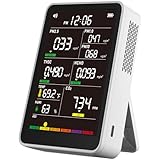
Overview: This professional-grade monitor offers comprehensive air quality analysis with 16-in-1 detection capabilities. It tracks PM1.0, PM2.5, PM10, CO2, TVOC, HCHO, temperature, and humidity, plus seven AQI alert functions. The device features a high-precision sensor system that updates every three seconds, displaying data on a crisp HD color screen.
What Makes It Stand Out: The sheer breadth of metrics makes this a standout for serious air quality monitoring. Unlike consumer-grade options, it detects formaldehyde (HCHO) and provides granular particulate matter readings across three size ranges. The one-button operation with double-click silencing simplifies use, while the portable design with 4-5 hour battery life enables testing anywhere—from homes to cars to campsites.
Value for Money: At $139.99, this is a significant investment. However, for users with health sensitivities, new homes, or workplace safety concerns, the professional-level accuracy and comprehensive data justify the cost. It replaces multiple single-function detectors, offering better value than buying separate devices for each pollutant.
Strengths and Weaknesses: Strengths include extensive metric coverage, high-precision sensors, portability, fast refresh rate, and stylish design. The 12-month warranty provides peace of mind. Weaknesses are the premium price point, limited battery life requiring frequent charging, and potentially overwhelming data for casual users who just need basic PM2.5 and CO2 tracking.
Bottom Line: Ideal for health-conscious individuals, new homeowners, or professionals needing detailed air quality analysis. The comprehensive monitoring capabilities make it worth the investment for those who need more than basic metrics.
3. GoveeLife Smart Air Quality Monitor with PM2.5, WiFi, Temperature & Humidity Sensors, LED Display, 2s Refresh, 2-Year Data Storage, for Home & Office Wired

Overview: The GoveeLife Smart Air Quality Monitor provides focused monitoring of three key indoor air quality indicators: PM2.5, temperature, and humidity. With a rapid two-second refresh rate and high accuracy ratings (±15 µg/m³ for PM2.5), this wired device delivers real-time data through its LED display and companion app. The unit also functions as a clock when connected to 2.4G WiFi.
What Makes It Stand Out: Its lightning-fast two-second data correction is among the quickest in its price class, providing near-instant feedback on air changes. The switchable display modes—standard and night mode—adapt to different lighting conditions. Most compelling is its seamless integration with GoveeLife appliances, enabling automatic activation of air purifiers, humidifiers, and fans based on detected conditions.
Value for Money: At $39.99, this monitor offers exceptional value. Few competitors under $40 provide smart home automation capabilities. While it tracks fewer metrics than premium models, its targeted approach covers the most critical indoor pollutants. The two-year data storage adds long-term value for trend analysis.
Strengths and Weaknesses: Strengths include rapid refresh rate, affordable pricing, smart home integration, dual clock function, and adjustable brightness modes. The wired design ensures continuous operation. Weaknesses are the limited three-metric coverage (no CO2 or VOCs), requirement for constant power, and ecosystem lock-in with GoveeLife devices for full automation benefits.
Bottom Line: An excellent budget-friendly choice for users invested in the GoveeLife ecosystem. It prioritizes speed and essential metrics over comprehensive coverage, making it perfect for bedrooms and offices where PM2.5 is the primary concern.
4. LEVOIT Air Purifier for Home Large Room Up to 1073Ft² with Air Quality Monitor, AHAM VERIFIDE, Smart WiFi, Washable Pre-Filter, HEPA Sleep Mode for Pets, Allergies, Dust, Pollen, Vital 100S-P, White

Overview: The LEVOIT Vital 100S-P combines powerful air purification with integrated monitoring in one sleek unit. AHAM VERIFIDE certified, it purifies air 4.8 times per hour in 222 sq ft rooms and once per hour in spaces up to 1,073 sq ft. The three-stage filtration system captures 99.97% of ultrafine particles as small as 0.1-0.3μm, including pollen, dust, and pet dander.
What Makes It Stand Out: This is an air purifier first, monitor second—a crucial distinction. The Pet Mode specifically addresses pet owners’ needs, using a wide U-shaped inlet to trap fur while conserving energy. The HEPA Sleep Mode with light detection automatically dims displays and quiets operation in darkness, making it ideal for bedrooms. Smart WiFi connectivity enables remote control and scheduling via the Vesync app.
Value for Money: At $113.95, it competes with standalone purifiers while adding monitoring capabilities. The AHAM certification ensures tested performance, justifying the price over uncertified competitors. Factor in the washable pre-filter reducing replacement costs, and the value increases. It’s essentially a premium purifier with monitoring included, not a monitor with basic purification.
Strengths and Weaknesses: Strengths include certified purification performance, large coverage area, pet-specific features, ultra-quiet sleep mode, and smart controls. The washable pre-filter extends filter life. Weaknesses are its size (less portable), ongoing filter replacement costs, and limited monitoring metrics compared to dedicated monitors.
Bottom Line: Perfect for pet owners and allergy sufferers needing proven air purification with basic monitoring. The certification and pet-specific features make it a worthwhile investment for improving air quality rather than just measuring it.
5. GoveeLife Smart Air Quality Monitor for Home, CO2 Detector for Health, Sleep Quality & Energy Efficiency, Thermometer Hygrometer with Real-Time Display & Alarm, for Office, Bedroom, Kitchen
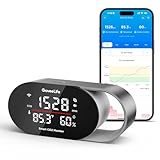
Overview: This specialized GoveeLife monitor focuses on CO2 detection using a high-precision SCD4x sensor with photoacoustic NDIR technology. It tracks four essential metrics: CO2 levels, temperature, humidity, and time. With a five-second refresh rate and ±(40ppm + 5%) accuracy, plus built-in pressure compensation for altitude adjustments, it provides reliable data for health and energy efficiency optimization.
What Makes It Stand Out: The triple alert system is exceptional—combining a built-in buzzer, instant app notifications, and detailed email reports when thresholds are exceeded. This multi-channel approach ensures critical alerts aren’t missed. The customizable LED display automatically adjusts brightness based on day/night schedules set in the app, eliminating sleep disruption. Two years of data storage with CSV export capability supports medical consultations and energy analysis.
Value for Money: At $59.98, it offers professional-grade CO2 monitoring at a consumer price point. The comprehensive alert system and data export features typically cost significantly more. For households concerned about stuffiness, sleep quality, or productivity, the investment pays dividends through improved ventilation timing and health outcomes.
Strengths and Weaknesses: Strengths include highly accurate CO2 sensing, triple-layer alerts, customizable display brightness, extensive data history, and pressure compensation for accuracy at any altitude. Weaknesses are the lack of PM2.5 or VOC detection, requiring a separate monitor for complete air quality assessment, and reliance on the app for full functionality.
Bottom Line: Essential for bedrooms, offices, and classrooms where CO2 buildup affects performance and health. The alert system and data tracking make it invaluable for optimizing ventilation and monitoring sleep environments.
6. Qingping Air Quality Monitor Gen 2, Air Quality Monitor Indoor Detects PM2.5, CO2, PM10, Noise, Temperature and Humidity, New Upgraded Alarm Clock Function, Air Quality Tester for Bedroom, Smart Home

Overview: The Qingping Air Quality Monitor Gen 2 is a sophisticated indoor environmental station tracking seven critical metrics: PM2.5, CO2, PM10, temperature, humidity, eTVOC, and noise levels. This second-generation device distinguishes itself with an integrated alarm clock function, making it particularly suited for bedroom deployment. The 4-inch IPS touchscreen provides at-a-glance readability with color-coded indicators, while dual-band Wi-Fi connectivity enables remote monitoring through the Qingping+ app.
What Makes It Stand Out: The replaceable PM sensor design is genuinely innovative, using magnetic attachment for effortless maintenance and future-proofing the device against sensor degradation. The high-resolution display (254 PPI) automatically adjusts brightness, while the comprehensive metric suite—including noise monitoring—offers a holistic environmental picture. Dual-band Wi-Fi support (2.4GHz and 5GHz) ensures robust connectivity uncommon in this category.
Value for Money: At $149.99, this monitor commands a premium justified by build quality and longevity. The replaceable sensor design reduces long-term ownership costs compared to disposable units. While pricier than basic monitors, its alarm clock integration eliminates the need for a separate bedside device, partially offsetting the investment for bedroom users.
Strengths and Weaknesses: Strengths include the vibrant touchscreen, replaceable sensor architecture, dual-band Wi-Fi, comprehensive environmental tracking, and practical alarm functionality. Critical weaknesses include the inability to detect formaldehyde, mandatory USB power connection (only 3-hour battery life), and absence of an included power adapter. The Qingping+ app provides 30 days of historical data but lacks broader smart home ecosystem integration.
Bottom Line: The Qingping Gen 2 excels as a permanent-installation bedroom monitor where it can remain powered. Its replaceable sensor and comprehensive metrics make it a sound long-term investment for health-conscious users who prioritize build quality over basic functionality and already own a USB power adapter.
7. Temtop Smart Air Quality Monitor - Indoor Air Quality Meter with PM2.5, AQI, Temperature and Humidity Detector for Home, Office or School, App Connectivity, OTA Updates, 60-Day Battery Life

Overview: The Temtop Smart Air Quality Monitor is an entry-level focused device that concentrates on essential air quality indicators: PM2.5, AQI, temperature, and humidity. Engineered for simplicity and maximum portability, this compact unit delivers reliable monitoring without complexity. Its standout feature is an extraordinary 60-day battery life, enabling true cordless operation and positioning it as a hassle-free solution for multi-room or on-the-go air quality awareness.
What Makes It Stand Out: The 60-day battery endurance is category-leading, eliminating frequent recharging and enabling placement anywhere without power outlet constraints. Designed in the USA, it emphasizes user experience with an easy-to-read display and instant feedback through color indicators and audible alerts when thresholds are exceeded. App notifications provide proactive warnings without requiring constant visual monitoring.
Value for Money: At $39.99, this monitor delivers exceptional accessibility to air quality monitoring. The extended battery life reduces environmental waste and replacement costs associated with frequent charging or disposable batteries. While limited to four metrics, it covers the most critical pollutants affecting health, offering tremendous value for budget-conscious consumers or first-time buyers.
Strengths and Weaknesses: Strengths include remarkable battery longevity, true portability, clear visual and audible alerts, OTA update capability, and unbeatable affordability. App connectivity adds modern convenience. Weaknesses include limited sensor range (no CO2, VOCs, or formaldehyde), basic display resolution, and potentially lower sensor precision than laboratory-grade alternatives. Battery performance may degrade in highly polluted environments requiring frequent sampling.
Bottom Line: The Temtop monitor is an ideal starter device for those prioritizing simplicity, portability, and PM2.5 tracking. Its battery life and price point make it perfect for renters, teachers, or travelers needing basic but reliable air quality awareness without advanced features or permanent installation requirements.
8. LEVOIT Air Purifiers for Home Large Room Up to 1875 Ft² with Washable Pre-Filter, AHAM VERIFIDE, Air Quality Monitor, HEPA Sleep Mode for Allergies, Pet Hair in Bedroom, Vital 200S-P, White

Overview: The LEVOIT Vital 200S-P is a high-performance air purifier engineered for large spaces up to 1875 square feet, combining true HEPA filtration with integrated air quality monitoring. Independently certified by AHAM, this unit delivers verified Clean Air Delivery Rates for smoke, dust, and pollen. Specifically designed for allergy sufferers and pet owners, it features a washable pre-filter to extend main filter life while capturing larger particles like pet hair.
What Makes It Stand Out: AHAM VERIFIDE certification provides independently tested performance validation with CADR ratings of 250 (smoke), 254 (dust), and 289 (pollen) CFM—figures backed by rigorous ANSI standards. The innovative U-shaped air inlet complements the traditional intake, dramatically increasing airflow while preventing pet hair clogging. Sleep mode operates whisper-quiet for undisturbed rest.
Value for Money: At $159.93, the Vital 200S-P offers professional-grade purification at a consumer price point. AHAM certification justifies the premium over uncertified competitors by guaranteeing advertised performance. The washable pre-filter reduces ongoing maintenance costs, while integrated air quality monitoring eliminates separate device purchases. For large-room allergy relief, it represents compelling long-term value.
Strengths and Weaknesses: Strengths include verified high CADR ratings, extensive coverage area, anti-clogging dual inlet design, washable pre-filter, ultra-quiet sleep mode, and built-in air quality feedback. Weaknesses include higher replacement filter costs, substantial footprint requiring dedicated floor space, and limited smart home integration compared to Wi-Fi-enabled competitors. The unit’s power may exceed needs for small rooms.
Bottom Line: The LEVOIT Vital 200S-P is an outstanding choice for allergy sufferers requiring proven large-room purification. Its AHAM certification ensures trustworthy performance, while the washable pre-filter and integrated monitoring enhance practicality. Invest in this unit if you need serious allergen removal rather than simple air quality tracking.
9. 18-in-1 Smart Air Quality Monitor - Indoor WiFi Air Quality Detector with Dual Chip, Real-Time for AQI, CO2, PM2.5, PM1.0, PM10, TVOC, HCHO, Time Display, Temperature & Humidity with APP (White-White)

Overview: This 18-in-1 Smart Air Quality Monitor delivers exhaustive environmental tracking including AQI, CO2, three particle sizes (PM1.0/2.5/10), TVOC, HCHO (formaldehyde), temperature, humidity, time, and date. Employing dual-chip architecture and Wi-Fi connectivity, it targets users wanting comprehensive data without premium-brand pricing. The skin-friendly surface and wall-mountable design facilitate seamless home integration.
What Makes It Stand Out: The dual-chip system dedicates separate processors to sensor data and UI operations, delivering faster response times and improved accuracy. Eighteen metrics provide near-complete indoor environmental profiling, including formaldehyde detection frequently omitted in competitors. Smart Life/Tuya app ecosystem offers robust customization, remote monitoring, and historical data storage with auto-brightness and screen-off monitoring for energy efficiency.
Value for Money: At $79.99, this monitor achieves impressive feature density at a mid-range price. It undercuts premium brands while offering more metrics than typical 5-7 function devices. Wall-mount capability and app control add value, though the 2.4GHz-only Wi-Fi limitation may inconvenience users with modern mesh networks. Overall, it delivers professional-grade monitoring at consumer pricing.
Strengths and Weaknesses: Strengths include comprehensive 18-metric coverage, dual-chip processing, formaldehyde detection, established app ecosystem, wall-mount option, and attractive aesthetic. Weaknesses include 2.4GHz Wi-Fi restriction requiring compatibility mode for WiFi 6+, unknown long-term sensor accuracy, potentially complex setup for novices, and unspecified battery life suggesting continuous power dependency.
Bottom Line: This 18-in-1 monitor suits data-hungry users wanting maximum environmental awareness without premium cost. Its formaldehyde detection and dual-chip performance differentiate it from entry-level models. Verify your network supports 2.4GHz and expect to keep it plugged in for continuous operation.
10. Professional 15-in-1 Air Quality Monitor with Smartphone APP - Dual Chip - Sensors Detect CO2, PM2.5/PM10, HCHO, TVOC | Real-Time Alerts & Custom Thresholds | for Home, Car, Office, Plants, Pets
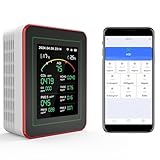
Overview: The Professional 15-in-1 Air Quality Monitor provides extensive indoor environmental surveillance, tracking CO2, PM2.5/PM10, HCHO, TVOC, temperature, humidity, and air pressure. Featuring dual-chip technology and a color LED display, this portable unit delivers real-time alerts and cloud-based data storage via smartphone app. Its versatility accommodates diverse settings from homes and offices to cars and industrial spaces.
What Makes It Stand Out: The dual-chip architecture separates sensor processing from UI management, ensuring rapid, accurate readings with minimal lag. The smart LED display employs color-coded alerts for immediate visual recognition of air quality fluctuations. Cloud storage enables seamless historical trend analysis and remote monitoring from anywhere, while custom threshold settings allow environment-specific alert configurations.
Value for Money: At $69.99, this monitor packs exceptional feature density into an affordable package. Fifteen metrics rival devices costing significantly more, while dual-chip processing enhances reliability. Portable design with dual power options increases versatility across locations. However, the unknown brand reputation and reliance on proprietary cloud storage may concern users prioritizing long-term support and data privacy.
Strengths and Weaknesses: Strengths include comprehensive 15-metric detection, dual-chip accuracy, color display alerts, cloud storage accessibility, portability, and aggressive pricing. Weaknesses include unspecified battery life, potential app stability issues, lack of industry certifications, unknown sensor precision over time, and display size not detailed which may impact readability for some users.
Bottom Line: This feature-rich monitor is a compelling budget option for users wanting extensive monitoring without premium expense. Its dual-chip system and 15-metric coverage provide professional-level environmental data suitable for both residential and light commercial applications. Confirm battery life and app reliability align with your use case before purchasing.
Understanding the Air Quality-Allergy Connection
Your allergic reactions aren’t random—they’re direct responses to specific airborne particles your immune system identifies as threats. Smart air quality monitors act as your personal environmental detective, identifying these triggers before they accumulate to problematic levels. Unlike traditional monitors that simply display numbers, modern smart devices correlate air quality data with your symptoms, helping you identify patterns and prevent flare-ups rather than just reacting to them. This proactive approach fundamentally changes the allergy management game from guesswork to data-driven precision.
Key Pollutants That Trigger Allergic Responses
Particulate Matter: The Invisible Culprits
Particulate matter, especially PM2.5 and PM10, represents the most significant threat to allergy sufferers. These microscopic particles penetrate deep into your respiratory system, with PM2.5 being small enough to enter your bloodstream. For allergy sufferers, these particles carry allergens like pollen fragments, dust mite debris, and pet dander. A monitor’s ability to detect particle counts as low as 0.3 microns determines its effectiveness for allergy relief.
Biological Allergens: Mold, Pollen, and Dust Mites
While most consumer monitors can’t directly identify specific biological species, they detect the conditions that allow these allergens to thrive. Elevated humidity levels above 50% create breeding grounds for dust mites and mold. Some advanced units now feature optical sensors that can differentiate between particle types, giving you clues about whether you’re dealing with organic or inorganic matter based on size distribution patterns.
Volatile Organic Compounds (VOCs) and Chemical Sensitivities
VOCs from cleaning products, furniture off-gassing, and building materials can exacerbate allergic reactions and trigger inflammatory responses even in people without traditional allergies. For those with multiple chemical sensitivities, monitoring TVOC (Total Volatile Organic Compounds) levels becomes as critical as tracking particulate matter. Look for monitors with metal-oxide semiconductor sensors that detect a broad spectrum of chemical compounds.
How Smart Air Quality Monitors Actually Work
Modern smart monitors employ a multi-sensor array that continuously samples your air through a small internal fan. Laser particle counters use light scattering technology to count and size individual particles passing through the detection chamber. Gas sensors measure chemical concentrations through electrical resistance changes when VOCs interact with a heated metal-oxide surface. Environmental sensors track temperature, humidity, and sometimes barometric pressure. This data streams to microprocessors that apply algorithms to convert raw sensor readings into meaningful air quality indices, typically updated every 1-2 minutes for real-time awareness.
Essential Features for Allergy-Specific Monitoring
Multi-Pollutant Detection Capability
Allergy sufferers need comprehensive detection, not single-pollutant focus. Prioritize monitors that simultaneously track PM2.5, PM10, VOCs, humidity, and temperature. Some advanced models now include carbon dioxide monitoring, which indirectly indicates ventilation adequacy—a critical factor for diluting allergen concentrations.
Rapid Response Time and Data Refresh Rate
When pollen counts spike or someone vacuums, you need immediate feedback. Look for devices that refresh data every 60 seconds or less. Slower refresh rates might miss transient but significant allergen events that trigger your symptoms.
Historical Data Analysis and Trending
Understanding your allergy patterns requires more than current readings. Robust data logging capabilities—preferably 30 days minimum on the device and unlimited cloud storage—help you correlate symptom flare-ups with specific environmental conditions, identifying your unique triggers over time.
Particulate Matter Detection: Going Beyond Basic Counting
Laser vs. Optical Particle Sensors
Laser-based particle counters remain the gold standard for accuracy, using precise light scattering to size and count particles. Optical sensors are less expensive but can misclassify particles, potentially underestimating allergen loads. For allergy relief, insist on true laser diffraction technology with detection down to 0.3 microns.
Particle Size Differentiation
Advanced monitors don’t just count particles—they categorize them by size. This matters because different allergens dominate different size ranges. Pollen typically appears in the 10-100 micron range, while dust mite allergens and pet dander concentrate in the 1-10 micron range. PM2.5 detection captures the most penetrating particles, but seeing the full size distribution helps you identify specific allergen sources.
VOCs and Chemical Sensitivities: What Allergy Sufferers Must Know
Metal-Oxide Semiconductor vs. Photoionization Detection
Most consumer monitors use metal-oxide semiconductor (MOS) sensors for VOCs. These are cost-effective and durable but require 24-48 hours to “burn in” and stabilize. Photoionization detectors (PIDs) offer superior accuracy and faster response but remain rare in residential devices due to cost. For chemical sensitivity management, look for monitors that allow manual calibration and show raw sensor values alongside processed air quality scores.
Formaldehyde and Specific VOC Tracking
General TVOC readings help, but formaldehyde—a common allergen sensitizer in building materials and furniture—deserves specific attention. Some premium monitors now include electrochemical formaldehyde sensors separate from general VOC detection. If you’ve recently renovated or purchased new furniture, this feature becomes non-negotiable.
Humidity and Temperature: The Allergen Multipliers
Optimal Ranges for Allergy Prevention
Humidity levels between 40-50% create the least hospitable environment for dust mites and mold while maintaining respiratory comfort. Temperatures between 68-72°F minimize off-gassing from materials while keeping you comfortable. Your monitor should alert you when conditions deviate from these allergy-friendly parameters, not just display numbers.
Dew Point Monitoring for Mold Prevention
Some sophisticated monitors calculate dew point—the temperature at which air becomes saturated and condensation forms. This metric predicts mold growth risk more accurately than relative humidity alone, especially during seasonal transitions when temperature fluctuations create micro-climates where mold thrives.
Real-Time Data and Mobile App Integration
Push Notifications and Smart Alerts
The best allergy-focused monitors let you customize alerts for your specific sensitivities. Set thresholds for each pollutant type, and receive instant notifications when levels exceed your personal tolerance. This feature proves invaluable when you’re away from home, allowing you to ventilate or activate air purifiers remotely before returning to a trigger-filled environment.
Data Visualization and Symptom Tracking
Look for apps that overlay air quality data with manual symptom logging. This correlation view—showing how your congestion or sneezing aligns with PM2.5 spikes—transforms abstract numbers into actionable health insights. Some platforms now integrate with wearable devices, automatically pulling heart rate variability and respiratory data to create a complete picture of your environmental health.
Smart Home Ecosystem Compatibility
Voice Assistant Integration
Alexa, Google Assistant, and Siri compatibility enable hands-free air quality checks—crucial when you’re in the middle of cooking or cleaning and can’t check your phone. More importantly, integration allows automated responses: “Alexa, when PM2.5 exceeds 35 μg/m³, turn on the living room air purifier and send me a notification.”
IFTTT and Advanced Automation
IFTTT (If This Then That) support unlocks sophisticated automation sequences. Create applets that trigger multiple devices simultaneously: when VOCs rise, turn on exhaust fans, activate air purifiers, and adjust HVAC settings. This proactive ecosystem approach multiplies your monitor’s value beyond simple reporting.
Accuracy and Calibration Considerations
Factory Calibration vs. Field Calibration
All sensors drift over time. Quality monitors include automatic baseline calibration that adjusts for sensor drift by assuming outdoor air periodically reaches clean baseline conditions. For allergy sufferers, manual calibration options using reference standards provide confidence that your readings remain accurate during peak pollen season when you need them most.
Cross-Sensitivity and Interference
Gas sensors can cross-react to multiple compounds, potentially over-reporting VOCs when humidity spikes or when cleaning products release interfering gases. Advanced monitors use compensation algorithms and multi-sensor fusion to minimize these errors. Understanding a device’s limitations helps you interpret readings correctly during complex exposure events.
Strategic Placement for Maximum Allergy Relief
The “Breathing Zone” Principle
Position monitors 3-6 feet off the ground in your primary living spaces—where you actually breathe. Placing units too high or too low misses the concentrated allergen layers that form in your personal breathing zone. Bedrooms deserve priority placement since you spend 8 hours breathing the same air unconsciously.
Multiple Monitor Networks
Single-point monitoring creates blind spots. Allergens concentrate differently in each room. A multi-monitor approach—one per primary living area plus a portable unit for spot-checking—provides comprehensive coverage. Some systems allow monitors to communicate, creating an indoor air quality map that identifies pollution sources and tracks allergen migration through your home.
Maintenance and Long-Term Ownership Costs
Sensor Lifespan and Replacement
Particle sensors typically last 5-7 years, while gas sensors degrade faster, requiring replacement every 2-3 years for optimal accuracy. Factor these replacement costs into your purchase decision. Some manufacturers offer sensor refurbishment programs that cost less than full unit replacement.
Cleaning and Environmental Factors
Dust accumulation on sensor inlets degrades performance. Monthly cleaning with compressed air maintains accuracy. Avoid placing monitors near vents, windows, or doors where temperature fluctuations and direct airflow create false readings. Consistent environmental conditions extend sensor life and data reliability.
Interpreting Data for Actionable Allergy Relief
Understanding Air Quality Indices (AQI)
Different monitors use different AQI scales—some proprietary, some aligned with EPA standards. Learn how your device calculates its overall score. A monitor might show “Good” air while PM2.5 levels exceed your personal tolerance. Customizable indices that let you weight pollutants based on your specific allergies provide more relevant guidance than generic scores.
Correlation vs. Causation in Symptom Tracking
Seeing PM2.5 spike on the same day your symptoms worsen doesn’t prove causation—until you see the pattern repeat over weeks. Use statistical features in advanced apps that calculate correlation coefficients between pollutants and symptoms. This data-driven approach identifies your true triggers, which might surprise you. Many sufferers discover their primary trigger isn’t what they assumed.
Cost vs. Value Analysis for Allergy Management
Entry-Level vs. Premium Investment
Budget monitors ($50-$150) typically track only PM2.5 and basic VOCs with limited app features. Mid-range devices ($150-$300) add accurate humidity, temperature, and multi-room capabilities. Premium units ($300+) offer professional-grade sensors, advanced analytics, and ecosystem integration. For severe allergy sufferers, the premium’s accuracy and automation features often pay for themselves through reduced medication costs and improved productivity.
Total Cost of Ownership Over Five Years
Calculate beyond the purchase price: add sensor replacement costs, subscription fees for advanced app features (some charge $5-10/month for historical data), and energy consumption (continuous operation adds $2-5 annually to electricity bills). A $200 monitor requiring $150 in sensor replacements and $60 in subscriptions over five years costs $410 total—making a $350 monitor with free lifetime service and longer-lasting sensors a better value.
Future Trends Reshaping Allergy Monitoring
AI-Powered Predictive Analytics
Emerging monitors use machine learning to predict allergen spikes based on weather forecasts, local pollen counts, and your home’s historical patterns. Imagine receiving an alert: “High pollen forecast tomorrow—close windows by 7 AM and pre-run air purifiers.” This predictive capability transforms reactive monitoring into proactive allergy defense.
Biosensors and Allergen-Specific Detection
Laboratory-grade biosensors that identify specific proteins from dust mites, pet dander, or pollen are miniaturizing for consumer use. By 2026, expect monitors that don’t just count particles but tell you “dust mite allergen levels are elevated” with clinical specificity. This breakthrough will revolutionize targeted allergen avoidance strategies.
Integration with Air Purifiers and HVAC Systems
Closed-Loop Air Quality Control
The ultimate allergy relief system pairs your monitor directly with air purification devices. When PM2.5 exceeds your threshold, the monitor automatically activates your purifier at maximum speed, then scales it back when levels normalize. This intelligent cycling reduces filter wear, noise, and energy consumption while maintaining optimal air quality—far more efficient than running purifiers 24/7.
HVAC System Optimization
Advanced monitors now communicate with smart thermostats to optimize ventilation rates based on real-time air quality. During high pollen days, the system reduces outdoor air intake while increasing filtration. On low-pollution days, it maximizes fresh air exchange. This dynamic balancing act maintains air quality while minimizing energy waste and allergen introduction.
Privacy and Data Security in Air Quality Monitoring
Local vs. Cloud Data Processing
Consider where your air quality data resides. Cloud-based systems offer convenience and advanced analytics but require trusting companies with your environmental and health data. Some privacy-focused monitors now process data locally on the device, sharing only anonymized trends. For those concerned about data harvesting, look for GDPR/CCPA-compliant devices with transparent data policies and optional local storage.
Health Data Integration Implications
As monitors increasingly sync with health apps and wearables, understand how this combined data might be used. Some companies anonymize and sell aggregated environmental health data. Read privacy policies carefully—your allergy patterns combined with location data create a detailed health profile. Opt for manufacturers with clear “no sale” data policies and end-to-end encryption.
Certification and Standards That Actually Matter
EPA and CARB Compliance
While no universal standard exists for consumer air quality monitors, EPA-validated testing methods and California Air Resources Board (CARB) certification for low emissions indicate rigorous evaluation. CARB certification ensures the monitor itself doesn’t off-gas VOCs—a critical consideration for chemically sensitive individuals.
FDA and Medical-Grade Considerations
Currently, consumer air quality monitors aren’t FDA-regulated medical devices. However, some manufacturers voluntarily follow ISO 13485 medical device quality management standards. While not a guarantee of accuracy, this certification indicates robust design controls and risk management—reassuring for those using monitors to manage chronic health conditions.
Frequently Asked Questions
1. Can air quality monitors detect specific allergens like pollen or dust mites?
Most consumer monitors detect particle sizes associated with allergens but can’t identify specific biological sources. They count particles in the 1-10 micron range where dust mite allergens concentrate, and 10-100 microns for pollen, but can’t distinguish between a pollen grain and a similar-sized dust particle. However, advanced models use optical properties and size distribution patterns to make educated guesses, and emerging biosensor technology promises specific allergen identification by 2026. For now, combine monitor data with local pollen forecasts and symptom tracking to infer specific triggers.
2. How many monitors do I need for effective allergy management?
Start with one monitor in your bedroom since you spend 8+ hours there breathing deeply during sleep. Add a second unit to your primary living area where you spend waking hours. If you have a multi-story home, place one on each level as pollutants stratify differently. A portable monitor for spot-checking problem areas like basements or kitchens completes a comprehensive system. Three to four well-placed units typically provide complete coverage for a 2,000 square foot home.
3. Why do my symptoms sometimes spike when the air quality monitor shows “Good” readings?
This discrepancy often stems from three issues: First, your personal sensitivity threshold may be lower than the generic AQI scale. What’s “Good” for the general population might trigger your specific allergies. Second, the monitor might be placed too far from your exposure source—pollen entering through a bedroom window won’t register in the living room. Third, some monitors average readings over time, smoothing out brief spikes that affect you. Check your app’s raw data for short-term peaks, and consider relocating the monitor closer to your breathing zone.
4. How often should I calibrate my air quality monitor for reliable allergy tracking?
Most modern monitors perform automatic baseline calibration every 1-2 weeks by assuming outdoor air periodically reaches clean conditions. However, for allergy-specific accuracy, manual calibration every 6 months using a reference monitor or professional service ensures reliability. Gas sensors drift faster than particle sensors and may need replacement every 2-3 years rather than recalibration. If you notice consistent discrepancies between your symptoms and readings, or after moving to a new home, recalibrate immediately.
5. Can I use an air quality monitor outdoors to track pollen before it enters my home?
Consumer-grade indoor monitors aren’t designed for outdoor use and will fail quickly when exposed to moisture, temperature extremes, and rapid sensor contamination. However, some weather-resistant models with proper IP ratings can function on covered porches or in sheds with protection from direct precipitation. For accurate outdoor pollen tracking, rely on local environmental monitoring stations and integrate that data with your indoor monitor through apps that overlay outdoor and indoor readings. This combination tells you when to close windows and activate filtration.
6. What’s the difference between a $50 monitor and a $300 one for allergy purposes?
The price difference reflects sensor quality, detection range, and analytical depth. Budget monitors typically use lower-cost optical particle sensors that miscount smaller allergen-carrying particles and lack true gas sensors, estimating VOCs from humidity and temperature instead. Premium units feature laser particle counters accurate to 0.3 microns, separate formaldehyde sensors, faster refresh rates (60 seconds vs. 5 minutes), and advanced apps with symptom correlation tools. For severe allergies, the premium’s accuracy and actionable insights justify the cost; mild sufferers may find budget options sufficient for basic awareness.
7. Should I place my monitor near my air purifier or far away?
Place monitors at least 6 feet away from air purifiers to avoid measuring the purified air stream directly, which creates artificially low readings that don’t represent your true breathing zone. The monitor should assess the room’s ambient air quality, not the purifier’s output. However, if using a closed-loop system where the monitor controls the purifier, position the monitor where you want air quality maintained, and let the purifier work from a corner location. The goal is measuring the air you breathe, not the air immediately exiting the purifier.
8. How do I interpret VOC readings if I have chemical sensitivities?
VOC readings in parts per billion (ppb) require context. Below 250 ppb generally indicates low chemical presence, but chemically sensitive individuals may react to levels as low as 100 ppb. Track your personal reactions alongside readings to establish your threshold. When VOCs spike, identify the source: new products, cleaning activities, or HVAC systems pulling in garage fumes. Use the monitor’s trending data to test interventions—does opening windows for 10 minutes drop VOCs to your comfortable range? This empirical approach builds your personalized chemical exposure management strategy.
9. Can smart air quality monitors help with asthma as well as allergies?
Absolutely. Asthma and allergies share many environmental triggers—particularly PM2.5, mold spores, and chemical irritants that inflame airways. Studies show that using air quality monitors to maintain PM2.5 below 12 μg/m³ reduces asthma exacerbations by up to 30%. The key difference is that asthma management demands stricter thresholds and faster response times. Set alerts at lower pollutant levels, and integrate monitors with both air purifiers and HVAC systems for immediate automatic response when air quality degrades. The data also helps physicians identify environmental factors contributing to poorly controlled asthma.
10. Will my monitor become obsolete as new sensor technology emerges?
Most monitors receive firmware updates that improve algorithms and app features, but sensor hardware remains fixed. However, the fundamental pollutants that trigger allergies (PM2.5, VOCs, humidity) won’t change, so your monitor’s core value persists. The sensor lifespan (5-7 years for particle sensors) naturally aligns with technology refresh cycles. Rather than obsolescence, expect modular upgrades—some manufacturers now offer replaceable sensor modules that let you upgrade specific detection capabilities without replacing the entire device. Consider your monitor a long-term health investment that evolves through software and selective hardware updates.