Every spring, millions of Americans greet the season with a box of tissues in one hand and antihistamines in the other. But what if you could see the invisible enemies floating through your home—pollen particles, pet dander, and mold spores—before they triggered that miserable sneezing fit? In 2026, smart air quality monitoring has evolved from a niche gadget into an essential health management tool for allergy sufferers. These intelligent devices don’t just measure the air; they translate invisible threats into actionable insights, empowering you to breathe easier and live better.
The landscape of indoor air quality technology has transformed dramatically. Today’s monitors are equipped with hypersensitive sensors, AI-driven predictive analytics, and seamless smart home integration that creates a proactive defense system against allergens. Whether you’re dealing with seasonal pollen, year-round dust mites, or the persistent challenge of pet allergies, understanding what to look for in a smart monitor can mean the difference between constant suffering and genuine relief. Let’s explore the critical factors that separate truly effective allergy-focused monitors from the sea of mediocre options flooding the market.
Top 10 Smart Air Quality Monitors for Allergy Sufferers
Detailed Product Reviews
1. Amazon Smart Air Quality Monitor – Know your air, Works with Alexa

Overview: The Amazon Smart Air Quality Monitor brings intelligent air tracking to your smart home ecosystem. This compact device monitors five critical indoor air factors—particulate matter (PM 2.5), volatile organic compounds, carbon monoxide, humidity, and temperature—delivering insights through a color-coded LED indicator and the Alexa app.
What Makes It Stand Out: Seamless Alexa integration sets this apart. It enables voice commands, mobile notifications, and automated Routines that trigger Alexa-enabled air purifiers, dehumidifiers, or fans when air quality drops. The visual LED provides at-a-glance status without checking your phone.
Value for Money: At $69.99, it sits in the mid-range for smart monitors. The price is justified if you already own Echo devices, as it unlocks powerful automation capabilities that cheaper monitors lack. However, it tracks fewer pollutants than professional-grade alternatives costing twice as much.
Strengths and Weaknesses: Strengths include effortless setup within the Alexa app, reliable notifications, and smart home orchestration. The compact design blends into any room. Weaknesses are the limited five-metric scope (no CO2 or PM1.0/PM10 tracking), lack of built-in display beyond the LED, and dependence on Alexa infrastructure—it’s essentially useless without Wi-Fi and an Echo ecosystem.
Bottom Line: Perfect for Alexa households wanting basic automated air management without technical complexity. Skip if you need comprehensive metrics or operate outside Amazon’s ecosystem.
2. Professional Indoor Air Quality Monitor with AQI Beep Alarms, Portable Real-Time Detector for Home Cars Plants and Pets (White)
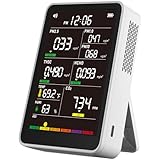
Overview: This professional-grade monitor delivers laboratory-level air analysis in a portable package. It tracks 16 metrics including PM1.0, PM2.5, PM10, CO2, TVOC, HCHO (formaldehyde), temperature, and humidity, making it ideal for health-conscious users, new homes, or sensitive environments requiring detailed analysis.
What Makes It Stand Out: The seven-tier AQI alert buzzer system provides immediate audible warnings when specific pollutants spike—crucial for those with respiratory issues. The high-precision sensor updates every three seconds, offering real-time data on a crisp HD display. Its 4-5 hour battery life and Type-C charging enable true portability for cars, campsites, or room-to-room testing scenarios.
Value for Money: At $139.99, this is a premium investment. The extensive metric range justifies the cost compared to basic monitors, though casual users may find it overkill. It competes with industrial devices costing significantly more while maintaining consumer-friendly operation and a modern aesthetic.
Strengths and Weaknesses: Strengths include comprehensive detection, rapid refresh rates, portability, and a sleek design that fits any décor. The one-button start and double-click silence function enhance usability. Weaknesses are the premium price point, potentially overwhelming data for average users, and battery life that requires daily charging for continuous monitoring.
Bottom Line: Ideal for air quality enthusiasts, allergy sufferers, or anyone needing professional-level data. Over-specified for those wanting simple, set-it-and-forget-it monitoring.
3. GoveeLife Smart Air Quality Monitor with PM2.5, WiFi, Temperature & Humidity Sensors, LED Display, 2s Refresh, 2-Year Data Storage, for Home & Office Wired

Overview: The GoveeLife Smart Air Quality Monitor offers essential air tracking at an accessible price point. It focuses on three core metrics—PM2.5, temperature, and humidity—with impressive ±15 µg/m³ accuracy for particulates and rapid two-second data refresh rates, making it a streamlined choice for everyday home monitoring.
What Makes It Stand Out: Unbeatable affordability meets smart functionality. The two-year data storage via the Govee app allows long-term trend analysis, while seamless integration with GoveeLife air purifiers, humidifiers, and heaters enables automated climate control. The switchable clock display and night mode add practical versatility.
Value for Money: At $39.99, this is exceptional value. It undercuts most competitors while delivering faster refresh rates and better data retention than many premium devices. The limitation to three metrics is a fair trade-off for the price, especially for users primarily concerned with particulate pollution.
Strengths and Weaknesses: Strengths include rapid data updates, straightforward app interface, LED air quality indicator with four color levels, and robust smart home compatibility within the Govee ecosystem. The wired design ensures continuous operation. Weaknesses are the narrow metric focus (no VOCs, CO2, or CO detection), lack of battery backup, and reliance on 2.4GHz Wi-Fi only.
Bottom Line: The best budget option for smart home users invested in Govee products. Delivers core functionality without frills, perfect for bedrooms, offices, and small living spaces.
4. Air Purifiers for Home Large Room up to 2180 Sq Ft, DBFIT HEPA Air Purifier with Washable Nylon Pre-Filter, PM2.5 Air Quality Sensor, Air Cleaner for Pet Hair, Odor, Smoke, Dust, Pollen AP2410
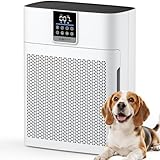
Overview: The DBFIT AP2410 combines powerful air purification with integrated monitoring for large spaces up to 2,180 square feet. Its three-stage filtration system—including a washable nylon pre-filter, True HEPA filter, and honeycomb activated carbon filter—tackles pet hair, odors, smoke, dust, and PM2.5 in spacious living areas, bedrooms, and pet zones.
What Makes It Stand Out: The cleanable PM2.5 sensor is a unique maintenance feature—simply wipe with a cotton swab to maintain accuracy. The washable nylon pre-filter saves money and extends main filter life, while the built-in essential oil diffuser adds aromatherapy functionality rarely found in purifiers. Sleep mode operates at a whisper-quiet 15dB with display lights off.
Value for Money: At $66.48, this is outstanding value for a large-room purifier with smart sensor technology. Competitors with similar coverage often cost $100+ without monitoring capabilities. The washable pre-filter reduces long-term operating costs significantly.
Strengths and Weaknesses: Strengths include massive coverage area, effective three-stage filtration, ultra-quiet operation, and the money-saving washable pre-filter. The real-time air quality display is intuitive. Weaknesses are limited monitoring scope (PM2.5 only, no CO2/VOCs), ongoing replacement filter costs, and the essential oil feature may irritate sensitive individuals or void HEPA efficiency claims.
Bottom Line: A top choice for pet owners and large-space dwellers wanting purification-first design with helpful monitoring. Not for those needing comprehensive air quality analysis alone.
5. GoveeLife Smart Air Quality Monitor for Home, CO2 Detector for Health, Sleep Quality & Energy Efficiency, Thermometer Hygrometer with Real-Time Display & Alarm, for Office, Bedroom, Kitchen
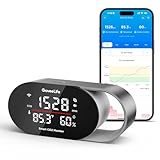
Overview: This specialized monitor focuses exclusively on carbon dioxide detection using a precise SCD4x NDIR sensor, while also tracking temperature, humidity, and time. Designed for health-conscious users, it helps prevent headaches, drowsiness, and concentration issues caused by elevated CO2 levels in bedrooms, offices, and classrooms where proper ventilation is critical.
What Makes It Stand Out: The triple alert system—buzzer, app notification, and email reports—ensures you never miss dangerous CO2 spikes, making it ideal for families with children or elderly members. Customizable LED brightness follows your day/night schedule, eliminating sleep disruption. Two-year data export in CSV format supports medical consultations or energy efficiency analysis.
Value for Money: At $59.98, it’s priced fairly for a dedicated CO2 monitor with professional-grade accuracy (±40ppm + 5%). While it lacks particulate tracking, its specialized focus and robust alert system justify the cost compared to generic multi-metric devices that skimp on CO2 precision and responsiveness.
Strengths and Weaknesses: Strengths include fast 5-second refresh rate, altitude pressure compensation, comprehensive alert options, and seamless app connectivity. The programmable display is excellent for light-sensitive sleepers. Weaknesses are the narrow focus (no PM2.5, VOCs, or CO detection), requirement for outdoor calibration, and clock display needing app connection.
Bottom Line: Essential for spaces where CO2 buildup is a concern—classrooms, crowded offices, or poorly ventilated bedrooms. Pair with a particulate monitor for complete air quality coverage.
6. Qingping Air Quality Monitor Gen 2, Air Quality Monitor Indoor Detects PM2.5, CO2, PM10, Noise, Temperature and Humidity, New Upgraded Alarm Clock Function, Air Quality Tester for Bedroom, Smart Home

Overview: The Qingping Air Quality Monitor Gen 2 positions itself as a premium indoor environmental hub, tracking seven key metrics including CO2, PM2.5, PM10, eTVOC, temperature, humidity, and even noise levels. Its integrated alarm clock functionality transforms it from a simple monitor into a multi-purpose bedside device that supports multiple daily alarms.
What Makes It Stand Out: What Makes It Stand Out is undoubtedly its user-centric design. The replaceable PM sensor module attaches magnetically, ensuring future maintenance is straightforward and cost-effective. The 4-inch IPS touchscreen delivers exceptional clarity at 254 PPI with auto-brightness adjustment, while color-coded indicators provide instant air quality assessment at a glance. Wi-Fi connectivity through the Qingping+ app enables remote monitoring and 30 days of historical data export.
Value for Money: Value for Money at $149.99 places this in the premium tier, but the build quality and feature set justify the investment compared to basic monitors lacking replaceable components or high-resolution displays. However, budget-conscious buyers might find comparable functionality for less.
Strengths and Weaknesses: Strengths include comprehensive multi-metric monitoring, elegant touchscreen interface, smart home integration, and innovative replaceable sensor design. Weaknesses are significant: it doesn’t measure formaldehyde, requires constant USB power (only 3-hour battery life), and the power adapter isn’t included. The price point may deter casual users.
Bottom Line: Bottom Line: Ideal for health-conscious homeowners seeking a sophisticated, all-in-one environmental monitoring solution with smart features. Its premium design and replaceable sensor make it a worthwhile long-term investment, provided you can overlook the constant power requirement and missing formaldehyde detection.
7. Air Purifier for Home Bedroom Large Room Up to 2000Ft²,Smart APP&Voice Control with Air Quality Sensor, Washable Pre Filter Cleaner for Pet Pollen Allergy Odor Dust Mold Smoke, Compatible with Alexa

Overview: This smart air purifier delivers serious performance for large spaces up to 2,000 square feet, boasting a CADR of 280m³/h that rapidly cleans 40m² rooms. Integrated laser sensors provide real-time PM2.5 detection with color-coded alerts, while the companion app offers 7-day history tracking and remote control capabilities.
What Makes It Stand Out: What Makes It Stand Out is the combination of high-efficiency purification and cost-saving design. The four-layer filtration system includes a reusable washable pre-filter that extends main filter life by 6-12 months, reducing replacement costs by 30%. Smart home integration via Alexa/Google Home and the afloia app enables hands-free operation and scheduled cycles, perfect for busy households.
Value for Money: Value for Money is exceptional at $69.99. Competing purifiers with this CADR rating typically cost $100+, and the washable pre-filter creates ongoing savings. The laser sensor’s 0.1-second accuracy rivals commercial-grade equipment at a fraction of the price.
Strengths and Weaknesses: Strengths include rapid large-area purification, accurate air quality monitoring, significant filter cost savings, and robust smart controls. Weaknesses: Wi-Fi limited to 2.4GHz only, replacement filters still represent ongoing expense, and high-speed operation may generate noticeable noise. The unit lacks advanced gas sensors for VOCs or CO2.
Bottom Line: Bottom Line: An outstanding choice for pet owners, allergy sufferers, and large households needing powerful, intelligent air purification without breaking the bank. The washable filter design and smart features make it a practical, cost-effective solution for maintaining clean air.
8. Temtop Smart Air Quality Monitor - Indoor Air Quality Meter with PM2.5, AQI, Temperature and Humidity Detector for Home, Office or School, App Connectivity, OTA Updates, 60-Day Battery Life

Overview: The Temtop Smart Air Quality Monitor offers essential indoor air quality tracking in an ultra-portable package, focusing on PM2.5, AQI, temperature, and humidity. Its standout feature is an incredible 60-day battery life that liberates users from constant charging, making it ideal for moving between rooms or taking on the go.
What Makes It Stand Out: What Makes It Stand Out is the exceptional portability combined with practical design. The compact form factor and extended battery enable monitoring in classrooms, offices, or while traveling without power constraints. Designed in the USA, the clear display uses intuitive color indicators and audible alerts when thresholds are exceeded, while app notifications keep you informed remotely.
Value for Money: Value for Money at $39.99 makes this the most accessible entry point for air quality monitoring. While it lacks advanced sensors, it covers the most critical pollutant (PM2.5) effectively for less than half the price of comprehensive monitors.
Strengths and Weaknesses: Strengths include remarkable 60-day battery life, true portability, straightforward operation, and proactive alert system. The lightweight design and app connectivity add convenience. Weaknesses: Limited to basic particulate and environmental metrics—no CO2, VOC, or formaldehyde detection. The display is functional but less sophisticated than high-resolution alternatives, and historical data capabilities are more limited.
Bottom Line: Bottom Line: Perfect for budget-conscious users needing reliable, portable particulate monitoring without complexity. Its extraordinary battery life and simplicity make it ideal for classrooms, rental properties, or as a starter device before investing in more comprehensive monitoring.
9. Professional 15-in-1 Air Quality Monitor with Smartphone APP - Dual Chip - Sensors Detect CO2, PM2.5/PM10, HCHO, TVOC | Real-Time Alerts & Custom Thresholds | for Home, Car, Office, Plants, Pets
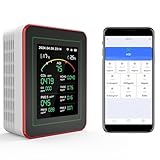
Overview: This Professional 15-in-1 Air Quality Monitor packs comprehensive sensing capabilities into a portable device, tracking CO2, PM2.5/PM10, formaldehyde (HCHO), TVOC, temperature, humidity, and air pressure. The dual-chip architecture ensures rapid, accurate readings while enabling both wired and wireless operation.
What Makes It Stand Out: What Makes It Stand Out is the advanced dual-chip system that dedicates separate processors to sensor data and user interface, eliminating lag and improving accuracy. The high-definition color screen provides real-time assessments with color-changing alerts for immediate visual feedback. Wi-Fi connectivity and dedicated app enable remote monitoring with cloud-stored data and instant threshold notifications.
Value for Money: Value for Money at $69.99 hits a sweet spot, offering formaldehyde detection and dual-chip processing typically found in $100+ professional units. The portable design adds versatility across homes, offices, cars, and even industrial settings.
Strengths and Weaknesses: Strengths include comprehensive multi-gas detection, innovative dual-chip precision, portable versatility, and robust app integration with cloud storage. The alert mode with color-coded warnings provides immediate situational awareness. Weaknesses: The manufacturer doesn’t specify battery life, which could limit portability. The dual-chip complexity may present a steeper learning curve for non-technical users, and app reliability isn’t as established as major brands.
Bottom Line: Bottom Line: An impressive mid-range performer delivering professional-grade monitoring capabilities. Ideal for users needing formaldehyde detection and high accuracy without premium pricing. The dual-chip innovation and comprehensive sensor array make it a smart choice for health-conscious families and workplace safety.
10. 18-in-1 Smart Air Quality Monitor - Indoor WiFi Air Quality Detector with Dual Chip, Real-Time for AQI, CO2, PM2.5, PM1.0, PM10, TVOC, HCHO, Time Display, Temperature & Humidity with APP (White-White)

Overview: The 18-in-1 Smart Air Quality Monitor represents the pinnacle of consumer-grade environmental tracking, measuring an exhaustive array of metrics including AQI, CO2, PM1.0/PM2.5/PM10, formaldehyde, TVOC, temperature, humidity, time, and date. This comprehensive approach provides unparalleled insight into indoor air quality dynamics.
What Makes It Stand Out: What Makes It Stand Out is the sheer breadth of monitoring combined with practical design elements. The dual-chip architecture ensures lightning-fast data processing while maintaining smooth UI interactions. Unlike competitors, it includes time/date display and wall-mounting capability, functioning as both scientific instrument and room fixture. The “Smart Life” app integration enables remote customization and historical data tracking across multiple devices.
Value for Money: Value for Money at $79.99 is remarkable given the 18-metric capability—competing devices with similar sensor arrays often exceed $150. The skin-friendly surface and premium finish suggest thoughtful industrial design beyond typical budget monitors.
Strengths and Weaknesses: Strengths include the most comprehensive sensor suite available, dual-chip accuracy, extensive app functionality with data storage, versatile mounting options, and auto-brightness display. The device covers virtually every air quality parameter homeowners need. Weaknesses: Wi-Fi limited to 2.4GHz with compatibility mode required for modern routers, complexity may overwhelm casual users, and the information density could be excessive for those wanting simple PM2.5 tracking.
Bottom Line: Bottom Line: Perfect for data-driven users, tech enthusiasts, and those managing complex indoor environments. If you want maximum information and future-proof features without professional-grade pricing, this comprehensive monitor delivers exceptional value and capability.
Why Air Quality Monitoring Matters More Than Ever for Allergy Sufferers
Your home should be your sanctuary, yet indoor air can be up to five times more polluted than outdoor air. For allergy sufferers, this statistic isn’t just alarming—it’s life-altering. Modern building practices have created energy-efficient homes that trap allergens inside, creating a concentrated cocktail of triggers that assault your respiratory system 24/7. Smart monitors serve as your early warning system, detecting allergen spikes before you feel that first tickle in your throat.
The connection between real-time air quality data and allergy symptom management is undeniable. When you can correlate that morning congestion spike with overnight dust mite activity or link your afternoon sneezing to peak pollen infiltration, you gain control. Instead of reactive medication, you’re making informed decisions about ventilation, air purification, and timing of outdoor activities. This shift from reactive to proactive management represents the single biggest advancement in allergy care for homeowners.
The Evolution of Smart Air Quality Technology in 2026
The air quality monitors of 2026 bear little resemblance to their clunky predecessors. We’ve moved beyond simple CO2 and humidity tracking into an era of multi-dimensional environmental sensing. The latest generation employs laser particle counters capable of distinguishing between pollen, dust, and smoke particles with remarkable precision. These devices don’t just report numbers—they interpret complex data patterns using machine learning algorithms trained on millions of allergen exposure scenarios.
What’s particularly revolutionary is the integration of hyperlocal outdoor allergen data. Modern monitors now pull real-time pollen counts from neighborhood-level sensors, cross-referencing this with your indoor readings to identify infiltration patterns. This means your device can alert you when oak pollen levels are rising in your specific zip code, even before the particles breach your home’s envelope. The technology has essentially created a meteorological system for your personal airspace.
Key Pollutants That Trigger Allergies (and What to Monitor)
Understanding your enemy is half the battle. Particulate matter (PM) remains the primary concern, but not all particles are created equal. PM2.5—particles smaller than 2.5 micrometers—can penetrate deep into lungs and carry allergens directly into your bloodstream. For allergy sufferers, PM10 is equally important as it captures larger particles like pollen grains and dust mite fragments. The most effective monitors in 2026 differentiate between these sizes and identify specific allergen categories.
Volatile Organic Compounds (VOCs) often fly under the radar but can amplify allergic responses by irritating mucous membranes. Formaldehyde from furniture, benzene from cleaning products, and other chemicals create a compounding effect that makes your body hyperreactive to traditional allergens. Advanced monitors now include metal oxide semiconductor sensors that detect VOCs at parts-per-billion concentrations. Additionally, monitoring carbon dioxide levels helps identify poor ventilation—stagnant air allows allergens to concentrate and humidity to rise, creating perfect conditions for dust mites and mold proliferation.
Essential Features to Look for in Allergy-Focused Air Quality Monitors
The feature set you choose can make or break your allergy management strategy. Multi-sensor arrays are non-negotiable—look for devices that simultaneously track PM1.0, PM2.5, PM10, VOCs, CO2, temperature, and humidity. But sensor quantity means nothing without quality. The best monitors use laser-based particle detection rather than cheaper infrared sensors, providing accuracy within ±3% for particle counts.
Real-time alerting is crucial for allergy sufferers. Your monitor should send instant notifications when allergen thresholds exceed your personalized limits—not generic factory settings. Look for customizable alert zones that let you set different thresholds for different times of day. A pollen spike at 6 AM before you wake requires a different response than one at 10 PM when windows are closed. Voice assistant integration takes this further, allowing you to ask, “What’s the pollen level in the bedroom?” and receive immediate spoken feedback.
Understanding Sensor Technology and Accuracy
Not all sensors are created equal, and marketing claims often obscure technical realities. Laser particle counters work by passing air through a laser beam and measuring light scattering. Higher-end units use dual-laser systems that can distinguish particle shapes, helping differentiate between spherical pollen grains and irregular dust particles. This shape recognition is a game-changer for targeted allergy management.
Sensor drift—the gradual loss of accuracy over time—plagues cheaper monitors. Quality devices in 2026 feature automatic baseline calibration that runs during low-activity hours, typically midnight to 4 AM. This self-correction ensures your readings remain accurate for years. For VOC sensors, look for devices with electrochemical or photoionization detection (PID) technology. These maintain sensitivity to specific chemicals that trigger allergic reactions, unlike broad-spectrum sensors that miss nuanced changes in your home’s chemical fingerprint.
Smart Home Integration: The Connected Allergy Defense System
A standalone monitor is helpful; an integrated system is transformative. The true power of 2026’s technology lies in its ability to trigger automated responses across your smart home ecosystem. When your monitor detects rising pollen levels, it should automatically signal your smart HVAC system to switch to recirculation mode, activate your air purifier to maximum speed, and close smart vents in bedrooms.
Look for Matter certification and Thread protocol support—these emerging standards ensure your monitor communicates seamlessly with devices from different manufacturers. IFTTT (If This Then That) integration remains valuable for creating custom automation chains. Imagine your monitor detecting high dust mite activity at 2 AM and automatically triggering your robot vacuum to clean the bedroom while adjusting your smart thermostat to lower humidity. This level of automation turns data into action without requiring your constant attention.
Mobile App Experience and Data Interpretation
The best sensor hardware is useless without intuitive software. Modern allergy-focused apps have evolved beyond simple dashboards into comprehensive health management platforms. Look for apps that provide allergen-specific trend analysis over 30, 60, and 90-day periods. This longitudinal data reveals patterns—perhaps your symptoms spike every Tuesday afternoon when neighbors mow lawns, or every time humidity exceeds 55% for three consecutive days.
Crucially, the app should translate raw data into actionable recommendations. Instead of displaying “PM2.5: 35 μg/m³,” it should state, “Moderate pollen detected—consider closing windows and running air purifier.” The most advanced apps now integrate with your phone’s health data, correlating air quality readings with your reported symptoms, sleep quality, and even local pharmacy allergy medication sales. This creates a personal allergy fingerprint that helps predict symptom severity before you feel it.
Placement Strategy: Where to Position Your Monitors
Strategic placement multiplies your monitor’s effectiveness. The living room seems logical, but bedrooms deserve priority since you spend eight hours breathing that air nightly. Place monitors 3-5 feet high—breathing level—away from windows, doors, and direct HVAC vents that create artificial readings. Avoid kitchens where cooking particulates skew data, and keep them at least six feet from air purifiers to prevent measuring cleaned air that doesn’t represent your actual breathing zone.
For multi-story homes, consider the “stack effect”—warm air rising carries allergens upward. A monitor on each floor provides a complete picture. Basements require special attention due to mold and radon risks, while attic spaces can harbor insulation particles and outdoor allergens entering through gaps. The 2026 best practice involves creating a “monitor network” where multiple devices communicate, showing you how air quality migrates through your home throughout the day.
The Role of Machine Learning and Predictive Analytics
Static alerts are old news. The cutting edge lies in predictive algorithms that learn your home’s unique allergen patterns. These systems analyze years of data to forecast air quality 24-48 hours ahead, factoring in weather forecasts, seasonal pollen cycles, and your household behaviors. If the algorithm knows you vacuum every Saturday morning and that activity spikes dust levels for two hours, it can pre-emptively ramp up air purification.
More impressively, machine learning now identifies the source of pollutants. By correlating indoor spikes with outdoor conditions, HVAC operation, and occupancy patterns, the system might determine that your highest pollen infiltration occurs not when windows are open, but when your central air conditioner cycles on—indicating leaky ductwork pulling in unfiltered attic air. This diagnostic capability transforms a simple monitor into a home health consultant.
Battery vs. Plug-In: Power Considerations
Power source decisions impact placement flexibility and data continuity. Battery-powered monitors offer placement freedom but require charging every 2-6 weeks depending on sensor activity. The latest lithium-polymer batteries last longer but still create data gaps during charging. For allergy sufferers, these gaps can miss critical overnight allergen spikes.
Plug-in monitors provide uninterrupted monitoring but tether you to outlets. The sweet spot in 2026 is hybrid power with battery backup—devices that plug in for primary power but seamlessly switch to battery during outages. This ensures continuous monitoring when you need it most: during storms when windows close and air stagnates. Some advanced models now feature power-over-Ethernet (PoE) capability, enabling placement in optimal locations without being limited by outlet proximity.
Maintenance and Calibration: Keeping Your Monitor Honest
Accuracy degrades without proper maintenance. Dust accumulation on sensor inlets reduces sensitivity—monthly cleaning with compressed air is essential. But internal calibration is where most users falter. High-end monitors now perform automatic zero-point calibration weekly, but manual calibration against reference standards every six months ensures peak performance. Some manufacturers offer mail-in recalibration services that return your device with a certified accuracy report.
Filter replacement matters even for monitors that don’t purify air. Pre-filters on sensor inlets capture large particles, preventing sensor contamination. These need replacement every 3-6 months in high-allergen environments. The app should track usage hours and send proactive replacement alerts. Neglecting maintenance creates false confidence—you’re making health decisions based on bad data, which is worse than having no monitor at all.
Budget Considerations and Value Proposition
Price ranges from $50 to $800, but cost doesn’t always correlate with allergy-specific value. Sub-$100 monitors typically use infrared sensors with ±15% accuracy—insufficient for clinical allergy management. The $200-400 sweet spot offers laser particle counting, multi-pollutant detection, and robust app support. Premium models above $500 add marginal improvements in sensor precision and build quality but shine in ecosystem integration and long-term support.
Consider total cost of ownership, not just purchase price. Factor in calibration services ($50-100 annually), replacement filters ($20-40 yearly), and app subscription fees (some advanced analytics require $5-10/month). A $300 monitor with $100/year maintenance over five years costs $800 total—still far less than repeated doctor visits and missed work days. For severe allergy sufferers, HSA/FSA accounts may reimburse monitors prescribed as medical devices, dramatically reducing out-of-pocket costs.
Privacy and Data Security in Air Quality Monitoring
Your air quality data reveals intimate details about your lifestyle—when you sleep, cook, clean, and even when you’re home. In 2026, data privacy has become paramount. Avoid monitors that require cloud accounts with vague data usage policies. Look for GDPR/CCPA-compliant manufacturers offering local data storage options with optional cloud backup. End-to-end encryption should be standard, not a premium feature.
Be wary of free apps monetizing your data. If you’re not paying for the service, your behavioral patterns are likely being sold to advertisers or insurance companies. The most privacy-conscious monitors now offer Matter-compatible local control, allowing integration with home automation systems without data ever leaving your network. For allergy sufferers managing sensitive health information, this local-first approach provides peace of mind alongside clean air.
Future-Proofing Your Investment
Technology evolves rapidly, and yesterday’s flagship becomes obsolete quickly. Choose monitors with over-the-air (OTA) firmware updates and modular sensor designs. Some manufacturers now offer upgradeable sensor pods—when a new allergen detection technology emerges, you replace a $50 module rather than a $400 device. Matter protocol support ensures compatibility with future smart home standards, protecting your investment from ecosystem lock-in.
Consider the manufacturer’s track record. Companies that have consistently updated three-year-old devices with new features demonstrate commitment to longevity. Avoid crowdfunded projects promising revolutionary technology without a history of post-launch support. The best future-proofing strategy is choosing established brands with open APIs, allowing third-party developers to extend functionality long after official support wanes.
Creating a Comprehensive Allergy Action Plan
A monitor is only as effective as the action plan it enables. Start by establishing baseline readings during a low-allergen period—typically after a deep clean with windows closed for 24 hours. This becomes your reference point. Set tiered alert thresholds: yellow for elevated levels requiring increased ventilation, red for dangerous concentrations demanding immediate air purification and activity restrictions.
Document your responses. When an alert triggers, note what action you took and symptom outcomes. Over time, you’ll discover which interventions work best for specific pollutants. Perhaps HEPA filtration resolves dust mite issues but does little for VOCs, requiring source control instead. Share this data with your allergist—objective environmental data combined with symptom logs creates powerful diagnostic information for personalized treatment plans. Your monitor becomes the bridge between environmental exposure and medical management.
Frequently Asked Questions
How accurate are consumer-grade air quality monitors compared to professional equipment?
Modern consumer monitors using laser particle counters achieve ±3-5% accuracy for PM2.5 and PM10, approaching professional-grade precision. The gap lies in VOC detection, where professional photoionization detectors (PIDs) remain more sensitive to specific chemicals. For allergy management, consumer devices provide clinically relevant data, especially when tracking trends over time rather than absolute values. The key is choosing monitors with documented accuracy specifications and regular calibration.
Can these monitors differentiate between types of pollen?
In 2026, some premium monitors can distinguish broad pollen categories—tree, grass, and weed—using particle shape analysis and seasonal algorithms. However, species-level identification (e.g., oak vs. birch) still requires laboratory analysis. The practical value lies in knowing when pollen counts spike and correlating that with your symptoms, allowing you to identify your specific triggers through careful logging. Most users find category-level detection sufficient for effective management.
Do I need multiple monitors for a multi-story home?
Yes, for comprehensive protection. Air quality varies dramatically between floors due to the stack effect, HVAC zoning, and different pollutant sources. A minimum of one monitor per floor is recommended, with priority given to bedrooms where you spend the most time. For severe allergy sufferers, a network of 3-4 monitors provides the data granularity needed to identify infiltration paths and optimize air purifier placement. Some systems allow monitors to communicate, creating a whole-home air quality map.
How often should I calibrate my air quality monitor?
Automatic zero-point calibration runs weekly in most quality devices, but manual calibration against reference standards should occur every 6-12 months. If you live in a high-pollution area or notice readings that don’t match your symptoms, increase frequency to quarterly. Many manufacturers offer seasonal calibration services that align with high-allergen periods. Always calibrate after any physical relocation or if the device has been unplugged for extended periods.
Will a smart monitor reduce my allergy symptoms by itself?
No—a monitor is a diagnostic tool, not a treatment. It provides the data needed to take effective action, such as timing medication, controlling ventilation, or optimizing air purifier use. Users who actively respond to alerts typically report 40-60% reduction in symptoms, but this requires behavioral changes. Think of it as a fitness tracker: the device provides insights, but you must do the work. The value lies in replacing guesswork with data-driven decisions.
Are subscription-based air quality apps worth the cost?
It depends on your allergy severity. Free apps provide basic real-time readings and simple alerts. Premium subscriptions ($5-15/month) offer predictive analytics, historical trend analysis, and integration with health apps. For moderate to severe sufferers, these features pay for themselves by preventing medication overuse and missed work days. Many offer free trials—test whether advanced features meaningfully improve your symptom management before committing.
Can air quality monitors detect mold spores?
Yes, but indirectly. Most monitors detect mold spores as part of their PM2.5 or PM10 readings, since spores fall within those size ranges. However, they cannot identify them as mold specifically. Some advanced units include humidity trend analysis that predicts mold risk, and a few premium models integrate with separate mold-specific sensors. For confirmed mold issues, professional testing remains necessary, but monitors excel at alerting you to conditions favorable for mold growth.
What’s the ideal humidity level for allergy sufferers?
Maintain relative humidity between 40-50%. Below 40%, your respiratory membranes dry out, increasing sensitivity to allergens. Above 50%, dust mites thrive and mold risk escalates. Quality monitors track humidity trends, not just snapshots, alerting you to sustained periods outside the optimal range. Smart integration can trigger humidifiers or dehumidifiers automatically, maintaining this Goldilocks zone without constant manual adjustment.
How long does it take to see patterns in my air quality data?
Initial baseline establishment takes 1-2 weeks of normal living. Meaningful pattern recognition—identifying specific triggers and optimal interventions—requires 30-90 days of data collection. Machine learning algorithms start providing predictive insights after 2-3 weeks, but seasonal patterns only emerge after a full year. Be patient and consistent with logging. The most valuable insights often come from comparing the same month year-over-year, revealing how climate change and environmental shifts affect your home’s allergen profile.
Can I use HSA or FSA funds to purchase an air quality monitor?
Often yes, with proper documentation. If your doctor writes a Letter of Medical Necessity stating the monitor is required for managing a diagnosed allergic condition, most HSA/FSA administrators will approve the expense. The device must be primarily for medical monitoring, not general environmental interest. Keep all receipts and the physician’s letter for tax purposes. Some manufacturers specifically market monitors as medical devices and provide the necessary purchase codes for reimbursement.