Your smart home never sleeps. While you’re dreaming, your security cameras record in crisp 4K, your NAS backs up terabytes of data, environmental sensors log micro-climate shifts every few seconds, and your home automation hub processes thousands of edge computations. This invisible orchestra of connectivity demands a robust network infrastructure that runs 24/7/365—but that reliability comes at a cost most homeowners never see on their utility bill. The humble Ethernet switch, tucked away in a utility closet, silently consumes more power than your refrigerator’s LED light, 24 hours a day.
In 2026, the networking industry has reached an inflection point where energy efficiency isn’t just a marketing checkbox but a fundamental design philosophy. Modern switches engineered for smart homes now deliver genuine 30% power reductions through sophisticated silicon designs, intelligent port management, and advanced Power over Ethernet (PoE) budgeting—without sacrificing a single megabit of performance. This guide explores the engineering breakthroughs and purchasing strategies that separate truly efficient switches from power-hungry imposters.
Top 10 Energy-Efficient Ethernet Switches for Smart Homes
Detailed Product Reviews
1. NETGEAR 8-Port Gigabit Ethernet Easy Smart Managed Essentials Switch (GS308E) - Desktop or Wall Mount, Home Network Hub, Office Ethernet Splitter, Silent Operation

Overview: The NETGEAR GS308E delivers eight Gigabit Ethernet ports with essential smart management features at an entry-level price point. This Easy Smart switch bridges the gap between unmanaged hubs and fully managed enterprise equipment, making it ideal for home offices and small businesses that need basic VLAN, QoS, and monitoring capabilities without complexity. The silent, fanless design ensures unobtrusive operation anywhere.
What Makes It Stand Out: This switch distinguishes itself with eight ports—three more than typical budget offerings—while maintaining a sub-$25 price tag. The industry-leading five-year hardware warranty provides exceptional peace of mind, doubling the coverage of most competitors. Its energy-efficient 802.3az compliance reduces power consumption automatically, while the intuitive web-based interface makes port configuration accessible to non-technical users.
Value for Money: At $23.99, the GS308E represents outstanding value. You’re paying only $2 more than NETGEAR’s five-port smart switch for three additional ports and a longer warranty. Compared to unmanaged alternatives, the modest premium unlocks network segmentation, traffic prioritization, and monitoring tools that future-proof your setup. For small networks needing growth capacity, this is the sweet spot between cost and capability.
Strengths and Weaknesses: Strengths: Eight Gigabit ports; five-year warranty; silent operation; essential management features; energy efficient; wall-mountable Weaknesses: Web interface lacks advanced options; no PoE support; plastic housing feels less durable than metal alternatives
Bottom Line: The GS308E is the best value smart-managed switch for most users. If you need more than five ports, the minimal price difference makes this an easy choice over its smaller sibling. The extended warranty and robust feature set make it a smart long-term investment.
2. NETGEAR 5-Port Gigabit Ethernet Easy Smart Managed Essentials Switch - Desktop or Wall Mount, Home Network Hub, Office Ethernet Splitter

Overview: This five-port Gigabit Ethernet switch offers basic smart management capabilities for users who need more control than unmanaged switches provide but don’t require enterprise features. Positioned as an entry-level managed solution, it targets home network enthusiasts and small office setups that prioritize traffic monitoring and basic security configuration.
What Makes It Stand Out: The switch’s primary appeal lies in its accessible management interface that demystifies network configuration for beginners. The Easy Smart software provides VLAN support, QoS controls, and port monitoring without overwhelming complexity. Its compact, silent design allows flexible placement, while 802.3az energy efficiency helps reduce operating costs.
Value for Money: At $21.99, this model sits in an awkward position. It’s only $2 cheaper than the eight-port GS308E yet offers three fewer ports and a shorter three-year warranty. While $13 less than TP-Link’s comparable model, the minimal savings don’t justify the reduced capacity. For most buyers, spending the extra $2 for the GS308E yields substantially better long-term value.
Strengths and Weaknesses: Strengths: User-friendly management; silent operation; energy efficient; VLAN and QoS support; compact form factor Weaknesses: Only five ports; three-year warranty (vs. five-year on GS308E); poor value compared to eight-port sibling; plastic construction
Bottom Line: Skip this model. The GS308E provides three additional ports, a longer warranty, and better future-proofing for just two dollars more. Only consider this if you absolutely cannot stretch your budget or have severe space constraints.
3. NETGEAR 5-Port Gigabit Ethernet Unmanaged Essentials Switch (GS305) - Home Network Hub, Office Ethernet Splitter, Plug-and-Play, Silent Operation, Desktop or Wall Mount

Overview: The GS305 is a straightforward plug-and-play switch for users who simply need to expand their network without configuration hassles. This unmanaged five-port Gigabit switch operates silently and automatically negotiates connections, making it perfect for connecting gaming consoles, smart TVs, and computers where advanced features aren’t required.
What Makes It Stand Out: Its standout feature is pure simplicity—no software, no logins, no configuration. At under $14, it’s one of the most affordable ways to add reliable Gigabit ports from a trusted brand. The three-year warranty exceeds expectations for this price class, and the auto-sensing ports eliminate compatibility concerns entirely.
Value for Money: Exceptional. For $13.49, you get reliable Gigabit connectivity from a major networking brand with solid warranty support. While it lacks management features, the cost savings over smart switches ($8-10 less) make sense for basic setups. If you don’t need VLANs, QoS, or monitoring, why pay for them? The energy-efficient design further reduces total cost of ownership.
Strengths and Weaknesses: Strengths: Lowest price; true plug-and-play; silent operation; three-year warranty; energy efficient; compact design Weaknesses: No management features; no VLAN support; no traffic monitoring; limited troubleshooting capabilities
Bottom Line: Buy this if you need simple, reliable port expansion without frills. For home entertainment centers or basic office setups, it’s perfect. However, consider a smart switch if you might need network segmentation or prioritization later—the small price difference buys valuable flexibility.
4. TP-Link 8 Port Gigabit Switch | Easy Smart Managed | Plug & Play | Desktop/Wall-Mount | Sturdy Metal w/ Shielded Ports | Support QoS, Vlan, IGMP and LAG (TL-SG108E)

Overview: TP-Link’s eight-port Easy Smart switch delivers advanced features typically found in more expensive managed switches. The metal housing and shielded ports signal professional-grade build quality, while support for 32 VLANs, IGMP snooping, and link aggregation makes it suitable for demanding home labs and small business environments.
What Makes It Stand Out: This switch packs serious capabilities: comprehensive VLAN support, port mirroring for diagnostics, loop prevention, and IGMP snooping for optimized multicast streaming. The sturdy metal chassis provides better durability and EMI protection than plastic alternatives. Cable diagnostics built into the web interface help troubleshoot physical layer issues without additional tools.
Value for Money: At $29.99, it’s $6 more than the NETGEAR GS308E but offers significantly more advanced features. The metal construction alone justifies part of the premium. For users who will actually configure VLANs and monitor traffic, the extra cost delivers tangible benefits. However, casual users may not leverage these capabilities, making the cheaper NETGEAR a better fit for basic needs.
Strengths and Weaknesses: Strengths: Robust metal housing; advanced VLAN support (32 simultaneous); IGMP snooping; port mirroring; loop prevention; cable diagnostics; shielded ports Weaknesses: Higher price; warranty details less clear than NETGEAR; interface can be complex for beginners
Bottom Line: Choose this switch if you need advanced management features and superior build quality. Network enthusiasts and small IT environments will appreciate the granular control. For typical home use, the NETGEAR GS308E remains the better value proposition.
5. NETGEAR 5-Port Gigabit Ethernet Easy Smart Managed Switch (GS105Ev2) - Managed, Desktop or Wall Mount, and Limited Lifetime Protection

Overview: The GS105Ev2 represents NETGEAR’s premium five-port Easy Smart switch, targeting business users who prioritize reliability and support over port density. This model combines essential management features with enterprise-grade warranty coverage, making it suitable for critical but small-scale deployments where downtime is costly.
What Makes It Stand Out: The lifetime limited hardware warranty with next-business-day replacement sets this apart from all competitors. Combined with 24/7 expert chat support, it offers peace of mind unmatched in this price class. The Easy Smart software provides VLAN, QoS, and monitoring capabilities, while the compact design allows discreet installation.
Value for Money: At $39.99 for five ports, the value proposition hinges entirely on the warranty and support. For businesses, the lifetime coverage and rapid replacement justify the premium. For home users, it’s overpriced—you’re paying $16 more than the GS308E for fewer ports and similar features. The cost per port is nearly double most alternatives.
Strengths and Weaknesses: Strengths: Lifetime warranty; next-business-day replacement; 24/7 expert support; reliable brand; silent operation; energy efficient Weaknesses: Very expensive per port; only five ports; plastic construction; overkill for home use
Bottom Line: This switch is ideal for small business critical applications where warranty and support matter more than price. For home users or non-essential deployments, the GS308E or TP-Link TL-SG108E offer far better value. Buy this only when uptime guarantees justify the substantial premium.
6. TP-Link 16 Port Gigabit Ethernet Network Switch, Desktop/ Wall-Mount, Fanless, Sturdy Metal w/ Shielded Ports, Traffic Optimization, Unmanaged (TL-SG116)
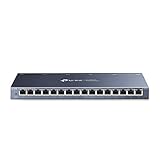
Overview: The TP-Link TL-SG116 is a robust 16-port unmanaged Gigabit Ethernet switch designed for seamless network expansion. Its fanless metal construction and energy-efficient technology make it ideal for small businesses, home offices, and noise-sensitive environments where reliability and quiet operation are paramount without breaking the budget.
What Makes It Stand Out: This switch distinguishes itself with an impressive 16-port density in a compact, fanless design that operates silently 24/7. The sturdy metal housing and shielded ports provide superior durability and EMI protection compared to plastic competitors. Advanced features like 802.1p/DSCP QoS and IGMP Snooping are rare finds in unmanaged switches, enabling basic traffic optimization for video streaming and VoIP without management complexity.
Value for Money: At $66.99, the TL-SG116 delivers exceptional value at approximately $4.19 per port. Competing 16-port switches often lack the premium metal build and advanced QoS features, typically costing $80-100. The energy-efficient technology significantly reduces long-term operational costs, making it a smart investment for growing networks that need reliable performance.
Strengths and Weaknesses:
- Strengths: Silent fanless operation; durable metal construction; advanced QoS and IGMP features; plug-and-play simplicity; excellent energy efficiency; high port density for expansion.
- Weaknesses: Unmanaged limitation restricts advanced configuration; no PoE support; may be overkill for basic home use; wall-mount requires separate hardware.
Bottom Line: The TL-SG116 is an outstanding choice for users needing reliable, quiet, and energy-efficient network expansion with premium build quality. It perfectly bridges the gap between basic unmanaged switches and complex managed solutions, making it ideal for small business deployments.
7. NETGEAR 8 Port PoE Gigabit Ethernet Easy Smart Managed Essentials Switch (GS308EP) - with 8 x PoE+ @ 62W, Desktop or Wall Mount
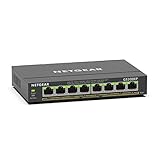
Overview: The NETGEAR GS308EP combines PoE+ convenience with smart managed features in an 8-port Gigabit switch. Delivering 62W total power budget across all ports, it enables deployment of IP cameras, VoIP phones, and wireless access points without separate power supplies, while offering basic network management capabilities for enhanced control.
What Makes It Stand Out: This switch uniquely integrates full PoE+ support on all eight ports with an intuitive Easy Smart management interface. The 62W power budget supports multiple high-power devices simultaneously, while features like VLAN, QoS, and traffic monitoring provide enterprise-lite control. NETGEAR’s industry-leading 3-year limited hardware warranty offers exceptional peace of mind rarely found in this category.
Value for Money: At $69.99, the GS308EP costs only $3 more than the non-PoE version, making PoE+ essentially free. Competing PoE+ switches typically start at $90-120. The combination of PoE capability, smart management, and premium warranty creates outstanding value for small-scale deployments requiring both power delivery and network control.
Strengths and Weaknesses:
- Strengths: PoE+ on all ports; generous 62W power budget; Easy Smart management features; excellent warranty coverage; reliable brand reputation; flexible placement options.
- Weaknesses: 62W may be insufficient for eight fully-loaded PoE+ devices; only 8 ports limits expansion; web interface can be slow; higher cost per port than non-PoE alternatives.
Bottom Line: The GS308EP is perfect for small business security systems or wireless networks needing PoE+ with basic management. It delivers professional features at a consumer-friendly price point, backed by NETGEAR’s reliable warranty and support infrastructure.
8. UGREEN Ethernet Switch, 5 Port Gigabit Ethernet Splitter, Plug & Play, Wall Mount & Desktop Network Switch Hub, Unmanaged, Compact, with LED, Fanless Quiet, for Internet Cable, Laptop, Router, NAS

Overview: The UGREEN 5-port Gigabit Ethernet switch is an ultra-affordable, no-frills network expansion solution for basic connectivity needs. Its compact, fanless design and universal plug-and-play compatibility make it ideal for home users, students, and small offices requiring simple, reliable network expansion without advanced features or complexity.
What Makes It Stand Out: This switch’s primary distinction is its remarkable sub-$8 price point, making it one of the most affordable Gigabit switches available. The versatile mounting options, broad OS compatibility, and completely silent operation provide unexpected flexibility for such an inexpensive device. Its energy-efficient design keeps power consumption minimal while maintaining full-duplex Gigabit speeds.
Value for Money: At $7.99, this switch redefines budget networking at roughly $1.60 per port. Even basic 5-port switches typically cost $15-25. While lacking advanced features, it delivers reliable Gigabit connectivity at a price that makes it nearly disposable, perfect for temporary setups or extending network access to remote rooms.
Strengths and Weaknesses:
- Strengths: Exceptionally affordable price; silent fanless operation; true plug-and-play simplicity; compact footprint; wide OS compatibility; low power consumption.
- Weaknesses: Plastic construction feels flimsy; no PoE support; no management features; limited to 5 ports; LED lights are overly bright; questionable long-term durability.
Bottom Line: The UGREEN switch is an unbeatable value for basic network expansion where cost is the primary concern. It’s perfect for home users needing extra ports for streaming devices or gaming consoles, but business users should invest in more robust solutions with better build quality and warranty support.
9. STEAMEMO 5-Port Gigabit Ethernet Switch | Smart Managed with VLAN/QoS | Plug & Play Desktop/Wall-Mount Network Hub w/ PoE in Design | Sturdy Metal & Energy-Efficient(Includes Power Adapter)

Overview: The STEAMEMO 5-port switch disrupts the market by offering smart managed features and innovative PoE-in capability at a budget price. This compact metal switch supports VLANs, QoS, and rate control while drawing power from an upstream PoE switch, making it ideal for flexible deployments in surveillance systems or temporary offices without convenient AC power.
What Makes It Stand Out: The unique PoE-in design allows installation anywhere without AC power, perfect for outdoor cameras or remote locations. Supporting up to 15 VLAN groups, port mirroring, and storm prevention, it delivers managed switch capabilities typically found in $50+ devices. The sturdy metal construction and included power adapter provide dual power options for maximum deployment flexibility.
Value for Money: At $12.99, this switch is a revelation, offering managed features at unmanaged prices. Competing smart switches cost 3-4 times more, and none offer PoE-in flexibility. For tech-savvy users needing VLAN segmentation or remote placement, it delivers professional-grade features that are simply unmatched in this price range.
Strengths and Weaknesses:
- Strengths: Innovative PoE-in power option; comprehensive VLAN and QoS support; sturdy metal build; includes power adapter; advanced traffic management; incredibly affordable for managed features.
- Weaknesses: Lesser-known brand; PoE-in requires upstream PoE switch; only 5 ports limit scalability; web interface may have translation issues; limited technical support resources.
Bottom Line: The STEAMEMO switch is a hidden gem for network enthusiasts and small businesses needing managed features on a shoestring budget. Its PoE-in capability solves unique installation challenges, making it perfect for security camera deployments or network segmentation in compact environments.
The Hidden Power Drain of Always-On Networks
Traditional Ethernet switches were designed for enterprise offices that powered down on evenings and weekends. They draw constant power per port regardless of whether a cable is plugged in, active, or idle. In a typical 24-port unmanaged switch, each port might consume 0.5-1 watt just sitting there—multiply that by 24 ports, then by 8,760 hours annually, and you’re looking at 100-200 kWh of pure waste before a single packet traverses the network.
Smart homes amplify this inefficiency. A 12-camera security system, multi-room streaming setup, and IoT mesh network might keep 16+ ports active continuously. Legacy switches lack the intelligence to detect actual data flow, meaning ports powering a rarely-triggered motion sensor and a 4K camera recording 24/7 receive identical power allocation. The cumulative effect? An extra $15-25 monthly on your electricity bill, purely from network infrastructure overhead.
What Makes an Ethernet Switch Truly Energy-Efficient?
Energy efficiency in modern switches transcends simple power ratings. True efficiency emerges from a holistic design philosophy integrating hardware architecture, firmware intelligence, and standards compliance. A genuinely efficient switch dynamically scales power delivery based on cable length, link status, and real-time traffic patterns. It employs advanced sleep states for idle ports, reduces PHY layer power consumption during low-traffic periods, and optimizes internal voltage regulation.
The most sophisticated models incorporate machine learning algorithms that learn your smart home’s traffic patterns—recognizing that your security cameras peak at night while your work devices dominate daytime hours. This allows predictive power budgeting that shifts wattage where and when it’s needed, cutting consumption during predictable lulls without manual intervention.
IEEE 802.3az: The Foundation of Modern Energy Savings
The IEEE 802.3az Energy Efficient Ethernet (EEE) standard, now universally implemented in 2026’s switch portfolios, fundamentally rethinks how Ethernet PHYs operate. When ports detect low utilization, EEE transitions links into Low Power Idle (LPI) mode within microseconds, reducing power draw by up to 70% per port during quiet periods. The magic lies in the handshake: both ends of the connection must support EEE, and the transition happens so rapidly—typically under 5 microseconds—that VoIP calls, video streams, and gaming sessions remain unaffected.
Critically, EEE’s effectiveness scales with your smart home’s diversity. A port connected to a climate sensor that transmits data every 30 seconds might spend 95% of its time in LPI mode, while a NAS backup link remains fully active. The standard also includes adaptive algorithms that learn traffic burst patterns, preventing power-cycling inefficiencies during sporadic but critical data transfers.
Beyond Standards: Proprietary Power-Saving Innovations
Leading manufacturers have pushed past IEEE 802.3az with proprietary enhancements that squeeze out additional savings. These include per-port voltage scaling that reduces power for shorter cable runs—since signal attenuation is lower over 10-meter runs versus 100-meter runs, the PHY can operate at lower transmit voltages. Another breakthrough involves intelligent link speed negotiation: a 10G-capable port connecting to a 100Mbps IoT device will downclock its entire PHY pipeline, saving up to 40% compared to running at full speed with throttled data.
Some advanced switches now feature “port hibernation” for devices that go offline predictably—like smart irrigation controllers in winter—completely cutting power while maintaining configuration states. When spring arrives, wake-on-LAN packets or scheduled timers reactivate ports without manual intervention. These features typically require managed switches with sophisticated firmware, but the 5-10% additional savings compound significantly over years of operation.
Calculating Real-World Power Savings in 24/7 Operations
Translating manufacturer claims into actual dollar savings requires understanding duty cycles and your specific device ecosystem. Start by auditing your network: document each connected device, its typical data throughput, and connection duration. A practical formula: Annual Savings = (Baseline Watts - Efficient Watts) × 24 × 365 ÷ 1000 × kWh Rate.
For a 16-port smart home setup, baseline power might be 80W (5W per port constant). An efficient switch with EEE and intelligent management might average 55W under identical loads—a 31% reduction. At $0.13/kWh, that’s $28.50 annually. Factor in PoE efficiency gains for powered devices, and savings can exceed $50/year. Over a 5-year switch lifespan, the energy savings often offset the premium price of enterprise-grade efficient hardware.
Key Features to Prioritize in 2026’s Market
The 2026 switch landscape introduces several non-negotiable features for smart home applications. Look for dynamic PoE budgeting with per-port wattage caps, AI-driven traffic analysis for predictive power management, and multi-gigabit ports that maintain efficiency at 2.5G and 5G speeds. Fanless designs with extended temperature ranges indicate superior thermal engineering, directly correlating with lower power consumption.
Pay attention to buffer memory architecture—switches with deeper, more efficient buffers reduce packet retransmissions, which indirectly saves power by minimizing active transmission time. Also prioritize models with modular power supplies; external adapters often achieve higher efficiency ratings (80 PLUS Titanium) than internal PSUs, and they allow replacement if standards improve.
Port Count and Configuration: Right-Sizing Your Network
Overshooting port count is the most common efficiency mistake. Each unused port still consumes 0.3-0.5W in standby, so a 48-port switch in a 12-device smart home wastes 10-15W continuously. Calculate your current device count, add 20% for growth, and select the smallest switch that accommodates that number. For most smart homes, 16-24 ports hits the sweet spot.
Consider port configuration carefully. A switch with eight PoE++ ports and eight standard ports offers more flexibility than 16 PoE ports when half your devices don’t require power. Some 2026 models feature software-defined PoE, allowing any port to become powered or unpowered via firmware, eliminating hardware constraints and optimizing power distribution across the entire switch.
PoE Efficiency: Powering Devices Without Waste
Power over Ethernet efficiency has become a critical differentiator. PoE++ (IEEE 802.3bt) delivers up to 90W per port but historically suffered from 15-20% conversion losses at the switch. Modern implementations use synchronous rectification and advanced DC-DC converters to achieve >95% efficiency. More importantly, intelligent PoE management now performs real-time power classification—if your 4K camera only draws 7W despite being allocated 15W, the switch reclaims that 8W surplus for other devices.
Look for per-port power monitoring with milliamp-precision reporting. This lets you identify inefficient devices: that “smart” light bulb drawing 12W via PoE when it should use 3W is costing you money. Some switches automatically negotiate lower power modes with compliant endpoints, enforcing efficiency at the device level rather than just the infrastructure level.
Intelligent Power Management Systems
The firmware layer separates good switches from great ones. Modern systems offer time-based power profiles—imagine your guest room ports powering down at 11 PM and reactivating at 7 AM automatically. Load-based fan control uses thermal sensors to spin fans only when necessary, with many 2026 models remaining passive-cooled under typical smart home loads.
Advanced implementations include cable diagnostics with power impact assessment. If a port detects a poor-quality cable causing signal retransmissions, it can either increase power marginally to improve signal integrity or alert you to replace the cable—preventing chronic inefficiency. The best systems integrate with home automation platforms like Home Assistant, allowing power consumption to trigger scenes: “If switch power draw exceeds 80W, turn off non-essential smart displays.”
The Role of Silicon Architecture in Modern Efficiency
The semiconductor revolution of 2025-2026 has fundamentally altered switch efficiency. New 5nm and 3nm process nodes for switch ASICs reduce leakage current by orders of magnitude compared to 28nm chips common in 2023 hardware. These modern chips integrate the PHY, switch fabric, and ARM management CPU into a single die, eliminating inter-chip communication overhead that wasted watts.
Fully integrated MAC/PHY designs also enable faster state transitions. When a port enters LPI mode, the entire pipeline from physical layer to buffer memory powers down in nanoseconds rather than microseconds, capturing more savings during millisecond-long traffic gaps. This architectural shift explains why 2026 switches achieve 30% savings over 2023 models despite using the same EEE standard—the implementation has simply become vastly more refined.
Heat Dissipation and Passive Cooling Designs
Every watt consumed becomes heat that must be removed. Inefficient switches require fans that consume 3-5W themselves and degrade over time. Modern efficient switches leverage thermal pad materials with 15W/mK conductivity and aluminum heatsink designs optimized through computational fluid dynamics to dissipate heat through natural convection.
For smart home installations, prioritize switches rated for 50°C ambient operation without active cooling. These models position high-power components vertically aligned with heatsink fins, creating chimney effects. Some designs even use phase-change thermal materials that absorb heat bursts during data spikes and release it gradually, preventing thermal throttling without constant airflow. A passive-cooled switch not only saves fan power but also operates silently and lasts longer—capacitor lifespan doubles for every 10°C reduction in operating temperature.
Future-Proofing: Wi-Fi 7 and Multi-Gigabit Considerations
Wi-Fi 7’s 320MHz channels and 46Gbps theoretical throughput demand multi-gigabit backhaul, but faster ports don’t have to mean higher power consumption. Modern 2.5GBASE-T and 5GBASE-T PHYs use cable length detection to modulate transmit power—short runs to Wi-Fi 7 access points use significantly less power than long runs at identical speeds.
When planning for Wi-Fi 7, consider switches with mixed-port configurations: four 10G SFP+ ports for backbone connections and 16 2.5G RJ45 ports for APs. This avoids powering 10G PHYs for devices that can’t utilize them. Also look for Energy Efficient Ethernet support at 2.5G/5G speeds—a recent 2026 advancement that extends EEE beyond traditional 1G ports, ensuring your future-proofing doesn’t become a power penalty.
Smart Home Integration and Management
An energy-efficient switch should be a first-class citizen in your smart home ecosystem, not a black box. Modern switches offer MQTT telemetry broadcasting real-time power consumption per port, allowing you to create dashboards in Home Assistant or Node-RED. RESTful APIs enable programmatic control: automatically power-cycle a hung security camera by cutting PoE for 10 seconds via automation script.
Look for SNMP v3 with encryption for secure monitoring, and LLDP (Link Layer Discovery Protocol) support that maps network topology automatically. When your home automation system knows the switch is port 5, it can correlate device behavior with power draw—essential for diagnosing that mysterious 3 AM power spike.
Remote Monitoring and Automation
Cloud-managed switches have evolved beyond enterprise toys into powerful smart home tools. These platforms provide AI-analyzed efficiency reports, identifying devices that could operate at lower link speeds or PoE classes. They also enable geofenced power management: when your phone leaves home, non-essential ports (smart mirrors, display panels) automatically hibernate.
However, evaluate local failover capabilities. A switch that can’t manage power locally when internet drops becomes a liability. The best designs offer hybrid management: cloud for convenience, local MQTT/API for reliability. Also consider power event logging with timestamps—when your utility company claims a voltage sag, you’ll have data proving it damaged your switch’s efficiency profile.
Firmware Updates and Long-Term Support
A switch’s efficiency profile improves over time through firmware updates. Manufacturers committed to sustainability release quarterly power management enhancements—tuning LPI transition thresholds, improving PoE classification accuracy, and reducing CPU idle power. Before purchasing, investigate the manufacturer’s firmware track record: Do they provide updates 3+ years post-launch? Is the update process zero-downtime?
Some 2026 switches feature A/B firmware partitions, allowing you to test efficiency improvements on a backup firmware image before committing. This is crucial for 24/7 smart homes where a buggy update could leave security systems offline. Also verify rollback capabilities and community support—open-source firmware projects like OpenWrt often extract another 5-10% efficiency through aggressive power tuning.
Environmental Certifications That Actually Matter
ENERGY STAR certification for network equipment became stringent in 2025, now requiring idle power testing with realistic cable lengths and dynamic load efficiency measurements. A switch bearing the 2026 ENERGY STAR logo must demonstrate <3W base consumption for a 16-port model and >85% average efficiency across 10%, 50%, and 100% load scenarios.
EPEAT Bronze/Silver/Gold ratings add criteria for recycled material content and modular repairability—a Gold-rated switch must have user-replaceable power supplies and fan modules. For European readers, TÜV Rheinland’s Green Product Mark includes carbon footprint disclosure, letting you compare lifecycle emissions. Avoid outdated certifications like RoHS compliance alone; it’s a baseline requirement, not an efficiency indicator.
Installation Best Practices for Maximum Efficiency
Even the most efficient switch wastes power when installed poorly. Cable length minimization is paramount: every extra meter of Cat6a increases PHY transmit power requirements. Centralize your switch location to keep runs under 30 meters where possible. Use shielded, high-quality cables with proper grounding—poor cables cause retransmissions that force ports to stay active longer.
Vertical mounting improves passive cooling by 15-20% compared to horizontal placement, as it aligns with natural convection currents. Ensure 2-inch clearance above and below the switch, and never stack equipment. For PoE deployments, home-run each cable directly from switch to device; daisy-chaining injectors or midspans introduces conversion losses. Configure port shutdown schedules for areas like guest suites—most managed switches support cron-style scheduling via CLI.
Troubleshooting Common Efficiency Issues
If your efficient switch isn’t delivering promised savings, first verify EEE negotiation using the switch’s management interface. Some older smart home devices have buggy EEE implementations that cause frequent LPI transitions, ironically increasing power. Disable EEE on those specific ports rather than globally.
PoE classification mismatches are another culprit. If a device is classified as Class 4 (30W) but only uses 5W, the switch might reserve 30W unnecessarily. Manually override classification via LLDP-MED or static configuration. Also check for broadcast storms from malfunctioning IoT devices—these keep ports out of LPI mode. Enable broadcast rate limiting to contain such issues. Finally, firmware bugs sometimes cause ports to report “idle” while still consuming full power; a factory reset and reconfiguration often resolves this.
Frequently Asked Questions
What does 30% power savings translate to in real dollars for a typical smart home?
For a 16-device smart home network consuming 80W continuously, a 30% reduction saves 210 kWh annually. At average US electricity rates ($0.13/kWh), that’s $27.30 per year. With PoE optimization for cameras and access points, savings often reach $45-60 annually. Over a 5-year switch lifespan, expect $200-300 in total savings—often covering the price premium over less efficient models.
How does Energy Efficient Ethernet (EEE) affect latency-sensitive applications like gaming or VoIP?
EEE’s LPI mode transitions in under 5 microseconds, which is imperceptible for applications requiring <10ms latency. However, for competitive gaming where every microsecond counts, most switches allow per-port EEE disabling. Modern implementations use predictive algorithms that recognize gaming traffic patterns and temporarily inhibit LPI during active sessions, delivering both efficiency and performance.
Are energy-efficient managed switches worth the cost over unmanaged models?
For smart homes with 10+ devices, absolutely. The per-port power monitoring and PoE management features alone typically pay back the $30-50 premium within 18-24 months through optimized power allocation. Managed switches also provide visibility into inefficiencies you can’t diagnose otherwise, like a device drawing excess PoE or a port stuck at high speed for a low-bandwidth sensor.
Can I mix energy-efficient switches with older, non-EEE hardware?
Yes, but EEE only activates between two compatible devices. If you connect an old switch to a new efficient switch, that specific link operates at full power. However, the efficient switch still optimizes all other ports. Consider using the old switch for non-critical, high-traffic devices (like a NAS that never idles) and the efficient switch for IoT and cameras where EEE provides maximum benefit.
What’s the difference between PoE+ and PoE++ efficiency in practical terms?
PoE++ (802.3bt) includes mandatory efficiency requirements: power sourcing equipment must achieve >90% conversion efficiency versus >85% for PoE+ (802.3at). More importantly, PoE++ introduces autoclass and power demotion features that dynamically adjust power allocation based on actual device needs, reducing reserved but unused wattage by up to 40% compared to PoE+’s static classification.
Do I need a 10G switch for Wi-Fi 7, or will 2.5G suffice?
For most Wi-Fi 7 access points, 2.5G provides sufficient backhaul. A 2.5G port consumes 30-40% less power than a 10G port when operating at 2.5G speeds. Only deploy 10G for devices that can saturate that bandwidth (like a high-performance NAS). Many 2026 switches offer smart rate ports that negotiate the most efficient speed, automatically selecting 2.5G for APs and 10G for servers.
How can I verify my switch is actually saving power?
Use the switch’s built-in power monitoring (SNMP OID 1.3.6.1.2.1.105.1.3.1.1.8 for PoE). Graph consumption over time with tools like Grafana. Perform A/B tests: measure total outlet power draw with all devices active, then disconnect half the devices and compare expected versus actual reduction. An efficient switch will show disproportionately larger savings due to LPI mode activation on idle ports.
Will using shorter Ethernet cables really make a noticeable difference?
Yes. PHY chips adjust transmit voltage based on cable length detection. A 10-meter run might use 1.2V, while a 100-meter run uses 2.5V—more than doubling power per port. In a 16-port setup, keeping runs under 30 meters saves approximately 8-12W continuously, translating to $10-15 annually. It also reduces heat, extending component lifespan.
Are there utility rebates or tax incentives for energy-efficient networking equipment?
Several US states (California, New York, Massachusetts) now include network equipment in their energy efficiency rebate programs, offering $20-50 per ENERGY STAR certified switch. The Inflation Reduction Act’s 25C tax credit covers “energy-efficient building envelope components,” and some interpretations include network infrastructure for smart homes with integrated energy management systems. Check Database of State Incentives for Renewables & Efficiency (DSIRE) for current programs.
How long should I expect firmware support for power management features?
Leading manufacturers committed to sustainability guarantee 5 years of firmware updates for enterprise switches and 3 years for prosumer models. However, the community-driven OpenWrt project extends support to 7+ years for popular hardware. Before buying, verify the manufacturer publishes a Product End-of-Life (EOL) policy and check community forums for active development. A switch abandoned after 2 years may never receive optimizations for new devices, locking you out of future 5-10% efficiency gains.