Remember when ceiling fans were just those wobbly things with pull chains that made clicking noises? Well, 2026 is officially the year they became the unexpected heroes of smart home design. We’re witnessing a fascinating convergence where ceiling fans aren’t just moving air anymore—they’re becoming intelligent lighting hubs, energy managers, and even wellness devices that respond to your daily rhythms.
Integrated lighting has transformed these fixtures from functional afterthoughts into architectural centerpieces, blending seamless automation with sophisticated aesthetics. But with this evolution comes genuine complexity. How do you choose between DC and AC motors when both claim “whisper-quiet” operation? What does “circadian-ready” actually mean for your sleep quality? And why does blade pitch matter more than ever in smart models? Let’s dive into everything you need to know before investing in this game-changing technology.
Top 10 Smart Ceiling Fans with Integrated Lighting
Detailed Product Reviews
1. 60 Inch Smart Ceiling Fan with Lights Remote,Control via Voice Alexa Google App Wifi,Silent DC Motor,Dimmable,Outdoor Indoor Modern Ceiling Fans for Large Bedroom Living Room Patio,Gold White Black
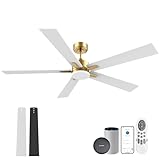
Overview: This 60-inch smart ceiling fan from Lorpies delivers powerful airflow for large spaces up to 5075 CFM while maintaining whisper-quiet operation below 30dB. Designed for both indoor and covered outdoor areas, it integrates modern smart home convenience with versatile lighting options and a reversible DC motor for year-round comfort.
What Makes It Stand Out: The combination of massive 60-inch span with near-silent operation sets this fan apart, particularly for large bedrooms or living areas where noise is a concern. Its triple-control system—voice commands via Alexa/Google, smartphone app, and dual-purpose remote—ensures you’ll never be without control options. The ability to switch between white and black blades adds uncommon aesthetic flexibility.
Value for Money: At $159.99, this fan punches above its weight class, offering premium features like damp-rating for patios, dual downrods (6" and 12"), and energy-efficient DC motor technology typically found in more expensive models. Comparable smart fans with similar CFM ratings often exceed $200, making this an excellent mid-range choice that doesn’t sacrifice capability.
Strengths and Weaknesses:
- Pros: Exceptionally quiet operation; versatile triple-control system; high airflow for large rooms; reversible motor for seasonal use; damp-rated for covered outdoor spaces; interchangeable blade colors
- Cons: 60-inch size may overwhelm smaller rooms; installation requires minimum 15° ceiling pitch for angled mounts; app connectivity occasionally lags during initial setup
Bottom Line: Perfect for large spaces requiring powerful, silent airflow with full smart home integration, this fan delivers premium performance at a competitive price point.
2. 52in Smart Low Profile Ceiling Fans with Lights Remote,Quiet DC Motor,Outdoor Indoor Flush Mount Ceiling Fan,Control with WIFI Alexa App,Dimmable,6-speed,3 White Wood blades,for Modern Bedroom Patio

Overview: This 52-inch flush-mount ceiling fan addresses low-ceiling installations without sacrificing smart functionality or performance. Operating at just 8.3 inches from ceiling to blade, it produces 4124 CFM of airflow while staying under 30dB, making it ideal for modern bedrooms, nurseries, or covered patios with height restrictions.
What Makes It Stand Out: The dedicated low-profile design is the star here, accommodating ceilings as low as 8 feet while still offering full smart integration. Its triple-control redundancy—voice, app, and remote—ensures accessibility even when WiFi fails. The white wood blades provide a contemporary aesthetic that suits minimalist decors better than traditional fan designs.
Value for Money: Priced at $149.98, this fan offers exceptional value for low-ceiling applications where standard downrod fans won’t work. While its 4124 CFM is modest compared to larger models, the specialized flush-mount design and smart features at this price point are impressive. Installation restrictions (no sloped ceilings, specific ceiling materials only) limit flexibility but target its intended market perfectly.
Strengths and Weaknesses:
- Pros: Ultra-low 8.3-inch profile; whisper-quiet operation; triple-control system; damp-rated for covered outdoor use; energy-efficient DC motor; easy installation
- Cons: Flush-mount only—no angled ceiling compatibility; limited to specific ceiling materials; lower airflow than standard-mount alternatives; no blade color options
Bottom Line: An excellent specialized solution for low-ceiling spaces requiring smart control, delivering quiet performance where traditional fans simply won’t fit.
3. Lumary Smart Ceiling Fan Light with 2200K Nightlight, WiFi & Bluetooth Low Profile Ceiling Fan with Light Remote for Bedroom, RGBAI & 42 Scenes Mode, Flush Mount Easy to Install, 5000 LM, 19in Black

Overview: The Lumary Smart Ceiling Fan redefines bedroom lighting with its innovative circular 2200K nightlight and RGBAI color system. This compact 19-inch flush-mount unit delivers an impressive 5000 lumens of adjustable brightness while maintaining ultra-quiet 32dB operation, making it perfect for bedrooms, nurseries, and home offices.
What Makes It Stand Out: The exclusive ring-shaped nightlight is a game-changer for nocturnal navigation without sleep disruption. With 16 million RGBAI colors and 42 scene modes, this fan transforms from functional appliance to dynamic ambiance creator. The 5000-lumen output rivals traditional fixtures while the brushless DC motor consumes 70% less energy than AC alternatives.
Value for Money: At $169.99, Lumary commands a premium over basic smart fans but justifies it with unique lighting capabilities. The RGBAI system and dedicated nightlight feature are rare at this price point, though the 19-inch size limits coverage to smaller rooms. For bedroom-specific use, the specialized features outweigh the size constraint.
Strengths and Weaknesses:
- Pros: Unique nightlight feature; 16 million RGBAI colors; exceptional 5000-lumen brightness; whisper-quiet operation; energy-efficient DC motor; easy flush-mount installation; Bluetooth remote included
- Cons: 19-inch diameter too small for large rooms; limited airflow compared to 52"+ fans; 2.4GHz WiFi only; no damp-rating for outdoor use
Bottom Line: Ideal for tech-savvy users prioritizing lighting innovation over maximum airflow, particularly in bedrooms where the nightlight feature shines brightest.
4. Dreo Smart Ceiling Fans with Lights, Low Profile Ceiling Fan with Alexa/App, 52’’ Dimmable Lighting & Color Tuning, RGB Ambient Light for Living Room, Game Room, Easy Installation, Quiet, Black

Overview: Dreo’s 52-inch smart ceiling fan targets the premium market with powerful 6040 CFM airflow and extensive customization options. This low-profile black fan combines robust performance with sophisticated RGB ambient lighting, offering six brightness levels, five color temperatures, and multiple preset modes for living spaces and game rooms.
What Makes It Stand Out: The granular control is exceptional—12 app-adjustable speeds beyond the standard six, plus three operational modes (Sleep, Natural, Auto) provide unmatched customization. The RGB ambient lighting with Constant, Breath, and Circle modes creates immersive atmospheres for gaming or entertainment. The one-blade-one-screw installation system significantly reduces setup frustration.
Value for Money: At $219.99, this is the most expensive option but delivers premium features absent in cheaper models. The high CFM rating, advanced RGB system, and memory function justify the price for users wanting maximum control. However, budget-conscious buyers may find comparable airflow and basic smart features for $50-70 less.
Strengths and Weaknesses:
- Pros: Powerful 6040 CFM airflow; extensive RGB customization; 12 app speeds + 3 modes; memory function; easy installation; quiet operation; memory function and timer
- Cons: Highest price point; 45dB noise level slightly higher than competitors; no outdoor/damp rating; limited to flat ceilings only
Bottom Line: Best suited for tech enthusiasts and gamers wanting maximum customization and airflow, willing to pay premium for advanced RGB and granular control features.
5. Sofucor 52 Inch Ceiling Fans with Lights, Smart Indoor/Outdoor Ceiling Fan With Remote, Work with Alexa/Google, Quiet Reversible DC Motor, 6-Speed, 8 Blade Black Ceiling Fans for Patio Bedroom Garage
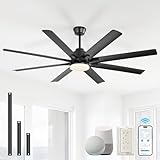
Overview: Sofucor’s 8-blade design generates an impressive 6500 CFM airflow, making it the most powerful option for spaces up to 25x25 feet. This versatile fan transitions seamlessly between indoor bedrooms and covered outdoor patios, featuring a quiet reversible DC motor that operates at just 35dB standard or 30dB in deep sleep mode.
What Makes It Stand Out: The eight-blade configuration produces superior air circulation compared to standard three-blade designs. Its triple downrod set (5", 10", 24") and ±15° tilt capability accommodate virtually any ceiling type, from low-profile to vaulted. The unified control system integrates voice, app, and remote without compromising functionality.
Value for Money: At $142.99, this fan offers the highest CFM-per-dollar ratio while maintaining premium smart features. The damp-rating and versatile mounting options eliminate the need for separate indoor/outdoor fans. While it lacks RGB lighting, the core performance and flexibility make it the best value for large space coverage.
Strengths and Weaknesses:
- Pros: Highest airflow (6500 CFM) at lowest price; 8-blade efficiency; triple downrod options; tilt-capable for vaulted ceilings; damp-rated; ultra-quiet sleep mode; reversible for energy savings
- Cons: No RGB or color-changing lights; basic dimming only; larger blade count may not suit all aesthetics; remote lacks advanced preset modes
Bottom Line: The top choice for buyers prioritizing maximum airflow and installation versatility over advanced lighting features, delivering exceptional value for large indoor and covered outdoor spaces.
6. Fszdorj 23.6’’ Ceiling Fan with Light, Upgraded Low Profile Fan, Flush Mount Ceiling Fan, 6 Speeds, Dimmable LED, App & Remote Control, Quiet DC Motor, for Bedroom, Living Room, F115 Black
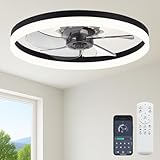
Overview: The Fszdorj 23.6" ceiling fan targets modern homeowners seeking compact, smart climate control with unique lighting options. This flush-mount unit combines a dimmable LED main light with a revolutionary standalone night light, controlled via app or remote. Its low-profile design suits bedrooms and living rooms with ceiling height constraints, while the quiet DC motor promises year-round comfort through reversible airflow and six speed settings.
What Makes It Stand Out: The independent night light system truly distinguishes this fan, offering three preset colors (violet, warm blue, soft warm) that can be mixed with the main light for customized ambiance. Unlike competitors with single light sources, this dual-light approach creates sophisticated mood lighting scenarios. The cancelled remote beep noise shows attention to user experience details often overlooked in this price category.
Value for Money: At $119.90, this fan sits in the mid-range sweet spot. You’re paying slightly more than basic models but gaining unique lighting flexibility and premium features like memory function and independent light control. Comparable fans with app control typically start at $100+, making the night light innovation a worthwhile premium for ambiance-focused buyers.
Strengths and Weaknesses: Strengths include the innovative dual-light system, whisper-quiet operation, comprehensive app/remote control with memory function, and reversible 6-speed motor. The 2-year support provides peace of mind. Weaknesses are the relatively small 23.6" blade span, limiting coverage for larger rooms, and the black finish may not suit all decor schemes.
Bottom Line: The Fszdorj excels for bedroom installations where ambiance matters as much as airflow. If you value customizable lighting over maximum air circulation, this fan delivers exceptional functionality at a fair price point.
7. Low Profile Ceiling Fans with Lights, Dimmable Smart RGB Ceiling Fan with Alexa/Google Assistant/App/Remote Control, 6-Speeds Reversible Woodgrain LED Ceiling Fan for Bedroom Kitchen Foyer
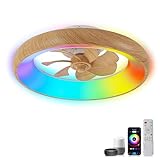
Overview: This smart ceiling fan merges farmhouse aesthetics with cutting-edge RGB lighting technology, creating a versatile fixture for modern rustic interiors. The 7-blade enclosed design houses a 30W LED system delivering 3600 lumens, while integration with Alexa and Google Assistant enables hands-free operation. Designed for low ceilings, it serves bedrooms, kitchens, and foyers seeking both functional airflow and statement lighting.
What Makes It Stand Out: The RGB mood lighting system with cycle modes transforms this from mere appliance to dynamic decor element. Few competitors offer true color-changing capabilities alongside stepless white temperature adjustment (3000K-6000K). The farmhouse woodgrain finish provides authentic rustic charm without sacrificing smart functionality, appealing to design-conscious homeowners who refuse to choose between style and technology.
Value for Money: Priced at $128.99, this fan commands a modest premium over standard smart fans. The RGB capability and high lumen output justify the cost for those wanting atmospheric lighting options. While you can find cheaper smart fans, the farmhouse styling and mood lighting modes are rarely bundled at this price, making it strong value for decor-focused buyers.
Strengths and Weaknesses: Strengths include versatile control options (voice/app/remote), powerful 3600-lumen output, reversible 6-speed motor, timer settings, and authentic farmhouse design. The RGB system offers genuine customization. Weaknesses: the enclosed 7-blade design may reduce maximum airflow efficiency compared to traditional blade fans, and the specific aesthetic won’t suit contemporary or minimalist spaces.
Bottom Line: Perfect for farmhouse, Scandinavian, or coastal decor enthusiasts wanting smart home integration. If RGB mood lighting and rustic style are priorities, this fan delivers impressive functionality without breaking the budget.
8. Ruibutrade Flower Modern Ceiling Fans with Lights, Low Profile Ceiling Fan with Remote for Bedroom, Flush Mount Ceiling Fan with LED Dimmable Light,3-Colors, 6-Speeds, Timing CeilingFan Lights-White
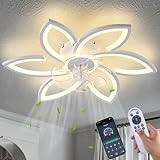
Overview: The Ruibutrade Flower ceiling fan distinguishes itself through artistic design, featuring a flower-shaped aesthetic that elevates it beyond typical flush-mount fixtures. At 30 inches with integrated 3-color LED lighting (3000K-6000K), this unit targets style-conscious homeowners with low ceilings. The quiet DC motor provides reversible airflow across six speeds, while dual control methods offer modern convenience for bedrooms, kitchens, and living spaces.
What Makes It Stand Out: The flower-shaped design is the obvious differentiator, offering sculptural appeal rarely found in ceiling fans under $100. This aesthetic choice doesn’t compromise functionality—you still get app control, stepless dimming, and seasonal reversible operation. The robust warranty package (2-year motor, 1-year parts) provides confidence uncommon in budget-friendly decorative fans.
Value for Money: At $99.99, this fan represents excellent value for design-focused buyers. Competitors with similar smart features typically cost $120+, while decorative fans often sacrifice functionality for form. Ruibutrade successfully balances both, making it ideal for renters or homeowners wanting visual impact without premium pricing.
Strengths and Weaknesses: Strengths include the unique flower design, quiet reversible motor, comprehensive control options, stepless dimming, and strong warranty support. The 30-inch size suits small-to-medium rooms perfectly. Weaknesses: the specific floral aesthetic may not align with all interior styles, and the brand recognition is lower than established competitors, potentially affecting long-term support reliability.
Bottom Line: An outstanding choice for those prioritizing design flair in smaller spaces. If you want a ceiling fan that doubles as a conversation piece while delivering solid performance, the Ruibutrade Flower fan offers compelling value.
9. SEHAUSEU LED Ceiling Fan, 20" Low Profile Ceiling Fan with Lights and Remote, 6 Speeds, Dimmable 3000K–6500K LED, App & Remote Control, for Bedroom/Kitchen/Living Room, White

Overview: The SEHAUSEU LED Ceiling Fan redefines budget smart home cooling with its remarkable $42.99 price point. This ultra-compact 20-inch unit combines oscillating airflow with full-spectrum LED lighting and multiple control methods. Despite its diminutive size, it packs impressive features: app/voice/remote control, 6-speed reversible motor, and flexible timer settings. Targeted at small spaces like kitchens, offices, or bedrooms where every dollar counts.
What Makes It Stand Out: The oscillation function at this price is genuinely revolutionary—most fans under $100 are fixed-direction. Combined with voice control integration and a 4-setting timer (1/2/4/8 hours), SEHAUSEU delivers premium features typically found in units costing three times more. The multi-directional airflow ensures even distribution in tight spaces where traditional fans create uncomfortable drafts.
Value for Money: Exceptional doesn’t begin to describe the value. At $42.99, this is the entry-level smart fan benchmark. You’re sacrificing blade span and brand prestige but gaining core smart functionality and unique oscillation. For renters, small apartments, or supplementary cooling, it’s nearly impossible to beat. Comparable oscillating smart fans start around $150.
Strengths and Weaknesses: Strengths include unbeatable pricing, oscillation capability, multiple control methods, reversible motor, and flexible timer. The 3000K-6500K dimming range is comprehensive. Weaknesses: the 20-inch size limits coverage to very small rooms only, build quality and motor longevity are questionable at this price, and customer support may be less robust than premium brands.
Bottom Line: Buy this for small spaces where budget is the primary constraint. It’s a feature-packed marvel for the price, but manage expectations regarding durability and coverage area.
10. Dreo Smart Ceiling Fan with Lights, 52 Inch, 12 Speeds & 3 Fan Modes, Stepless Color Tones, Dimmable LED Light, 12H Timer, Quiet DC Motor, Remote/APP/Alexa Control, White Ceiling Fans Indoor

Overview: The Dreo Smart Ceiling Fan represents the premium tier of smart climate control, boasting a substantial 52-inch blade span and class-leading 12-speed motor with three distinct wind modes. Engineered for discerning homeowners, this unit delivers up to 5673 CFM through a brushless DC motor while maintaining whisper-quiet operation. Full smart integration with Alexa, Google Home, and a dedicated app provides unprecedented customization for large living spaces and bedrooms.
What Makes It Stand Out: The 12-speed granularity and three wind modes (Natural, Normal, Sleep) create a tailored airflow experience unmatched by competitors. Most fans offer 6 speeds at best. The brushless DC motor technology reduces friction and noise dramatically, while customizable preset routines automate scenes for reading, working, or sleeping. This is smart home climate control elevated to an art form.
Value for Money: At $198.07, Dreo commands a premium but justifies it through superior engineering and features. The 5673 CFM output, 12-speed control, and advanced motor technology place it alongside commercial-grade fans costing $300+. For large rooms requiring serious airflow with silent operation, the investment pays dividends in comfort and energy efficiency.
Strengths and Weaknesses: Strengths include exceptional airflow performance, ultra-quiet brushless motor, extensive speed/mode options, 12-hour timer, seamless smart integration, and full lighting customization (2700K-6500K). The build quality is premium. Weaknesses: the 52-inch size may overwhelm smaller rooms, and the higher price point puts it out of reach for budget-conscious buyers. Installation complexity increases with larger units.
Bottom Line: For large spaces where performance and silence are non-negotiable, the Dreo is the clear winner. If you want the best smart fan technology available and have the room to accommodate it, this is your top-tier choice.
The Evolution of Smart Ceiling Fans
The smart ceiling fan category has matured dramatically since those early Wi-Fi-enabled models that simply replaced your remote control. In 2026, we’re seeing true integration—fans that communicate with your thermostat, respond to air quality sensors, and adjust lighting based on the sun’s position. The technology has shifted from gimmicky app controls to genuine home ecosystem players.
Modern units feature onboard processors capable of running complex algorithms that learn your preferences over time. They don’t just respond to commands; they anticipate needs. For instance, advanced models now integrate with occupancy sensors to activate when you enter a room, adjusting both airflow and lighting intensity based on time of day and historical usage patterns. This represents a fundamental shift from reactive to proactive climate control.
Why Integrated Lighting Changes Everything
The marriage of illumination and air circulation in a single fixture solves multiple design and functional challenges. From an electrical standpoint, you’re eliminating separate switch legs and reducing ceiling clutter. But the real magic happens in the software layer.
Integrated systems can coordinate light temperature with fan speed to create specific “scenes”—imagine a “concentration mode” with cool, bright lighting and gentle air movement, or a “wind-down scene” with warm amber glow and barely perceptible breeze. This synchronization wasn’t possible when fans and lights operated as separate systems. The unified control also means you can manage both functions through single voice commands or automation routines, reducing friction in your daily smart home interactions.
Key Smart Features to Look For in 2026
Voice Assistant Integration
Gone are the days of limited compatibility. Today’s premium smart fans support multi-assistant architectures, meaning they can simultaneously respond to Alexa, Google Assistant, and Siri without preference conflicts. Look for natural language processing capabilities that understand contextual commands like “make it feel like a spring morning”—which might trigger specific light temperature, fan speed, and even oscillation patterns.
App Control and Connectivity
The best apps in 2026 offer offline functionality, so you’re not helpless when the internet goes down. They provide granular control over fan curves (the relationship between speed settings and actual RPM), lighting transition times, and even blade direction scheduling. Pay attention to connectivity protocols: Thread-enabled devices with Matter certification offer the most robust mesh networking and future-proof compatibility.
Automation and Scheduling
Basic scheduling is table stakes now. Advanced automation includes geofencing that prepares your home as you commute, humidity-triggered responses that prevent mold in bathrooms, and temperature differentials that work in concert with your HVAC system. The most sophisticated models incorporate machine learning that recognizes when you’re home early on a hot day and preemptively cools your space using optimal efficiency patterns.
Understanding Lighting Integration
LED Technology Advancements
2026’s integrated LEDs have moved beyond simple diode arrays. We’re seeing chip-on-board (COB) technology that provides more uniform light distribution and better thermal management. The key specification is luminous efficacy—aim for 120+ lumens per watt. Also consider the Color Rendering Index (CRI); values above 90 ensure your home’s colors appear true and vibrant, crucial for spaces where you entertain or work.
Color Temperature and Dimming Capabilities
Variable CCT (Correlated Color Temperature) from 2200K to 6500K is now standard, but the granularity matters. Look for fans offering 100K increments rather than coarse 500K jumps. Dimming protocols have also evolved: PWM (Pulse Width Modulation) at high frequencies (10kHz+) eliminates flicker that can cause eye strain and headaches. Some premium models even offer independent control of uplight and downlight, creating layered lighting effects from a single fixture.
Circadian Rhythm Support
This is where 2026 technology truly shines. True circadian fans integrate with your calendar and local sunrise/sunset data, automatically adjusting light spectrum throughout the day to support your natural hormone cycles. Morning light includes subtle blue wavelengths to suppress melatonin, while evening illumination gradually shifts to amber-red spectrums that promote relaxation. The fan component supports this by adjusting airflow to complement your body’s natural temperature regulation cycles.
Energy Efficiency: What the Numbers Mean
Don’t just look at the Energy Star label—dig into the specifics. The critical metric is CFM per watt (cubic feet of air moved per minute, per watt consumed). In 2026, excellent efficiency starts at 6000 CFM per watt for standard models, with premium DC-motor units exceeding 8000 CFM per watt.
For lighting, understand that the advertised wattage is often the maximum draw; typical usage might be 30-40% lower. Look for power factor correction (PFC) circuitry, which reduces reactive power waste and can lower your electricity bill by 8-12% annually. Some utilities now offer rebates specifically for smart fans with PFC, so check your local programs.
Sizing and Placement Considerations
Room Size and Blade Span
The old rules still apply but with smart-specific caveats. For rooms up to 75 square feet, a 36-inch fan works, but consider that smart features shine in spaces you actually occupy. Medium rooms (76-144 sq ft) need 42-48 inch spans. Large spaces (145-225 sq ft) require 52-56 inches. For great rooms over 225 square feet, either go 60+ inches or install multiple smaller smart fans that can work in concert.
Ceiling Height Requirements
Smart fans are heavier due to control modules and LED drivers. Minimum ceiling height remains 8 feet, but the clearance calculations are stricter. You need at least 18 inches from blade tip to nearest wall, and 12 inches from ceiling to blade for optimal air draw. For low ceilings, hugger-mount smart fans now exist with recessed control boxes that preserve headroom. High ceilings (10+ feet) absolutely require downrods—never use a close-mount kit, as it cripples both airflow and smart sensor effectiveness.
Optimal Positioning for Airflow
Smart sensors need proper placement to function accurately. Install the fan 7-9 feet above the floor, centered in the room but at least 3 feet from HVAC vents to avoid conflicting air currents. In bedrooms, position directly over the bed but not over your face—this ensures motion sensors detect occupancy without false triggers from nighttime movements. For open-concept spaces, coordinate placement with your smart lighting zones to create cohesive automation scenes.
Installation: What You Need to Know
DIY vs Professional Installation
If you’re replacing an existing fan, DIY is feasible if you understand three-way switch configurations and can identify a neutral wire (required for 99% of smart fans). However, fresh installations or upgrades from a simple light fixture demand professional electricians. The complexity of separate load wires for fan and light functions, plus the need for reinforced ceiling boxes rated for 70+ pounds, makes expert installation worth the $150-300 investment.
Electrical Requirements
Most smart fans require a dedicated 15-amp circuit, but the bigger issue is wire gauge. Older homes with 16-gauge wiring may need upgrading to 14-gauge to handle the continuous low-voltage draw of smart modules. Pay special attention to switch boxes: standard depth is often insufficient. You’ll need 22 cubic inches minimum to accommodate smart switches alongside the fan’s receiver module. Always turn off power at the breaker, not just the switch—smart fans have constant hot wires that can surprise you.
Smart Home Hub Compatibility
Even “hubless” Wi-Fi fans benefit from a central coordinator. In 2026, Matter-compatible hubs (Apple TV 4K, SmartThings Station, Echo Show 8) provide the most reliable experience, enabling local control that works during internet outages. Verify your fan’s firmware is Matter 1.3 or higher, which resolved early connectivity glitches. If you’re running Home Assistant, look for fans with local API access—cloud-dependent models become expensive paperweights when servers go down.
Design Aesthetics for Modern Homes
Blade Materials and Finishes
Smart fans demand stable materials that won’t warp and affect the precision motor control. Solid wood blades, while beautiful, expand and contract with humidity, causing wobble that smart sensors detect as faults. For consistent performance, consider ABS plastic with wood grain finishes or aircraft-grade aluminum with powder coating. Matte black and brushed nickel remain popular, but 2026 trends show movement toward living finishes like oil-rubbed bronze that patina gracefully.
Light Fixture Styles
Integrated lighting design has bifurcated into two philosophies: invisible integration where the light source is completely hidden within the motor housing, and statement designs where the LED array becomes a sculptural element. The former offers cleaner aesthetics; the latter provides better light distribution. Consider your ceiling height—statement fixtures need at least 9-foot ceilings to avoid visual overwhelm.
Minimalist vs Statement Designs
Minimalist smart fans with three blades and slim profiles work beautifully in contemporary spaces but may sacrifice some airflow efficiency. Statement fans with 5-6 blades, dual motors, or asymmetrical designs create focal points while delivering superior air movement. The smart features should enhance, not compete with, the design. Look for fans where the control receiver is integrated into the canopy rather than hanging below, maintaining clean sightlines.
Motor Technology and Performance
DC vs AC Motors in 2026
DC motors have won the efficiency battle, using up to 70% less energy than AC equivalents. But the real advantage lies in control precision. DC motors offer 6-8 distinct speed settings versus AC’s typical 3, allowing fine-tuned airflow that smart automation can leverage. They also reverse direction electronically without manual switches—crucial for seasonal automation routines. However, premium AC motors with integrated variable frequency drives (VFD) now offer similar efficiency with legendary durability. For most homeowners, DC remains the sweet spot.
Noise Levels and Quiet Operation
The “sone” rating is your friend here—aim for less than 1.0 sone at high speed. Smart fans produce noise from three sources: motor hum, blade turbulence, and control module whine. Quality units use silicon steel laminations in motors to reduce electromagnetic noise, and aerodynamically optimized blade edges that minimize air chopping sounds. Be wary of fans that advertise “silent” operation but omit module noise; the power supply for LEDs can produce high-frequency whine that’s maddening in quiet rooms.
Airflow Efficiency Metrics
Beyond CFM, understand “velocity consistency”—the ability to maintain steady airflow across all speeds without pulsing. Smart fans with torque-compensation algorithms excel here, adjusting power delivery in real-time to maintain speed as air resistance changes. Also consider “throw distance,” the reach of airflow from the fan’s center. In 2026, expect 15-20 feet of effective throw from a 52-inch fan, with smart oscillation features that can direct airflow in patterns rather than just spinning.
Advanced Features Worth Considering
Environmental Sensors
Built-in temperature and humidity sensors enable autonomous operation, but 2026’s standout feature is particulate matter detection. Fans with air quality sensors can automatically increase circulation when they detect cooking fumes or pollen spikes, working with your HVAC system to filter air faster. Some models even include CO2 sensors that trigger gentle air movement to prevent stuffiness in sealed, energy-efficient homes.
Learning Algorithms
True AI learning goes beyond simple scheduling. Advanced fans analyze occupancy patterns, outdoor weather forecasts, and even your sleep tracker data to optimize comfort proactively. They learn that you prefer faster air movement during your 3 PM energy slump, or that you sleep better with a specific light/fan combination. The most sophisticated models share anonymized learning across a cloud network, improving recommendations for all users through federated learning.
Integration with Home Ecosystems
The gold standard is Matter-over-Thread with additional manufacturer APIs. This dual approach ensures rock-solid local control while enabling advanced features through proprietary apps. Check for specific integrations: does the fan appear as both a fan and a light in your smart home app? Can you control it via Apple HomeKit adaptive lighting? Does it support Google Home’s energy dashboard? The deepest integrations allow you to use the fan as a trigger for other devices—like starting your coffee maker when the morning fan routine activates.
Price Ranges and Value Proposition
Budget tier ($250-400) offers reliable Wi-Fi control and decent LEDs but often lacks advanced sensors and may use cloud-dependent APIs. Mid-range ($400-750) is the sweet spot, providing Matter/Thread support, quality motors, and true circadian lighting. Premium tier ($750-1500+) delivers aircraft-grade materials, advanced AI, and designer aesthetics that rival high-end furniture.
Consider total cost of ownership: a $600 fan that cuts your HVAC runtime by 15% can pay for itself in 3-4 years. Factor in potential utility rebates ($50-150 in many regions) and the value of consolidated fixtures (eliminating separate light purchases). The most expensive mistake is buying cheap and replacing it when the limited smart features frustrate you—budget for the functionality you’ll actually use daily.
Warranty and Support Expectations
Motor warranties should be lifetime, but read the fine print—some cover only the motor itself, not the integrated electronics. Look for 3-5 year warranties on LED arrays and smart modules. Control electronics are the failure point in 87% of service calls, so prioritize brands offering advanced replacement programs where they ship a new module before you return the old one.
Support quality varies dramatically. Premium manufacturers now offer remote diagnostics where they can analyze fan logs to identify issues without a service call. Check community forums and Reddit for real-world support experiences. Avoid brands requiring you to ship the entire fan for warranty service; modular designs where you can swap the control unit or LED ring are vastly more practical.
Common Mistakes to Avoid
First, never install a smart fan on a standard ceiling box—always use a fan-rated box with #10 screws. Second, don’t assume your 2.4GHz Wi-Fi is sufficient; 2026’s best features require 5GHz or Thread connectivity. Third, avoid fans without local control options; when guests visit or your phone dies, you need physical wall switches that provide full functionality, not just on/off.
Another critical error is ignoring firmware update policies. Some manufacturers abandon support after 18 months, leaving security vulnerabilities. Check that the brand has a track record of updates and a public end-of-support policy. Finally, don’t mount too close to walls—smart sensors need clearance to function properly, and cramped installation voids most warranties.
Future-Proofing Your Investment
Matter 1.3 certification is non-negotiable for longevity. This ensures compatibility with ecosystems that don’t even exist yet. Look for fans with over-the-air firmware updates and publicly documented APIs—this indicates a commitment to ongoing improvement. Modular LED light engines are crucial; LED technology evolves rapidly, and replaceable modules let you upgrade to better spectrum or efficiency without replacing the entire fan.
Consider power-over-Ethernet (PoE) models if you’re building or renovating. While rare and expensive now, PoE fans eliminate wireless connectivity issues and enable features like centralized power backup. Even if you don’t go PoE, ensure your fan has a USB-C service port—this allows technicians to perform diagnostics and firmware flashes without disassembly.
Smart Home Ecosystem Compatibility
Your fan shouldn’t exist in isolation. In 2026, the most powerful setups use fans as environmental anchors that trigger broader home responses. When your bedroom fan’s humidity sensor detects elevated moisture, it should signal your smart vents to increase bathroom exhaust and your dehumidifier to power on. This level of integration requires either Matter’s multi-admin feature or a powerful hub like Home Assistant.
Check for IFTTT or similar automation platform support, even if you don’t use it now—it provides insurance against ecosystem lock-in. The fan should expose both fan speed and light brightness as continuous variables (0-100%) to automation platforms, not just discrete steps. Finally, verify it supports multi-user households with granular permissions, so your teenager can’t crank the living room fan to max at 2 AM from their phone.
Frequently Asked Questions
1. Will a smart ceiling fan work when my internet goes down?
Yes, if you choose a Matter-over-Thread model with a local hub. These create a self-healing mesh network that operates independently of cloud services. However, Wi-Fi-only fans typically lose app control (though wall switches still work). Always test offline functionality before your internet fails—disconnect your router and verify the app still controls the fan through your hub.
2. How difficult is it to replace the LED module if it fails?
Most 2026 designs feature tool-free LED replacement that takes under five minutes. You’ll remove the light cover (usually twist-lock), disconnect a plug-and-play connector, and swap the module. Costs range from $40-120 depending on the fan tier. Keep your original packaging; many warranties require using authorized replacement parts, and third-party LEDs can cause electrical incompatibility that voids coverage.
3. Can I install a smart fan on a sloped ceiling?
Absolutely, but you need a sloped-ceiling adapter that maintains the fan’s vertical orientation. The adapter should match your ceiling pitch (common angles are 15°, 30°, and 45°). Smart fans are more sensitive to balance issues on slopes, so budget for professional installation and ensure the adapter includes a stability brace. Some premium models have self-leveling motor housings that compensate for up to 20° of slope automatically.
4. What’s the realistic lifespan of the smart control module?
Quality modules last 7-10 years, but heat is the enemy. Ensure your fan has adequate ventilation around the control housing—at least 2 inches of clearance above the canopy. Modules in poorly ventilated tropical installations sometimes fail in 3-4 years. The good news: replacement modules cost $80-150 and are user-installable, far cheaper than replacing the entire fan. Look for models with external module placement rather than integrated into the motor housing for easier service.
5. Do smart fans really save money compared to traditional fans?
The savings come from HVAC synergy, not just the fan itself. A smart fan that automatically circulates conditioned air can reduce heating/cooling costs by 15-30%, translating to $200-500 annually in typical climates. The fan’s own energy use is negligible—about $10-25 per year. The break-even point is usually 3-5 years when factoring in both energy savings and eliminated costs of separate smart bulbs and switches.
6. How do I prevent my smart fan from being hacked?
Choose Matter-certified devices with mandatory encryption and secure boot processes. Change the default password immediately upon installation—yes, even local Thread devices have setup passwords. Keep firmware updated; enable automatic updates if available. Isolate your smart home devices on a separate VLAN if you have a managed network. And physically disable any features you don’t use (like remote access) to reduce attack surface.
7. Can smart fans help with allergies and air quality?
Definitely. Models with PM2.5 sensors can detect pollen and dust spikes, automatically increasing circulation to pull air through your HVAC filter more frequently. Some integrate directly with air purifiers, creating coordinated cleaning cycles. For maximum benefit, pair a smart fan with a MERV-13 or HEPA filter system and program automation that runs the fan at medium speed whenever outdoor pollen counts exceed your threshold via API integration.
8. What’s the difference between “smart” and “Wi-Fi enabled” ceiling fans?
“Wi-Fi enabled” typically means app control only—basic on/off and speed adjustment. “Smart” implies deeper capabilities: sensor integration, automation, ecosystem connectivity, and learning algorithms. The litmus test: can the fan trigger other devices or respond to complex conditions? If it only works through the manufacturer’s app with no API access, it’s just Wi-Fi enabled. True smart fans operate as autonomous home ecosystem members.
9. Will my smart fan interfere with other wireless devices?
Properly designed fans use frequency-hopping spread spectrum (FHSS) or Thread’s congestion avoidance to minimize interference. However, cheap Wi-Fi fans can congest 2.4GHz bands. If you have many smart devices, insist on Thread/Matter models that operate on 2.4GHz but use 802.15.4 protocol, which coexists peacefully with Wi-Fi. Avoid Bluetooth-only fans for primary control—they’re prone to connection drops when multiple devices compete for bandwidth.
10. How do I choose between a smart fan and a smart switch for my existing fan?
Smart switches ($50-100) are cost-effective for basic speed and light control but can’t add sensors, precise DC motor control, or advanced automation. They’re ideal if your existing fan is high-quality and relatively new. Smart fans ($300-800) justify their cost when you need integrated lighting, want environmental sensing, or lack separate fan/light wiring. The breakpoint is usually around the 5-year mark—if your current fan is older, replacement makes more sense than retrofitting.