Nothing kills the sense of security faster than a frozen security camera feed right when you need it most. You tap open your app, expecting crystal-clear footage, and instead get that maddening spinning wheel of doom. The culprit? More often than not, it’s your camera choking on an overcrowded, sluggish Wi-Fi connection. While standard single-band cameras were fine in simpler times, today’s smart homes—with their streaming devices, gaming consoles, and dozens of connected gadgets—turn the 2.4GHz band into a digital traffic jam. Dual-band Wi-Fi security cameras offer a powerful escape route, leveraging the faster, less-congested 5GHz highway to deliver smooth, buffer-free video that actually protects your home when it matters.
Understanding this technology isn’t just for IT professionals anymore. Whether you’re monitoring your front porch for package thieves or keeping an eye on elderly parents, the difference between reliable footage and frustrating gaps can hinge on something as simple as frequency selection. This guide will walk you through everything you need to know about dual-band Wi-Fi security cameras—from the underlying technology to practical installation strategies—so you can build a surveillance system that works flawlessly in the real world, not just on a spec sheet.
Top 10 Dual-Band Wi-Fi Security Cameras
Detailed Product Reviews
1. ARCCTV Cameras for Home Security 2pcs with WiFi 6&5GHz/2.4GHz, Motion Tracking Never Miss a Moment, 2-Way Audio, Night Vision, Compatible with Alexa Upgrades Your Idoor Security

Overview: The ARCCTV 2-camera kit delivers modern indoor surveillance with 2K resolution and WiFi 6 connectivity. Designed for comprehensive room monitoring, these pan-tilt cameras offer 360° coverage, motion tracking, and two-way audio. At $44.99 for a two-pack, it targets budget-conscious buyers wanting advanced features without monthly fees. The system integrates with Alexa and provides flexible storage options, making it suitable for monitoring pets, children, or general home security.
What Makes It Stand Out: WiFi 6 support is rare in sub-$50 camera kits, delivering faster, more stable streaming with less network congestion. The intelligent motion tracking automatically follows subjects, eliminating manual camera adjustments. Enhanced night vision provides 30-foot visibility in total darkness. Unlike many competitors, you get free local recording via microSD (up to 256GB) without mandatory cloud subscriptions, though cloud storage remains available as an option.
Value for Money: At approximately $22.50 per camera, this kit significantly undercuts most WiFi 6-equipped alternatives that typically cost $40+ per unit. The inclusion of pan-tilt functionality, motion tracking, and two-way audio at this price point represents exceptional value. While you must purchase an SD card separately, avoiding recurring cloud fees saves money long-term. Comparable indoor cameras from established brands like Wyze or Eufy cost more while offering similar resolution but lack WiFi 6.
Strengths and Weaknesses: Strengths: WiFi 6 connectivity; intelligent motion tracking; 360° coverage; Alexa compatibility; free local storage option; straightforward app setup; two-way audio with noise cancellation.
Weaknesses: Indoor use only; microSD card not included; cloud storage requires subscription; brand recognition lower than competitors; motion tracking may lag with fast-moving subjects.
Bottom Line: The ARCCTV kit is an excellent choice for tech-savvy users wanting cutting-edge WiFi 6 performance on a budget. Perfect for indoor monitoring scenarios where motion tracking adds real value. Just add your own SD card to avoid subscription costs.
2. 2026 Enhanced 2K UHD Security Cameras Wireless Outdoor – Free Cloud & SD Storage, Dual-Band WiFi 2.4G/5G, Full-Color Night Vision, 6-Month Battery, Motion Alerts, IP66 Weatherproof, 2-Way Talk

Overview: This outdoor security camera promises wire-free convenience with an impressive 6-month battery life and true full-color night vision. The $25.97 price point positions it as a budget-friendly option for exterior monitoring. With 2K UHD resolution, IP66 weatherproofing, and dual-band WiFi support, it competes with cameras twice its price. The system offers both free cloud storage and SD card options, appealing to users wanting flexibility without mandatory subscriptions.
What Makes It Stand Out: The combination of extended battery life and color night vision at this price is remarkable. Most competitors require wired power or solar panels for continuous operation, while this unit runs half a year on a single charge. The upgraded spotlight enables color recording in darkness, capturing details traditional infrared cameras miss. Dual-band WiFi ensures reliable connectivity in challenging outdoor environments, and the free rolling cloud storage eliminates the subscription barrier that plagues many budget cameras.
Value for Money: At under $26, this camera delivers features typically found in $60-$100 models. The 6-month battery life alone justifies the cost, saving installation expenses for wiring. Free cloud storage provides immediate value without recurring fees. While the “realhide” brand lacks the track record of Arlo or Blink, the specifications match or exceed entry-level offerings from those brands at a fraction of the cost. The IP66 rating ensures durability without premium pricing.
Strengths and Weaknesses: Strengths: Exceptional 6-month battery life; full-color night vision; IP66 weatherproofing; free cloud storage; dual-band WiFi; extremely affordable; flexible storage options.
Weaknesses: Brand recognition concerns; battery life varies by usage; single camera (not a pack); limited warranty information; may lack advanced AI detection; mounting hardware quality unknown.
Bottom Line: An unbeatable budget option for basic outdoor security needs. Ideal for renters or those wanting hassle-free installation. The long battery life and color night vision make it perfect for monitoring driveways or entry points without electrical work. Just manage expectations regarding brand support.
3. Sensforge 2.5K White Indoor Pan-Tilt Dome Security Camera (2-Pack), AI Human & Pet Detection, 360° Coverage, Two-Way Audio, Dual-Band Wi-Fi (2.4G/5G), 64GB SD Card Included, No Monthly Fees

Overview: The Sensforge 2-pack offers premium indoor monitoring with superior 2.5K resolution and advanced AI detection for humans and pets. At $89.99, these dome cameras provide complete 360° coverage with included 64GB SD cards, eliminating hidden costs. Designed for discerning users monitoring babies, pets, or elderly family members, the system delivers intelligent alerts without subscription fees. Dual-band WiFi ensures stable connectivity, while two-way audio enables real-time communication.
What Makes It Stand Out: The 2.5K resolution exceeds standard 2K offerings, capturing finer details for critical identification. AI-powered detection specifically recognizes humans and pets, dramatically reducing false alerts from shadows or curtains. The inclusion of two 64GB SD cards ($20+ value) provides immediate out-of-box functionality with zero monthly fees—a rare combination. The dome design offers discreet aesthetics compared to bullet-style cameras, blending better with home décor while providing full rotation.
Value for Money: At $45 per camera with included storage, Sensforge matches mid-tier pricing while delivering high-tier features. Competitors like Eufy or Aqara charge similar amounts but often require separate storage purchases or cloud subscriptions. The AI detection accuracy rivals premium brands costing $70+ per camera. Over two years, avoiding $3-10 monthly cloud fees saves $72-240, making the higher upfront cost financially smart. The 2.5K resolution provides 25% more pixels than 2K, justifying the modest price premium.
Strengths and Weaknesses: Strengths: Superior 2.5K resolution; advanced AI detection; included 64GB SD cards; no subscription required; 360° coverage; dual-band WiFi; dome aesthetics; reliable motion alerts.
Weaknesses: Indoor-only design; higher initial cost; brand less known than Ring/Nest; limited smart home integration; night vision range unspecified; no pan-tilt auto-tracking.
Bottom Line: Perfect for pet owners and parents wanting crystal-clear indoor monitoring without ongoing costs. The included storage and AI detection make it worth the premium over basic 2K cameras. Choose this for intelligent, subscription-free home awareness.
4. Sensforge 2.5K Indoor Pan-Tilt Dome Security Camera, AI Human & Pet Detection, 360° Coverage, Two-Way Audio, Dual-Band Wi-Fi (2.4G/5G), 64GB SD Card Included, No Monthly Fees

Overview: This single-unit Sensforge camera brings the same premium 2.5K resolution and AI detection as its 2-pack sibling, but at $45.99 for solo use cases. Ideal for monitoring a specific room or area, it includes a 64GB SD card and charges no monthly fees. The pan-tilt dome provides 360° horizontal rotation with 90° vertical tilt, ensuring no blind spots. Dual-band WiFi support and two-way audio round out a feature set aimed at intelligent indoor security.
What Makes It Stand Out: Getting 2.5K resolution with dedicated AI human/pet detection under $50 is exceptional, especially with included local storage. The camera’s ability to distinguish between people, pets, and general motion significantly reduces notification fatigue—a common complaint with budget cameras. The dome form factor offers more placement flexibility and cleaner aesthetics than fixed cameras. No-cloud-required operation appeals to privacy-conscious users wanting footage to remain local and subscription-free.
Value for Money: At $45.99 with a 64GB card included, this single camera costs less than one-third of comparable AI-equipped models from major brands. The resolution advantage over 2K cameras is noticeable when identifying faces or reading text. While the 2-pack offers better per-unit pricing, this single unit remains an excellent value for targeted monitoring. Avoiding cloud subscriptions provides immediate ROI, and the included storage eliminates a $15-25 additional purchase required by most competitors.
Strengths and Weaknesses: Strengths: 2.5K resolution; AI-specific detection; included 64GB SD card; no monthly fees; 360° coverage; dual-band WiFi; two-way audio; easy setup.
Weaknesses: Indoor-only; single unit limits coverage; brand recognition lower; no auto-tracking; night vision details vague; limited third-party integrations.
Bottom Line: An outstanding single-camera solution for apartment dwellers or specific room monitoring. The AI detection and included storage make it smarter and more complete than similarly priced alternatives. Ideal for pet owners needing one reliable camera without subscription hassles.
5. ARCCTV Security Camera Wireless Outdoor, 4MP Recharge Battery Powered WiFi Camera with Solar Panel, Motion Detection, Color Night Vision, 2-Way-Audio, 2.4G/5G Dual Band WiFi (2 Pack)

Overview: The ARCCTV outdoor 2-pack delivers wire-free security with 4MP Ultra HD resolution and optional solar charging at $43.19. Each camera captures 2560×1440 video—twice 1080p clarity—while the rechargeable battery provides 60 days of power. Dual-band WiFi ensures stable outdoor connectivity, and smart AI distinguishes between people, vehicles, and animals. The system supports local microSD storage (up to 128GB) or cloud backup, offering flexibility for various security needs.
What Makes It Stand Out: 4MP resolution is uncommon in sub-$25 per camera outdoor kits, providing noticeably sharper detail for license plate and facial recognition. The optional solar panel accessory enables truly perpetual operation, unlike battery-only competitors. Advanced AI detection categorizes motion types rather than just detecting movement, sending more relevant alerts. The dual-band WiFi auto-selects optimal frequencies, crucial for outdoor installations where signal strength varies. At this price, getting two weather-resistant cameras with smart detection is remarkable.
Value for Money: At $21.60 per camera, this 2-pack demolishes pricing from Arlo, Blink, and Reolink for comparable resolution. While the 60-day battery is shorter than some competitors, the solar option provides unlimited runtime for sunny locations. The 4MP sensor alone justifies the cost—most budget outdoor cameras max at 2K. Cloud storage requires subscription, but local SD card support keeps costs optional. For multi-camera outdoor coverage, this offers the lowest per-unit cost for 4MP quality we’ve seen.
Strengths and Weaknesses: Strengths: 4MP Ultra HD resolution; optional solar power; intelligent AI detection; dual-band WiFi; two-camera value; weather-resistant design; two-way audio; flexible storage.
Weaknesses: 60-day battery shorter than premium alternatives; solar panel sold separately; microSD card not included; brand support uncertain; IP rating unspecified; cloud storage costs extra.
Bottom Line: The best value for comprehensive outdoor coverage on a tight budget. The 4MP resolution provides superior evidence quality, and the solar compatibility solves battery concerns. Perfect for covering multiple entry points without breaking the bank—just add your own SD cards.
6. ARCCTV Solar Security Cameras Wireless Outdoor, 4MP 360° View Battery Powered Outdoor Camera, Night Vision with Spotlight, 2-Way Audio, PIR Motion Sensor, 2.4G/5G Dual Band WiFi (2 Pack)
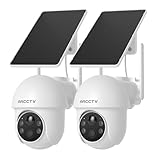
Overview: The ARCCTV Solar Security Camera 2-pack delivers comprehensive outdoor surveillance with 4MP Ultra HD resolution and manual 360° pan-tilt control. These completely wire-free cameras feature detachable solar panels for flexible positioning, ensuring continuous power without maintenance. Designed for DIY installation, each unit includes PIR motion sensors, two-way audio, and dual-band WiFi connectivity for reliable performance in various weather conditions.
What Makes It Stand Out: The detachable solar panel design is a key differentiator, allowing you to mount the camera in the optimal viewing location while placing the panel in maximum sunlight. The manual 355° pan and 90° tilt control via the ARCCTV app eliminates blind spots without the complexity of auto-tracking. Dual-band WiFi (2.4/5GHz) automatically selects the best connection for smooth streaming and quick alerts.
Value for Money: At $66.47 for two cameras ($33.24 each), this package offers solid value. Individual comparable solar cameras typically retail for $40-60, making this 2-pack economical for covering multiple entry points. The detachable panels add practical value by solving common solar camera placement constraints where camera position and sun exposure don’t align.
Strengths and Weaknesses: Strengths include true wire-free operation, sharp 4MP resolution, flexible solar panel placement, dual-band WiFi, and straightforward 5-minute installation. The PIR sensor reduces false alerts effectively. Weaknesses: pan-tilt requires manual app control (no auto-tracking), initial WiFi setup demands router proximity, and performance depends on adequate sun exposure. Night vision with spotlight is effective but may trigger more false alerts than IR-only sensors.
Bottom Line: An excellent choice for homeowners seeking affordable, flexible outdoor coverage across multiple areas. The manual 360° control and detachable solar panels make it ideal for those wanting customizable surveillance without subscription fees. Recommended for DIY installers prioritizing placement flexibility over automation.
7. Cinnado 5MP Security Camera Indoor-5G/2.4G Dual WiFi Cameras for Home Security with Audio and Video Ideal for Pet/Nanny/Baby Monitor, 360 Auto Tracking, SD/Cloud Storage, Support Alexa/Google Home, D1

Overview: The Cinnado indoor security camera combines 5MP Super HD resolution with intelligent 360° auto-tracking, making it ideal for monitoring pets, babies, or caregivers. This wired camera supports dual-band WiFi, invisible IR night vision, and integrates seamlessly with Alexa and Google Home. The compact design offers multiple storage options and multi-user sharing for family access.
What Makes It Stand Out: The 5MP resolution delivers noticeably sharper images than standard 1080p or 2K cameras, capturing fine details like pet expressions or text on packages. The 360° auto-tracking feature automatically follows movement throughout the room, a significant advantage over manual-control cameras. Invisible 940nm IR lights provide discreet night monitoring without the red glow that can disturb sleep or alert intruders.
Value for Money: At $29.99, this camera significantly undercuts competitors offering 5MP resolution and auto-tracking, which typically cost $40-60. The inclusion of dual-band WiFi and smart home integration at this price point represents excellent value for feature-conscious buyers seeking premium capabilities without premium pricing.
Strengths and Weaknesses: Strengths include superior 5MP clarity, intelligent auto-tracking, invisible IR night vision, stable dual-band WiFi, and broad smart home compatibility. Two-way audio is clear and responsive. Weaknesses: requires constant power (not battery-powered), limited to indoor use, SD card not included, and cloud storage requires paid subscription after the 30-day trial. The wired design restricts placement flexibility compared to wireless alternatives.
Bottom Line: Outstanding value for indoor monitoring needs, particularly for pet owners and parents. The auto-tracking and high resolution justify the modest investment. Recommended for those wanting premium features without premium pricing, provided you have convenient power access and don’t need outdoor deployment.
8. ARCCTV Solar Security Camera Outdoor Wireless, 4MP Battery Powered Home Surveillance Camera with Embedded Solar Panel, PIR Motion Sensor, 2.4G/5G Dual Band WiFi (2 Pack)

Overview: This ARCCTV 2-pack offers streamlined outdoor security with embedded solar panels and 4MP Ultra HD resolution. The completely wire-free design eliminates maintenance concerns while delivering reliable surveillance through dual-band WiFi connectivity. These cameras feature PIR motion detection, enhanced night vision, and flexible storage options in a weatherproof package designed for permanent outdoor installation without wiring.
What Makes It Stand Out: The integrated solar panel creates a cleaner, more compact installation compared to detachable panel systems. True 100% wire-free operation with automatic dual-band WiFi selection simplifies deployment. The cameras operate reliably in extreme temperatures (-4°F to 122°F), making them suitable for harsh climates where other solar cameras fail. The embedded design also reduces theft risk of separate components.
Value for Money: At $49.99 for two cameras ($25 each), this is among the most affordable solar security camera packs available. Comparable single cameras cost $35-50, making this bundle exceptional value for covering multiple areas. The embedded design reduces installation complexity and potential points of failure compared to detachable systems.
Strengths and Weaknesses: Strengths include unbeatable price-per-camera, integrated solar panel, sharp 4MP resolution, dual-band WiFi, robust weatherproofing, and flexible SD/cloud storage. The embedded design enhances durability and aesthetics. Weaknesses: fixed viewing angle (no pan-tilt), solar panel placement limited by camera location, SD card not included, and cloud storage requires subscription. Initial setup requires strong WiFi signal.
Bottom Line: The best budget option for straightforward outdoor surveillance. While lacking advanced features like auto-tracking, it delivers essential security at an unmatched price. Recommended for cost-conscious buyers wanting reliable, maintenance-free coverage of multiple outdoor areas without monthly fees or complex installation.
9. 2025 Upgraded 2K Security Cameras Wireless Outdoor, Free Cloud Storage, 1-6 Months Battery Life, Waterproof, 2-Way Talk, AI Motion Detection Spotlight Siren Alarm Cameras for Home Security

Overview: This 2025 upgraded model delivers capable outdoor security with 2K resolution and an industry-leading battery life claim of up to 6 months. The camera’s standout feature is free cloud storage (SD quality) without mandatory subscriptions. AI-powered motion detection, integrated spotlight and siren alarm, and dual-band WiFi support round out a comprehensive feature set at a budget price point designed for cost-conscious consumers.
What Makes It Stand Out: The combination of free cloud storage and exceptional battery life is rare in this price category. The AI motion detection reduces false alerts compared to standard PIR sensors. The spotlight and siren provide active deterrence, not just passive monitoring. Dual-band WiFi support ensures reliable connectivity in congested network environments where 2.4GHz struggles.
Value for Money: At $26.98, this camera offers remarkable value. The free cloud storage eliminates ongoing costs that competitors charge $3-10 monthly for. Even with SD-quality cloud video, the savings quickly offset the modest initial investment. The long battery life reduces maintenance effort significantly, making total cost of ownership extremely low over time.
Strengths and Weaknesses: Strengths include extremely low price, free cloud storage, impressive battery life, AI detection, active deterrence features, dual-band WiFi, and IP66 waterproof rating. Weaknesses: 2K resolution lags behind 4MP/5MP cameras, free cloud limited to SD quality, battery life varies dramatically based on trigger frequency, and brand recognition is limited. Night vision quality is adequate but not exceptional compared to premium models.
Bottom Line: An unbeatable choice for budget-focused buyers wanting minimal total cost of ownership. The free cloud storage and long battery life are compelling advantages. Recommended for secondary surveillance areas or those wanting to avoid subscription fees entirely while maintaining essential security features.
10. VIMTAG 2.5K Cameras for Home Security, 2.4G& 5G Color Night Vision Security Camera Indoor Outdoor for Baby Pet Dog Cat with Phone APP, Motion Detection 2-Way Audio, Work with Alexa,Cloud, 2 Pack

Overview: The VIMTAG 2-pack delivers 2.5K resolution with WiFi 6 support and continuous plug-in power for uninterrupted surveillance. These versatile cameras work both indoors and outdoors with IP65 weatherproofing and color night vision. Designed for 24/7 operation, they eliminate battery concerns while providing smart detection, two-way audio, and Alexa integration at an aggressive price point for two units.
What Makes It Stand Out: WiFi 6 compatibility future-proofs your security setup with faster, more stable connections in crowded network environments. The plug-in design ensures continuous operation without charging downtime, crucial for critical monitoring areas. Color night vision with built-in LED illumination provides better identification than traditional IR black-and-white footage, helping distinguish clothing colors or vehicle details.
Value for Money: At $27.99 for two cameras ($14 each), this offers the lowest per-camera cost in the lineup. While requiring power outlets, the elimination of batteries and solar panels reduces long-term costs and maintenance. Comparable plug-in cameras cost $25-40 each, making this 2-pack exceptional value for wired installations, despite the installation constraint.
Strengths and Weaknesses: Strengths include lowest price-per-camera, WiFi 6 support, continuous power, color night vision, smart detection, weatherproof design, and reliable two-way audio. Weaknesses: requires accessible power outlet (severely limits placement), wired design complicates outdoor installation, lower 2.5K resolution than premium models, and cloud storage likely requires subscription. Extension cords may compromise weatherproofing.
Bottom Line: Perfect for buyers with convenient power access wanting maximum value. The WiFi 6 and color night vision are standout features at this price. Recommended for indoor use and outdoor areas near buildings where power is available, prioritizing continuous operation and low cost over installation flexibility.
Why Your Security Camera Keeps Buffering (And How Dual-Band Wi-Fi Fixes It)
Buffering isn’t random—it’s a symptom of specific network bottlenecks. When your security camera transmits video, it’s sending a constant stream of data packets to your router. If those packets get delayed, dropped, or stuck behind other devices’ data, your feed stutters or freezes. Single-band cameras are locked to the 2.4GHz frequency, which only offers three non-overlapping channels. In a typical neighborhood, you might be competing with 20+ neighboring networks, plus Bluetooth devices, baby monitors, and microwaves that all operate in this crowded space.
Dual-band cameras solve this by giving you two separate highways for your data. The 2.4GHz band provides longer range and better wall penetration for cameras placed far from your router, while the 5GHz band offers dramatically higher speeds with less interference for cameras within its range. Think of it like having both a reliable country road and a high-speed expressway at your disposal—you can route each camera’s traffic to the path that makes most sense for its location and bandwidth needs.
Understanding Dual-Band Technology: 2.4GHz vs 5GHz for Security Cameras
The Science Behind Wireless Frequency Bands
Wireless frequencies behave differently based on their wavelength. The 2.4GHz band uses longer waves that travel farther and bend around obstacles more effectively, making it ideal for outdoor cameras or devices separated by multiple walls. However, this range advantage comes at a cost: lower data throughput and massive congestion. The theoretical maximum speed of 2.4GHz under ideal conditions is 600Mbps, but real-world performance often drops to 50-100Mbps due to interference.
The 5GHz band uses shorter waves that deliver much faster speeds—up to 1300Mbps on modern Wi-Fi 5 routers and even higher on Wi-Fi 6/6E systems. These waves don’t travel as far and struggle with solid obstacles, but they provide 23 non-overlapping channels compared to 2.4GHz’s paltry three. For security cameras streaming 2K or 4K video, this bandwidth difference isn’t just nice to have; it’s essential for maintaining consistent frame rates without compression artifacts.
Why Single-Band Cameras Struggle in Modern Homes
Today’s average household runs 25+ connected devices simultaneously. Your smart TV might be streaming Netflix, your teenager is gaming online, someone’s video calling, and your phone is automatically backing up photos—all while your security camera tries to push high-definition video upstream. Single-band cameras must fight for limited bandwidth in this digital mosh pit. They can’t switch frequencies when interference spikes, and they’re vulnerable to what’s called “co-channel interference” when neighboring networks overlap.
Dual-band cameras, conversely, can operate on the 5GHz band where there’s typically breathing room. Even if you have multiple dual-band cameras, you can distribute them across different 5GHz channels to prevent them from interfering with each other. This frequency agility is what transforms a jittery, unreliable feed into smooth, courtroom-quality footage.
Key Benefits of Upgrading to Dual-Band Wi-Fi Security Cameras
The most immediate benefit is eliminating buffering during critical moments. When your camera detects motion and starts recording, a dual-band connection ensures the footage uploads smoothly without dropped frames that could miss crucial details like a license plate or face. This reliability extends to two-way audio communication—no more choppy, delayed conversations with delivery drivers.
Beyond stability, dual-band cameras enable higher quality settings. Many users downgrade their camera resolution to 720p not because the camera can’t handle 4K, but because their network chokes on the data. With 5GHz connectivity, you can actually use those premium resolution features you paid for. Night vision footage, which requires even more data to maintain clarity in low light, becomes consistently sharp instead of pixelated mush.
You’ll also see dramatically improved app responsiveness. Live view will load in 1-2 seconds instead of 10-15, and scrubbing through recorded footage feels instant because the camera can stream data faster than your phone can display it. For cloud storage users, faster upload speeds mean your footage reaches secure servers before a savvy intruder could potentially disable the camera.
Essential Features to Look for in Dual-Band Security Cameras
Video Resolution and Bandwidth Requirements
Before buying, understand the real bandwidth demands of different resolutions. A 1080p camera at 30fps with H.264 compression needs roughly 2-4Mbps. Bump that to 2K (4MP) and you’re looking at 4-8Mbps. A 4K camera can demand 8-16Mbps depending on compression efficiency. Your 2.4GHz network might handle one 4K camera, but add two more plus your household devices, and you’re instantly saturated.
Look for cameras with adjustable bit rate settings. The best dual-band cameras let you set different profiles for each frequency—perhaps 4K streaming on 5GHz when you’re home, but dropping to 1080p on 2.4GHz for remote viewing when network conditions are less predictable. This flexibility ensures you always get usable footage without overwhelming your network.
Advanced Video Compression Technologies
Compression is the secret sauce that makes high-quality video feasible on residential networks. H.265 (HEVC) compression can reduce bandwidth needs by 40-50% compared to older H.264 while maintaining the same visual quality. Some manufacturers use proprietary codecs that claim even better efficiency. When evaluating cameras, check if they support H.265+ or Smart H.265+—these enhanced versions use scene-adaptive compression, applying less compression to complex scenes with lots of motion and more to static backgrounds.
This matters enormously for dual-band cameras because efficient compression makes 5GHz’s speed advantage even more impactful. A camera using H.265+ might stream 4K footage at just 6Mbps, leaving plenty of headroom on a 5GHz connection for other devices. Conversely, an inefficient codec could waste that premium bandwidth, negating the dual-band benefit.
Smart Bandwidth Management
Top-tier dual-band cameras include intelligent features that actively manage their network usage. Look for “adaptive streaming” or “dynamic bit rate” capabilities that automatically adjust video quality based on network conditions. If your 5GHz signal temporarily weakens, the camera should seamlessly shift to a lower resolution rather than dropping frames.
Some cameras offer “band steering” technology that automatically selects the optimal frequency based on current congestion and signal strength. Others let you set priority rules, like always using 5GHz for motion-triggered recordings but 2.4GHz for routine live viewing. These smart features transform dual-band from a static hardware spec into a dynamic performance advantage.
How to Assess Your Network Infrastructure Before Buying
Router Compatibility and Wi-Fi Standards
Your dual-band camera is only as good as your router. If you’re still using an old single-band 2.4GHz router, you’ll need to upgrade your entire network first. Most modern routers support dual-band, but check the Wi-Fi standard. Wi-Fi 5 (802.11ac) is the minimum you should accept, while Wi-Fi 6 (802.11ax) or Wi-Fi 6E offers significant improvements in handling multiple devices simultaneously.
Pay attention to your router’s 5GHz coverage area. Budget routers might only provide reliable 5GHz signal within 30-40 feet and one wall. Mesh Wi-Fi systems excel here, creating a seamless 5GHz blanket across your property. For outdoor cameras, consider a mesh node placed near the installation location to ensure strong 5GHz connectivity.
Understanding Your Internet Speed Needs
Your internal Wi-Fi speed and internet upload speed are two different beasts. A camera might stream perfectly to your phone on the same network, but struggle when you view remotely if your upload bandwidth is insufficient. Calculate your needs: if you have four 4K cameras each needing 8Mbps, that’s 32Mbps just for security footage. Add a 50% buffer for other devices, and you need at least 50Mbps upload speed.
Use tools like Speedtest.net to measure your actual upload speed during peak evening hours. Many ISPs advertise high download speeds but skimp on upload—it’s not uncommon to see 200Mbps down but only 10Mbps up. If your upload is the bottleneck, no amount of dual-band wizardry will fix remote viewing issues. You might need to upgrade your internet plan or reduce camera resolution/bit rates.
Installation Best Practices for Dual-Band Cameras
Optimal Camera Placement Strategies
Placement affects which frequency band works best. For cameras within 50 feet of your router with minimal obstructions, always prioritize 5GHz. This includes most indoor cameras in main living areas and outdoor cameras mounted on the same side of the house as your router.
For cameras at the edge of your property or separated by multiple walls, start with 2.4GHz for reliability. However, don’t give up on 5GHz immediately. Sometimes moving the camera just a few feet horizontally or vertically can find a “signal path” through windows or doorways that allows 5GHz to penetrate. Use your phone’s Wi-Fi analyzer app (like WiFi Analyzer on Android or AirPort Utility on iOS) to map actual signal strength at the proposed installation spot.
Consider elevation carefully. Wi-Fi signals spread outward and downward from routers. Mounting an outdoor camera too high might place it in a dead zone, while mounting it too low could introduce ground-level interference from moisture and vegetation. The sweet spot is typically 8-10 feet high for outdoor cameras, angled slightly downward.
Network Configuration Tips
Separate your 2.4GHz and 5GHz networks with different SSIDs during initial setup. This lets you manually choose which band each camera uses and monitor performance separately. Many routers default to a single SSID with band steering, which can cause cameras to flip-flop between frequencies unpredictably.
Reserve IP addresses for your cameras in your router’s DHCP settings. This prevents IP conflicts and ensures your camera app always finds the devices. Assign cameras to the less-crowded 5GHz channels—use channels 36-48 or 149-165, as these are typically less congested than the default channel 6 that most routers auto-select.
Enable Quality of Service (QoS) settings on your router and prioritize your cameras’ MAC addresses. This ensures that when your network gets busy, your security footage gets bandwidth first, not your smart TV’s 4K stream. Some routers let you set device priority levels; always place cameras in the highest tier.
Security Considerations for Dual-Band Wi-Fi Cameras
Encryption Standards and Protocols
Never connect security cameras to open or WEP-encrypted networks. WPA2-AES is the minimum acceptable standard, while WPA3 offers better protection against brute-force attacks. Some dual-band cameras support enterprise-grade authentication (WPA2-Enterprise), which is overkill for home use but valuable for business installations.
Check if the camera supports HTTPS for all communications, not just login. Some budget cameras encrypt the login process but send video streams over unencrypted HTTP, making them vulnerable to interception. Look for “SSL/TLS encryption” in the specifications. The gold standard is end-to-end encryption where footage is encrypted on the camera before transmission and only decrypted on your viewing device.
Network Segmentation Strategies
Create a separate VLAN (Virtual Local Area Network) for your cameras if your router supports it. This isolates cameras from your main network, so even if a camera gets hacked, attackers can’t access your computers, NAS drives, or smart home hubs. Many modern routers offer “guest network” features that can serve this purpose—just ensure the guest network can still communicate with your main network for app access.
Consider disabling internet access for cameras that only need local recording to an NVR (Network Video Recorder). For cloud-connected cameras, block outbound connections to countries you don’t recognize in your router’s firewall settings. Reputable manufacturers use domestic servers; unexpected foreign connections could indicate malware.
Troubleshooting Common Dual-Band Connectivity Issues
If your camera refuses to connect to 5GHz, first verify it’s not too far from the router. Check the router’s channel width settings—some cameras only support 20MHz or 40MHz channels, not the 80MHz or 160MHz channels many routers default to for maximum speed. Narrowing the channel width can improve compatibility and actually increase range.
Intermittent disconnections often stem from IP address conflicts or DHCP lease expirations. Set a static IP outside your router’s DHCP range (e.g., if DHCP hands out 192.168.1.100-200, use 192.168.1.210 for your camera). Also, disable “Wi-Fi optimization” or “airtime fairness” features on your router, as these can deprioritize continuous streaming devices like cameras.
If you experience lag only during certain times of day, you’re likely hitting network congestion. Use your router’s traffic analyzer to identify bandwidth hogs. Sometimes the culprit isn’t what you’d expect—cloud backup services, Windows updates, or even a misconfigured smart TV can saturate your upload. Schedule these tasks for overnight hours when camera activity is typically lower.
Future-Proofing Your Security Camera Setup
Wi-Fi 6E is already here, adding a 6GHz band with even more channels and less interference. While few cameras support 6GHz yet, buying a Wi-Fi 6E router now ensures your network infrastructure is ready. The 6GHz band will be particularly transformative for 8K cameras and multi-camera setups that need to stream simultaneously.
Consider cameras with Ethernet ports even if you plan to use Wi-Fi. This gives you a fallback option if Wi-Fi performance degrades over time, and allows you to power the camera via PoE (Power over Ethernet), simplifying installation. Some hybrid cameras can use Wi-Fi for data and a separate power cable, giving you the best of both worlds.
Look for cameras that support ONVIF (Open Network Video Interface Forum) standards. This ensures compatibility with third-party NVRs and VMS (Video Management Software), so you’re not locked into one manufacturer’s ecosystem if they go out of business or stop supporting your model. Future-proofing is about flexibility, not just raw specs.
Frequently Asked Questions
Will dual-band cameras work with my old single-band router?
No, dual-band cameras require a dual-band router to utilize the 5GHz frequency. They will fall back to 2.4GHz on a single-band router, but you’ll lose all the performance benefits that solve buffering. Think of it like owning a sports car but only having access to dirt roads—you need the right infrastructure to unlock the potential.
How much faster is 5GHz really for security cameras?
In real-world conditions with typical home interference, 5GHz is 3-5 times faster than 2.4GHz for devices within its effective range. More importantly, it offers 23 non-overlapping channels versus 2.4GHz’s three, meaning far less congestion. You’ll see the biggest difference in upload reliability, which is critical for cloud storage and remote viewing.
Can I mix dual-band and single-band cameras on the same network?
Absolutely, and this is often a smart budget strategy. Use dual-band cameras for critical high-traffic areas like your front door and driveway where you need 4K clarity, and single-band cameras for less important zones like a side yard or storage shed. Just ensure your router’s QoS settings prioritize the dual-band cameras if bandwidth becomes scarce.
Why does my 5GHz signal keep dropping on my outdoor camera?
The 5GHz frequency struggles with physical barriers and moisture. Even morning dew on leaves can attenuate the signal. Try repositioning the camera to have the clearest line-of-sight to your router, even if it’s farther away. Sometimes moving it 5 feet horizontally makes more difference than moving it 20 feet closer. Also, check if your router’s 5GHz power settings are set to maximum.
Do dual-band cameras use more electricity?
The Wi-Fi radio itself uses negligible extra power—typically less than 0.5 watts more than single-band. However, if you’re enabling higher resolution and frame rates made possible by 5GHz, the overall camera power consumption might increase by 10-15%. For battery-powered cameras, this can reduce battery life by a few weeks, so balance performance needs with power constraints.
Will switching to dual-band eliminate my cloud storage delays?
Partially. Dual-band solves the local Wi-Fi bottleneck, but cloud storage also depends on your internet upload speed. If your ISP provides slow upload speeds, you’ll still experience delays. The combination of dual-band Wi-Fi and adequate upload bandwidth (at least 10Mbps per 4K camera) is what creates truly instant cloud uploads.
How do I know which frequency my camera is currently using?
Most camera apps display the connection details in settings. Look for “Network Info,” “Wi-Fi Status,” or a similar option. It should show the SSID name and sometimes the frequency band. Alternatively, log into your router’s admin panel and check the connected devices list—it typically shows which band each device is using. Some routers even let you assign device names for easy identification.
Can neighbors interfere with my 5GHz camera signal?
Much less than with 2.4GHz. While 5GHz can experience interference, the shorter range means you’re primarily competing with neighbors in adjacent rooms or very close proximity. The 23 available channels also make it easy to find a clear one. Use a Wi-Fi analyzer to scan for neighboring 5GHz networks and manually select the least congested channel in your router settings.
Are dual-band cameras harder to hack?
The frequency band itself doesn’t inherently affect security, but dual-band cameras are typically newer models with better security features. They more often support WPA3 encryption, have regular firmware updates, and include modern security chipsets. The real security advantage comes from being able to isolate cameras on a separate 5GHz network with stronger encryption while keeping less-secure IoT devices on 2.4GHz.
What’s the realistic range difference between 2.4GHz and 5GHz?
In a typical wood-frame home, 2.4GHz reaches about 150 feet with usable signal through walls. 5GHz manages about 50 feet reliably through one wall, or up to 80 feet with clear line-of-sight. For outdoor installations, 2.4GHz might reach 300+ feet in open space, while 5GHz taps out around 100-150 feet. However, a strong 5GHz signal at 40 feet delivers far better performance than a weak 2.4GHz signal at 100 feet.