You can’t see it. You can’t smell it. But every breath you take inside your home could be filled with microscopic pollutants that affect your health, sleep, and cognitive performance. While we obsess over the air quality index (AQI) reports for outdoor pollution, the air inside our homes is often 2-5 times more contaminated—and until recently, measuring it was limited to expensive industrial equipment. Enter smart air quality monitors: the unassuming devices that have democratized environmental science, putting lab-grade insights onto your smartphone in real time.
These modern sentinels don’t just reveal what you’re breathing; they decode the invisible dance between fine particulate matter (PM2.5) and carbon dioxide (CO2), two of the most consequential indoor pollutants. Whether you’re a concerned parent, a remote worker questioning that 3 p.m. mental fog, or simply someone who wants to optimize their living space, understanding how these devices work—and what to look for—is no longer optional. It’s the foundation of building a truly healthy home.
Top 10 Smart Air Quality Monitors for PM2.5 and CO2
Detailed Product Reviews
1. 18-in-1 Smart Air Quality Monitor - Indoor WiFi Air Quality Detector with Dual Chip, Real-Time for AQI, CO2, PM2.5, PM1.0, PM10, TVOC, HCHO, Time Display, Temperature & Humidity with Aler (White-B2)

Overview: The Bcetasy 18-in-1 Smart Air Quality Monitor delivers comprehensive indoor air analysis at an accessible price point. This WiFi-enabled device tracks AQI, CO2, PM2.5, PM1.0, PM10, TVOC, HCHO, temperature, humidity, and time—all displayed on a sleek, skin-friendly interface designed for whole-home deployment.
What Makes It Stand Out: Its dual-chip architecture separates sensor processing from UI management, ensuring rapid, accurate readings without lag. The Smart Life/Tuya Smart app integration enables remote monitoring, historical data tracking, and custom alerts. Unique screen-off monitoring and auto-brightness features, plus wall-mountable design, make it a true set-and-forget smart home solution.
Value for Money: At $79.99, this monitor undercuts competitors while delivering 18 metrics. Purchasing individual detectors for each parameter would cost significantly more. The inclusion of app data storage and firmware update capability provides ongoing value without subscription fees, making it one of the most cost-effective comprehensive solutions available.
Strengths and Weaknesses: Strengths include extensive sensor array, robust app ecosystem, and user-friendly operation. The dual-chip system ensures reliability. Weaknesses are the 2.4GHz WiFi limitation (requiring compatibility mode for WiFi 6 routers) and unspecified battery runtime, suggesting it’s primarily AC-powered. Initial setup may require patience for non-tech-savvy users.
Bottom Line: This monitor excels for smart home enthusiasts seeking maximum data at minimum cost. While WiFi restrictions may frustrate some, its comprehensive sensing, thoughtful features, and attractive price make it a top contender for whole-home air quality management.
2. Professional Indoor Air Quality Monitor with AQI Beep Alarms, Portable Real-Time Detector for Home Cars Plants and Pets (White)
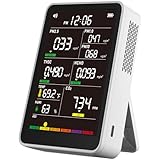
Overview: The MORPTRA Professional 16-in-1 Monitor positions itself as a premium, portable solution for serious air quality tracking. At $139.99, it focuses on core pollutants—PM1.0, PM2.5, PM10, CO2, TVOC, HCHO, temperature, and humidity—with professional-grade precision for homes, cars, and workplaces.
What Makes It Stand Out: Seven distinct AQI buzzer alerts provide immediate, audible warnings without checking the screen. The high-precision sensor system updates every three seconds, offering near real-time responsiveness. One-touch operation and double-click silence function demonstrate exceptional user experience design, while the 12-month warranty adds confidence.
Value for Money: The $139.99 price reflects its professional aspirations. You’re paying for sensor speed, accuracy, and build quality rather than metric quantity. The 4-5 hour battery life and fast-charging capability justify the premium for users needing portable, reliable monitoring. It’s an investment for health-conscious households.
Strengths and Weaknesses: Strengths include rapid refresh rate, intuitive controls, strong battery performance, and comprehensive alerts. The HD color display enhances readability. Weaknesses are fewer tracked metrics than 18-in-1 models and a higher price point. The lack of WiFi connectivity limits remote monitoring capabilities.
Bottom Line: Perfect for users prioritizing precision and responsiveness over maximum data points. If you need reliable, portable monitoring with instant alerts, this justifies its premium price. For whole-home smart integration, consider WiFi-enabled alternatives.
3. 18 in 1 Air Quality Monitor Indoor, Portable CO2 Detector for CO2, Temperature (°F), Humidity, VOC, PM2.5, PM1.0, PM10 & Time Display, 【Dual Chip & High Accuracy】 Air Quality Tester for Home

Overview: The Nanezan 18-in-1 Monitor balances comprehensive sensing with true portability at $99.99. Its 5000mAh battery liberates users from power outlets, enabling rapid air quality assessment across multiple locations—from living rooms and offices to cars and hotels—without compromising on sensor depth.
What Makes It Stand Out: The CO2 alarm with audible buzzer provides critical safety warnings when levels exceed thresholds, particularly valuable during wildfire season. The innovative AQI smiley face offers at-a-glance air quality assessment that slides across the screen, making complex data instantly understandable for all family members.
Value for Money: At $99.99, the premium over wall-mounted models purchases genuine mobility. The dual-chip 5.0 architecture and large battery deliver performance that justifies the cost for users needing multi-room testing. It’s a versatile middle ground between basic detectors and premium smart monitors.
Strengths and Weaknesses: Strengths include powerful battery, portable design, intuitive smiley face UI, and comprehensive 18-metric sensing. The CO2 alarm adds safety value. Weaknesses are higher price than stationary alternatives and potentially less robust app features. The skin-friendly surface, while premium, may scratch during transport.
Bottom Line: Ideal for renters, travelers, and those wanting to test multiple spaces without buying several units. The portability and safety features outweigh the modest price premium, making it a smart choice for dynamic air quality management.
4. Qingping Air Quality Monitor Gen 2, Air Quality Monitor Indoor Detects PM2.5, CO2, PM10, Noise, Temperature and Humidity, New Upgraded Alarm Clock Function, Air Quality Tester for Bedroom, Smart Home

Overview: The Qingping Air Monitor Gen 2 commands $149.99 with a focus on premium user experience and design innovation. It tracks seven key metrics—PM2.5, PM10, CO2, eTVOC, temperature, humidity, and noise—through a stunning 4-inch IPS touchscreen that doubles as a sophisticated alarm clock.
What Makes It Stand Out: The magnetic, replaceable PM sensor is a game-changer for longevity, eliminating disposable device concerns. The 254 PPI touchscreen offers smartphone-level clarity with auto-adjusting brightness. Dual-band WiFi (2.4/5GHz) support eliminates connectivity headaches, while the alarm clock integration adds daily utility beyond air monitoring.
Value for Money: While expensive, the price reflects premium materials and forward-thinking design. The replaceable sensor alone extends usable life by years, offsetting replacement costs. For tech enthusiasts who value interface quality and device longevity, this justifies the investment over cheaper, sealed units.
Strengths and Weaknesses: Strengths include exceptional display, innovative replaceable sensor, dual-band WiFi, and multi-functional design. The build quality feels premium. Weaknesses are limited metric count (no formaldehyde), very short battery life requiring constant USB power, and the highest price in this comparison. The noise metric is less critical for most users.
Bottom Line: Best for users wanting the finest display and build quality who don’t need every possible sensor. The replaceable sensor and dual-band WiFi future-proof the investment, but the tethered power requirement limits placement flexibility.
5. 18-in-1 Smart Air Quality Monitor - Indoor WiFi Air Quality Detector with Dual Chip, Real-Time for AQI, CO2, PM2.5, PM1.0, PM10, TVOC, HCHO, Time Display, Temperature & Humidity with APP (White-White)

Overview: This Bcetasy 18-in-1 Monitor shares identical features with the White-B2 variant, offering comprehensive air quality tracking for $79.99. It measures AQI, CO2, PM2.5, PM1.0, PM10, TVOC, HCHO, temperature, humidity, time, and date—providing whole-home protection through WiFi connectivity and app integration.
What Makes It Stand Out: Like its sibling, the dual-chip system ensures rapid, accurate readings while the Smart Life/Tuya Smart app enables remote monitoring and historical data storage. The screen-off monitoring capability and auto-brightness features distinguish it from budget alternatives, while wall-mountable design offers flexible installation options for permanent placement.
Value for Money: At $79.99, it represents exceptional value for an 18-metric smart monitor. Purchasing individual detectors for each parameter would cost significantly more. The inclusion of app-based controls and data tracking without subscription fees makes this one of the most cost-effective comprehensive solutions available.
Strengths and Weaknesses: Strengths mirror the White-B2 model: extensive sensor array, robust dual-band processing, user-friendly app integration, and thoughtful power management features. The dual-chip architecture ensures reliability. Weaknesses include the 2.4GHz WiFi limitation requiring router compatibility mode, unspecified battery capacity suggesting AC-power dependency, and potential learning curve for app setup.
Bottom Line: Choose between this and the White-B2 variant based on aesthetic preference. For comprehensive, affordable smart home air monitoring, this delivers unmatched sensor variety and connectivity at a budget-friendly price point.
6. GoveeLife Smart Air Quality Monitor with PM2.5, WiFi, Temperature & Humidity Sensors, LED Display, 2s Refresh, 2-Year Data Storage, for Home & Office Wired

Overview: The GoveeLife Smart Air Quality Monitor delivers essential indoor air quality tracking with PM2.5, temperature, and humidity monitoring. Designed for seamless integration into the Govee ecosystem, this wired device features a crisp LED display with switchable clock and air quality modes, making it ideal for home or office use where continuous monitoring is needed.
What Makes It Stand Out: This monitor’s standout feature is its deep integration with GoveeLife appliances. When PM2.5 levels change, compatible air purifiers, humidifiers, and heaters automatically adjust, creating a truly smart environment. The two-second data refresh rate provides near-instant feedback, while two-year data storage offers valuable long-term trend analysis through the GoveeHome app.
Value for Money: At $39.99, this monitor represents excellent value for users invested in the Govee ecosystem. While it only tracks three metrics, its automation capabilities justify the price. Competing standalone monitors with similar accuracy typically cost more, but lack the smart-home integration that makes this device particularly useful.
Strengths and Weaknesses: Strengths: Seamless GoveeLife device automation; fast 2-second refresh rate; excellent data storage; clear LED indicator with four air quality levels; affordable entry point. Weaknesses: Requires constant power connection; limited to three metrics; only works with 2.4G Wi-Fi; PM2.5 accuracy of ±15 µg/m³ is decent but not professional-grade; ecosystem lock-in.
Bottom Line: The GoveeLife monitor is perfect for smart home enthusiasts already using Govee appliances. Its automation features and rapid refresh rate make it a practical choice, though the wired design and limited metrics may not suit everyone.
7. 10 in 1 Smart Air Quality Monitor Indoor,Carbon Monoxide Detectors,Co2 Detector,Professional Air Quality Test Kit with CO2 | CO | TVOC | HCHO | Temp | AQI | PM2.5 | PM0.3 | PM10

Overview: This budget-friendly 10-in-1 air quality monitor packs an impressive array of sensors into a portable device. It tracks CO, CO2, formaldehyde, TVOC, PM2.5, PM10, and more, making it a comprehensive solution for health-conscious users. The built-in rechargeable battery and lightweight design enable on-the-go monitoring across multiple environments.
What Makes It Stand Out: The sheer sensor variety at this price point is remarkable. With <±5% error rates and a high-definition color screen that changes color during alarms, it delivers professional-level monitoring affordably. The 20-hour battery life and USB charging make it exceptionally portable for home, office, or workshop use.
Value for Money: At $29.98, this is arguably the best value in air quality monitoring. Ten sensors with high accuracy specs typically cost three to four times more. While build quality may not match premium brands, the functionality-per-dollar ratio is unbeatable for users needing broad detection capabilities without breaking the bank.
Strengths and Weaknesses: Strengths: Unbeatable price for 10 sensors; excellent 20-hour battery life; portable and lightweight; high accuracy claims; color-coded alerts; easy operation. Weaknesses: Brand reliability uncertain; sensor longevity unproven; accuracy claims may not hold up over time; no smart home integration; limited data storage; screen quality unknown.
Bottom Line: This monitor is a fantastic entry-level option for those wanting comprehensive air quality data on a tight budget. While it may lack premium features and long-term reliability, its sensor array and portability make it worth the investment for initial assessments.
8. Qingping Air Quality Monitor Gen 2, Air Quality Monitor Indoor Detects PM2.5, CO2, PM10, Noise, Temperature and Humidity, New Upgraded Alarm Clock Function, Air Quality Tester for Bedroom, Smart Home

Overview: The Qingping Gen 2 positions itself as a premium indoor air quality monitor with a sleek 4-inch IPS touchscreen and comprehensive monitoring of seven key metrics including noise levels. Designed for bedroom and smart home use, it combines air quality monitoring with alarm clock functionality, offering a sophisticated alternative to basic monitors.
What Makes It Stand Out: The high-resolution touchscreen (254 PPI) with auto-brightness adjustment provides exceptional clarity, while the replaceable PM sensor design extends the device’s lifespan significantly. Unique among these monitors, it tracks noise levels and supports both 2.4GHz and 5GHz Wi-Fi. The magnetic back cover and multiple alarm settings add premium convenience features.
Value for Money: At $149.99, this is a premium investment. While expensive compared to basic monitors, the superior display quality, replaceable sensor, dual-band Wi-Fi, and noise monitoring justify the cost for users prioritizing aesthetics and longevity. However, the limited battery life (3 hours) means it’s primarily a plugged-in device.
Strengths and Weaknesses: Strengths: Gorgeous 4-inch touchscreen; replaceable PM sensor extends lifespan; noise level monitoring; dual-band Wi-Fi support; elegant design; alarm clock integration. Weaknesses: Very expensive; only 3-hour battery life; no formaldehyde detection; limited to 30 days of historical data; overkill for basic needs.
Bottom Line: The Qingping Gen 2 is ideal for tech-savvy users seeking a premium, feature-rich monitor with excellent display quality. Its replaceable sensor design makes it a smart long-term investment, though the price and limited portability may deter casual users.
9. Professional 15-in-1 Air Quality Monitor with Smartphone APP - Dual Chip - Sensors Detect CO2, PM2.5/PM10, HCHO, TVOC | Real-Time Alerts & Custom Thresholds | for Home, Car, Office, Plants, Pets
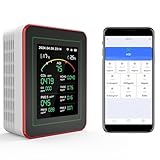
Overview: This professional-grade monitor offers an impressive 15-in-1 detection system with dual-chip architecture for enhanced accuracy and responsiveness. Covering CO2, particulates, formaldehyde, TVOCs, and more, it’s designed for users needing comprehensive environmental data across diverse settings from homes to industrial spaces.
What Makes It Stand Out: The dual-chip system—one chip dedicated to sensor data processing and another to user interface—ensures faster, more reliable readings than single-chip competitors. Combined with customizable alert thresholds and cloud-based data storage, it offers professional monitoring capabilities at a mid-range price point.
Value for Money: Priced at $69.99, this monitor strikes an excellent balance between comprehensive detection and affordability. While more expensive than budget options, the dual-chip architecture, 15 sensors, and smart app integration provide significant value for serious users. Professional equipment with similar specs often costs $200+.
Strengths and Weaknesses: Strengths: Dual-chip system for superior accuracy; 15 comprehensive sensors; custom alert thresholds; cloud data storage; portable design; Wi-Fi connectivity; suitable for diverse environments. Weaknesses: Brand recognition limited; app reliability unknown; build quality uncertain; may be complex for casual users; no mention of sensor replaceability.
Bottom Line: An excellent choice for users requiring detailed, accurate air quality data across multiple locations. The dual-chip design and extensive sensor array make it a professional tool at a consumer price, ideal for health-conscious households and small businesses.
10. 16-in-1 Smart WiFi Air Quality Monitor CO2 CO TVOC HCHO PM2.5 PM10 & Weather Stations Wireless Indoor Outdoor Thermometer with Multiple sensors,Air Quality Tester for Bedroom, Smart Home 2CO15-3

Overview: This versatile 16-in-1 device combines air quality monitoring with weather station functionality, offering comprehensive environmental tracking. It monitors CO2, CO, formaldehyde, TVOC, particulates, and includes three wireless temperature/humidity sensors for multi-room monitoring, making it ideal for whole-home coverage.
What Makes It Stand Out: The inclusion of three wireless sensors sets this apart, allowing simultaneous monitoring of four locations. The weather station integration, 2.8-inch color TFT screen, and multiple mounting options (stand, wall, paste) provide exceptional flexibility. One-year data storage via the app surpasses most competitors.
Value for Money: At $109.00 with three included sensors, this monitor offers strong value for whole-home monitoring. Individual sensors typically cost $20-30 each, making the bundle pricing attractive. While not cheap, the 16-metric capability and weather features justify the cost for comprehensive home monitoring.
Strengths and Weaknesses: Strengths: Three wireless sensors included; 16-in-1 comprehensive monitoring; weather station features; multiple mounting options; one-year data storage; rechargeable battery; versatile placement. Weaknesses: Only 2.4GHz Wi-Fi; sensors require AAA batteries (not included); complex setup with multiple sensors; larger footprint; some users report pairing issues requiring re-pairing.
Bottom Line: Perfect for users wanting whole-home environmental monitoring without buying separate devices. The sensor bundle and weather features make it a cost-effective comprehensive solution, though Wi-Fi limitations and battery requirements should be considered.
Understanding the Invisible Threats: PM2.5 and CO2 Explained
Before investing in any monitoring technology, you need to understand exactly what you’re measuring. PM2.5 and CO2 represent fundamentally different classes of indoor air pollution, each with distinct sources, health impacts, and mitigation strategies. A quality smart monitor treats them as separate variables in a complex equation, not as a single “air quality score” to be gamified.
What is PM2.5 and Why Should You Care?
PM2.5 refers to particulate matter measuring 2.5 micrometers or less in diameter—roughly 30 times smaller than the width of a human hair. These particles aren’t just dust; they’re a cocktail of combustion byproducts, chemical reactions, organic compounds, and even liquid droplets that can penetrate deep into your respiratory system and enter your bloodstream. Sources inside your home are surprisingly diverse: cooking with gas or oil, burning candles, running a fireplace, using certain cleaning products, and even peeling an orange can spike PM2.5 levels dramatically.
The insidious nature of PM2.5 lies in its size. Because these particles are so small, they bypass your body’s natural filtration systems, potentially triggering inflammation, exacerbating asthma, and contributing to cardiovascular disease. Short-term exposure can cause immediate symptoms like throat irritation and coughing, but the real concern is cumulative exposure over years. A smart monitor’s laser scattering sensor essentially counts these particles in real time, giving you a window into a threat that would otherwise remain completely invisible.
The Carbon Dioxide Conundrum: More Than Just a Climate Issue
While CO2 is a natural component of air, indoor concentrations tell a completely different story. Unlike PM2.5, CO2 isn’t toxic in the traditional sense—you won’t drop dead from moderate elevation. Instead, it acts as a proxy for ventilation efficiency and directly impacts human cognition and comfort. Every exhale adds CO2 to your environment, and in poorly ventilated spaces, levels can climb from ambient (~400 ppm) to over 2,000 ppm within hours.
The cognitive effects are well-documented and startling. At 1,000 ppm, decision-making performance decreases measurably. At 1,400 ppm, cognitive function drops by 21% on strategic thinking tasks. By 2,000 ppm, you’re essentially operating with the mental acuity of someone who’s had a couple of drinks. This isn’t about long-term health risks—this is about your immediate ability to think, focus, and perform. Smart monitors use non-dispersive infrared (NDIR) sensors to track CO2 with precision, turning abstract ventilation theory into actionable data.
How Smart Air Quality Monitors Actually Work
Peeling back the plastic casing reveals a fascinating interplay of physics and engineering. These aren’t magic boxes; they’re carefully calibrated instruments that convert physical phenomena into digital signals your phone can interpret.
The Science Behind PM2.5 Detection: Laser Scattering Technology
Most consumer monitors use a technique called laser light scattering. Here’s what happens inside that tiny chamber: a fan pulls air through an inlet channel at a controlled flow rate. As the air stream passes through a laser beam, any particles present scatter the light. A photodetector positioned at a specific angle measures this scattered light, and the intensity and pattern of scattering correlate directly to particle size and number.
The sophistication lies in the algorithm. Raw scattering data is noisy and ambiguous—a large particle might scatter light similarly to a cluster of small ones. Advanced monitors use Mie scattering theory and proprietary algorithms to distinguish particle size distributions, converting counts into mass concentration (µg/m³). Cheaper units might only count particles, giving you a relative number that’s less useful for health assessments. The laser’s wavelength, power stability, and the photodetector’s sensitivity determine accuracy, which is why sensor modules from reputable manufacturers cost significantly more than generic alternatives.
CO2 Sensing: NDIR Sensors Demystified
NDIR sensors operate on a principle as old as spectroscopy itself: different gases absorb specific wavelengths of infrared light. Inside the sensor, an infrared lamp emits light through a sampling chamber. At the other end, a detector measures how much light at CO2’s characteristic absorption wavelength (around 4.26 micrometers) makes it through. More CO2 means more absorption, and the difference between emitted and detected intensity gives you concentration.
The genius is in the reference channel. Quality sensors use a dual-wavelength system—one wavelength that CO2 absorbs, and another nearby wavelength that it doesn’t. This compensates for dust on the optics, lamp aging, and temperature drift. Cheaper sensors might skip this, leading to drift and false readings. The sampling chamber’s path length also matters; longer paths increase sensitivity but require more power and space. This is why compact monitors often sacrifice some accuracy for form factor.
Data Processing: From Raw Numbers to Actionable Insights
Raw sensor data is nearly useless without context. The microcontroller inside your monitor performs several layers of processing: noise filtering (removing spurious spikes), temperature and humidity compensation (both affect sensor readings), and calibration against known references. Then comes the interpretation layer—converting µg/m³ into AQI categories, or ppm into ventilation recommendations.
The smartest monitors don’t just show numbers; they identify patterns. Machine learning algorithms can distinguish between a cooking spike and a candle burning, or correlate CO2 rises with occupancy. This contextual awareness transforms data into wisdom, suggesting you open a window now versus noting that your HVAC system seems underperforming every Tuesday afternoon.
Essential Features That Define a Quality Monitor
Not all monitors are created equal. The market ranges from $30 novelty devices to $500 professional-grade units, and the differences aren’t just cosmetic. Knowing which features genuinely matter prevents costly mistakes.
Accuracy and Precision: The Gold Standard Metrics
Accuracy tells you how close the reading is to the true value; precision tells you how consistent repeated measurements are. A monitor can be precisely wrong or accurately inconsistent—neither helps you. Look for devices that specify accuracy as ±(value + % of reading) rather than vague percentages. For PM2.5, ±5 µg/m³ plus 15% of reading is respectable for consumer gear. For CO2, ±50 ppm plus 3% is solid.
Crucially, check if the manufacturer provides third-party validation data. Reputable companies submit units to aerosol labs for testing against reference instruments. If they only claim “high accuracy” without specifics, be skeptical. The best monitors also display confidence intervals or data quality indicators, acknowledging that readings can be less reliable at very low or very high concentrations.
Connectivity Options: Wi-Fi, Bluetooth, and Beyond
Bluetooth-only monitors tether you to proximity—you must be within 30 feet to see data. Wi-Fi enables cloud logging, remote monitoring, and alerts while you’re away. But dig deeper: does the Wi-Fi support 5 GHz, or only 2.4 GHz? Is the cloud service free, or will you face subscription fees after year one? Does the company have a history of sunsetting older products, bricking your device?
Local data access is the pro move. Monitors with MQTT support or local API endpoints let you bypass cloud dependencies, integrating directly with home automation systems like Home Assistant. This isn’t just about privacy; it’s about longevity. Companies come and go, but local network control keeps your monitor useful indefinitely.
Real-Time vs. Averaged Data: What Matters Most?
Real-time data shows instantaneous values, updating every second. This is crucial for identifying pollution events—like that moment you start searing a steak. However, real-time data is noisy; a single spike might be a sensor artifact. Averaged data (1-minute, 10-minute, hourly) smooths this noise, revealing trends and compliance with health standards.
The best monitors offer both, with configurable averaging periods. They also store high-resolution data locally, letting you export raw logs for detailed analysis. Be wary of devices that only show 24-hour averages; they’re hiding the very spikes that could inform your behavior changes.
Power Options: Battery Life and Wired Considerations
Battery-powered monitors offer placement flexibility—stick one in a bathroom to track humidity and particulates from showers. But constant Wi-Fi and sensor operation drains batteries quickly. Expect 6-12 hours on a charge for continuous monitoring, or days if sampling intermittently. This is fine for spot checks but frustrating for permanent placement.
Wired monitors (USB-powered) provide uninterrupted operation and often more powerful sensors that draw more current. Some offer power-over-Ethernet (PoE) for commercial installations. The sweet spot? A wired primary monitor in your main living area, supplemented by battery-powered units for targeted investigations.
Decoding the Specifications: What the Numbers Mean
Specification sheets read like alphabet soup: PM2.5, CO2, TVOC, NDIR, AQI. Understanding these terms prevents buying a monitor that looks impressive but delivers meaningless data.
Sensor Range and Resolution: Finding the Sweet Spot
Range defines the minimum and maximum values the sensor can measure. For PM2.5, a range of 0-999 µg/m³ covers everything from pristine air to severe wildfire smoke. For CO2, 400-5,000 ppm handles normal to dangerously stuffy conditions. Wider isn’t always better; sensors optimized for narrow ranges are often more accurate within those bounds.
Resolution is the smallest change the sensor can detect. A PM2.5 resolution of 1 µg/m³ is standard; 0.1 µg/m³ is overkill for home use and often marketing fluff, as noise levels exceed that precision. For CO2, 1 ppm resolution is useful; anything finer is rarely meaningful. Be suspicious of monitors claiming 0.01 µg/m³ resolution—they’re showing you noise, not signal.
Response Time: Why Seconds Matter
Response time (T90) measures how quickly the sensor reaches 90% of the final reading after a step change. For PM2.5, a T90 under 10 seconds lets you see immediate effects of opening a window or starting cooking. For CO2, 30-60 seconds is typical due to gas diffusion rates.
Slow response times mask important events. If your CO2 sensor takes five minutes to register a room full of people, you’ll miss the opportunity to ventilate proactively. Fast response requires good airflow through the sensor chamber and minimal signal filtering, which is why professional monitors often seem “jumpy”—they’re actually showing you reality in real time.
Cross-Sensitivity: When Other Gases Interfere
No sensor is perfectly selective. NDIR CO2 sensors can be affected by water vapor, though good ones compensate. Electrochemical sensors for TVOCs (total volatile organic compounds) are notoriously cross-sensitive to humidity and other gases. Even PM2.5 sensors can be fooled by high humidity, as water droplets scatter light like particles.
Quality manufacturers publish cross-sensitivity coefficients. They’ll admit their CO2 sensor reads 10 ppm high at 80% humidity, or that their VOC sensor responds to ethanol (hand sanitizer) and methane. Transparency here indicates engineering integrity. If a spec sheet claims “no interference,” it’s either marketing spin or they’re not testing thoroughly.
Smart Integration: Building Your Healthy Home Ecosystem
A monitor that only shows data on its own app is a glorified thermometer. True smart integration turns data into automated action, creating a responsive environment that protects you without constant manual intervention.
IFTTT, Alexa, and Google Home: Automation Possibilities
Basic integration lets you ask, “Alexa, what’s the air quality?” More powerful setups trigger actions: when CO2 exceeds 1,000 ppm, turn on the HVAC fan. When PM2.5 spikes during cooking, activate a smart range hood. When overall air quality drops at night, run an air purifier on high for 20 minutes then return to sleep mode.
The key is bidirectional communication. Can your monitor receive commands, or only broadcast data? The most advanced units accept triggers—like pausing alerts during a known cooking time, or increasing sampling frequency when another sensor detects motion. This turns a passive sensor into an active participant in your home’s ecosystem.
API Access: For the Data Enthusiasts
For those who want ultimate control, an open API is non-negotiable. RESTful APIs let you pull data into custom dashboards, correlate air quality with sleep tracker data, or feed it into machine learning models. MQTT support enables real-time streaming with minimal latency, perfect for home automation.
Check the documentation quality before buying. Is the API well-documented with examples? Does it require cloud authentication, or work locally? Some manufacturers advertise “API access” but only provide a closed cloud interface. True local API access means your monitor works even if the manufacturer goes bankrupt or decides to start charging subscription fees.
Placement Strategy: Where to Put Your Monitor for Maximum Effect
Even the most accurate monitor becomes useless if placed incorrectly. Air is not homogeneous; concentrations vary dramatically within a room based on sources, airflow, and temperature gradients.
The Height Factor: Breathing Zone Basics
Place monitors at breathing height—4-6 feet off the ground. CO2 is slightly denser than air but mixes quickly in a ventilated room; PM2.5 behaves like a gas at this scale. Putting a monitor on a shelf near the ceiling or on a low table gives you building air readings, not personal exposure data.
In bedrooms, position it near the bed but not directly next to your head, where exhaled CO2 creates artificially high readings. In living rooms, center it in the main activity area, away from direct HVAC drafts that create false “clean” readings.
Avoiding Common Placement Mistakes
Never place monitors near windows or doors where outdoor air skews readings. Avoid kitchens—unless you’re specifically tracking cooking pollution—because grease coats sensors. Keep them away from direct sunlight, which heats the casing and affects sensor electronics. Don’t hide them in corners where stagnant air pools; you want representative room air.
Most importantly, avoid placing them near air purifiers or humidifiers. A monitor sitting on top of an air purifier will read pristine air while the rest of the room remains polluted, creating a dangerous false sense of security.
Multi-Room Monitoring: When One Isn’t Enough
A single monitor gives you a weighted average of your home’s air quality—useful, but limited. Two monitors let you compare ventilation effectiveness between rooms. Three or more reveal pollution migration patterns: does cooking PM2.5 reach bedrooms? Does bathroom humidity spike affect adjacent spaces?
The law of diminishing returns applies. Start with one quality monitor in your primary living space. Add a second if you work from home (office air quality directly impacts productivity). Add a third for bedrooms if sleep quality is a concern. Beyond that, you’re usually better off investing in source control (better ventilation, air purifiers) rather than more sensors.
Interpreting Your Data: From Numbers to Action
Raw data without context is just noise. Understanding what your monitor is telling you—and what to do about it—separates informed action from alarmist overreaction.
Understanding PM2.5 AQI Scales
Most monitors convert µg/m³ into an Air Quality Index (AQI) score, typically 0-500. The EPA’s AQI breakpoints are based on 24-hour averages, not instant readings. Using them for real-time data is technically incorrect but practically useful as a guideline.
Better monitors show both instantaneous AQI and running averages. A spike to 150 AQI during cooking isn’t a health crisis if it drops back to 30 within an hour. But sustained 100+ AQI for days indicates a serious problem requiring investigation. Learn your monitor’s color coding, but dig into the actual µg/m³ values for nuance.
CO2 ppm Levels and Cognitive Impact
The difference between 600 ppm and 1,000 ppm is invisible but profound. Below 600 ppm indicates excellent ventilation—outdoor air levels. 600-1,000 ppm is typical for occupied, well-ventilated spaces. 1,000-1,500 ppm signals inadequate fresh air; you’ll feel drowsy. Above 1,500 ppm, decision-making suffers measurably. Above 2,000 ppm, you’re in a stuffy conference room after a three-hour meeting.
Track your home’s baseline. Overnight, with windows closed and two people sleeping, you might see 1,200-1,500 ppm. If it’s consistently higher, your bedroom needs mechanical ventilation or a cracked window. The goal isn’t zero CO2—it’s keeping levels below 1,000 ppm during active hours.
Identifying Patterns and Pollution Sources
Data becomes powerful when you overlay it with life. Note when you cook, clean, or have guests. Export your data and plot it against activities. You might discover that your “airtight” home hits 2,000 ppm CO2 every morning because the HVAC recirculates air without fresh intake. Or that PM2.5 spikes every Wednesday when the neighbor uses their fireplace.
The best monitors include event logging or let you add manual markers. This turns anecdotes into evidence, helping you prioritize interventions. Maybe you need a range hood upgrade more than an air purifier, or a heat recovery ventilator instead of cracking windows in winter.
Maintenance and Calibration: Keeping Your Monitor Honest
Sensors drift. Lenses get dirty. Electronics age. A monitor that’s accurate out of the box can be laughably wrong within a year without proper maintenance. Understanding this keeps your data trustworthy.
Automatic vs. Manual Calibration
CO2 sensors typically auto-calibrate by assuming the lowest reading over a period (often 8 days) represents outdoor air at 400 ppm. This works if your space regularly reaches ambient levels. If you live in a constantly occupied apartment, the sensor drifts upward, thinking 500 ppm is “fresh air.”
Manual calibration uses a known reference—outdoor air or calibration gas—to set a baseline. This is more reliable but requires diligence. Some monitors offer forced calibration modes; you take them outside, wait 10 minutes, then press a button. Do this monthly for best results. PM2.5 sensors can’t auto-calibrate; they require periodic cleaning and eventual replacement.
Sensor Drift: What It Is and How to Combat It
Drift is the slow creep of readings away from true values. For laser scattering sensors, drift happens as the laser diode ages and loses intensity, and as the optical chamber accumulates dust. For NDIR CO2 sensors, drift comes from lamp degradation and mirror fogging.
Combat drift with regular zero checks. Take your PM2.5 monitor outside on a clear day with low regional pollution; it should read within 5 µg/m³ of the local EPA station reading. If not, the sensor needs cleaning or recalibration. For CO2, check against outdoor air at 400 ppm. Document these checks; trending drift rates tells you when sensor replacement is imminent.
Cleaning and Care Best Practices
Never use compressed air on a PM2.5 sensor—it damages the delicate fan and optics. Instead, use a soft brush on inlets and a cotton swab with isopropyl alcohol on accessible optical surfaces. Do this every three months, or monthly in dusty environments.
For CO2 sensors, the chamber is sealed; don’t open it. Keep the monitor’s exterior clean and ensure inlet/outlet ports remain unobstructed. If your monitor has a filter, replace it per manufacturer specs—clogged filters reduce airflow and create false low readings. Store monitors in a clean, dry place if not in use; humidity accelerates sensor degradation.
Cost vs. Value: Investing Wisely in Air Quality
Price correlates poorly with quality in this market. A $200 monitor might outperform a $400 one if its sensors are better matched to your needs. Understanding cost structures helps you spend smart.
Price Tiers and What They Deliver
$50-100: Basic PM2.5 or CO2 monitoring, rarely both. Accuracy is marginal; these are “awareness” devices, not precision tools. Fine for spotting major issues but unreliable for fine-tuned optimization.
$100-250: The sweet spot for most users. Dual PM2.5 and CO2 sensors, Wi-Fi connectivity, decent apps, and sometimes local API access. Accuracy is good enough for health-based decisions. This is where you find the best value.
$250-500: Professional-grade sensors, often with traceable calibration certificates. Features like data export, multiple pollutant tracking (VOCs, NO2), and robust build quality. Overkill for most homes but essential for serious enthusiasts or home offices.
$500+: Reference-grade equipment. Not necessary unless you’re conducting research or need legally defensible data.
The Hidden Costs: Subscription Services and Sensor Replacement
That $150 monitor might cost $10/month for cloud storage and advanced analytics. Over three years, that’s $510 total. Always check for subscription requirements. Some manufacturers lock basic features like data export or alert customization behind paywalls.
Sensor modules have finite lifespans. PM2.5 lasers last 2-3 years of continuous use; NDIR CO2 sensors, 5-10 years. Replacement modules can cost 30-50% of a new device. Factor this into your purchase decision. A monitor with a $60 replacement sensor is more sustainable than a disposable unit.
Longevity: How Long Should a Monitor Last?
A well-maintained monitor should provide useful data for 3-5 years. After that, sensor drift becomes significant even with calibration. Electronics may last longer, but outdated Wi-Fi standards or app support can render them obsolete. Look for devices with user-replaceable sensor modules and open firmware. This future-proofs your investment, letting you upgrade sensors without discarding the entire unit.
Health Implications: Connecting Data to Wellness
Data without health context is just trivia. Understanding the physiological impact of PM2.5 and CO2 transforms your monitor from a gadget into a wellness tool.
Short-Term Effects of Poor Air Quality
PM2.5 spikes cause immediate airway irritation, headaches, and fatigue. If you notice these symptoms correlating with high readings, you’ve found your trigger. CO2 elevation produces subtler effects: that mid-afternoon slump, difficulty concentrating, or feeling “stuffy” despite comfortable temperature. Many users report that reducing CO2 below 800 ppm eliminates the need for a second cup of coffee.
Track subjective symptoms alongside objective data. Use a simple 1-10 scale for energy, focus, and respiratory comfort. Over weeks, you’ll see patterns. Maybe your child’s morning cough disappears when you keep PM2.5 under 15 µg/m³ overnight. That’s actionable health intelligence.
Long-Term Risks and Vulnerable Populations
Children breathe more air per pound of body weight, making them more susceptible to PM2.5. Their developing lungs can suffer permanent damage from chronic exposure. Pregnant women, the elderly, and those with cardiovascular or respiratory conditions face heightened risks. For these groups, maintaining PM2.5 consistently below 12 µg/m³ (the EPA annual standard) isn’t paranoid—it’s prudent.
CO2’s long-term effects are less studied but concerning. Chronic exposure to 1,500+ ppm might stress the body’s acid-base balance, though research is emerging. The precautionary principle suggests keeping levels as low as practical, especially for children whose cognitive development depends on optimal learning environments.
Productivity and Sleep: The Overlooked Benefits
Poor air quality sabotages deep sleep. Elevated CO2 in bedrooms reduces sleep efficiency and increases wakefulness. PM2.5 can trigger nighttime coughing or allergic reactions. Users who optimize bedroom air quality often report falling asleep faster and waking more refreshed.
For knowledge workers, the productivity gains are quantifiable. One study showed that reducing CO2 from 1,400 ppm to 600 ppm improved cognitive scores by 61%. If you work from home, a $200 monitor that helps you maintain optimal air quality could pay for itself in a week of improved output.
Standards and Certifications: Navigating the Regulatory Landscape
Certifications provide a baseline of trust, but they’re often misunderstood. Knowing what they actually certify prevents misplaced confidence.
FDA, EPA, and CE Marks: What They Actually Mean
FDA: Almost no consumer air quality monitors are FDA-cleared. FDA clearance is for medical devices making health claims. A monitor measuring air quality is an environmental instrument, not a medical one. “FDA-approved” on a monitor is usually meaningless or misleading.
EPA: The EPA doesn’t certify monitors. They set standards for outdoor air and reference methods for measurement. A monitor “meeting EPA standards” means its readings correlate with EPA reference methods, which is good, but it’s not an official endorsement.
CE Mark: This European conformity mark indicates the device meets electromagnetic compatibility and safety standards. It says nothing about sensor accuracy. It’s a legal requirement for sale, not a quality benchmark.
Accuracy Standards: Understanding the ± Game
Look for compliance with international standards like ISO 16000-29 for PM2.5 or ISO 16000-40 for CO2. These define test methodologies and acceptable error margins. A monitor claiming “±3% accuracy” without specifying the standard or test conditions is giving you marketing, not engineering.
For PM2.5, the EPA’s performance targets for low-cost sensors specify ±5 µg/m³ for concentrations under 50 µg/m³, and ±10% above that. Any monitor you consider should meet or exceed these targets. Ask manufacturers for their validation reports; serious ones will share them.
The Future of Air Quality Monitoring
The technology is evolving rapidly, driven by increasing awareness and component miniaturization. Today’s cutting-edge features will be tomorrow’s baseline expectations.
Emerging Technologies on the Horizon
Laser-induced incandescence (LII) promises more accurate PM2.5 sizing by heating particles with a laser and measuring their thermal radiation. Photoacoustic spectroscopy could make CO2 sensors smaller and cheaper by detecting sound waves generated by light absorption. Multi-gas sensor arrays using metal-oxide semiconductors are becoming selective enough to distinguish individual VOCs, not just total concentration.
Miniaturized mass spectrometers—once room-sized instruments—are entering the prototype phase for consumer use. These could identify specific chemical compounds, telling you whether your VOCs are from cleaning products, off-gassing furniture, or outdoor traffic pollution.
The Role of AI in Predictive Air Quality Management
Current monitors react to pollution events. Next-generation devices will predict them. By correlating your home’s data with local outdoor monitors, weather forecasts, and your calendar (“Wednesday is cleaning day”), AI models can forecast spikes and preemptively ventilate or purify. Imagine your HVAC system ramping up fresh air intake an hour before a predicted temperature inversion traps outdoor pollution, or getting a notification to close windows before a dust storm arrives.
Federated learning—where monitors learn from aggregate data without sharing personal information—could create hyper-local pollution maps, showing how air quality varies block by block in real time. Your monitor becomes both a personal tool and a node in a community sensor network.
Frequently Asked Questions
How accurate are consumer-grade monitors compared to professional equipment?
Consumer monitors typically achieve ±10-15% accuracy versus reference-grade instruments costing $10,000+. For health-based decisions, this is sufficient. The key is consistency—track trends and relative changes rather than obsessing over absolute numbers. Professional equipment offers better precision at low concentrations and holds calibration longer, but for identifying pollution sources and tracking ventilation effectiveness, a good consumer monitor is more than adequate.
What’s the difference between PM2.5 and PM10?
PM10 includes all particles under 10 micrometers, while PM2.5 is the subset under 2.5 micrometers. PM10 captures larger dust, pollen, and some mold spores. PM2.5 is more dangerous because it penetrates deeper into lungs and bloodstream. Most health standards focus on PM2.5 for this reason. Some monitors measure both, but PM2.5 is the priority for health tracking.
How often should I calibrate my CO2 monitor?
If your monitor has auto-calibration, verify it monthly by comparing outdoor readings to 400 ppm. For manual calibration, do this monthly in a home with variable occupancy, or quarterly in consistently occupied spaces. Always calibrate after moving the monitor to a new environment, as baseline assumptions change. Mark calibration dates in your calendar; drift is gradual and easy to miss until readings are significantly off.
Can these monitors detect viruses or bacteria?
No. Individual viruses and bacteria are too small for laser scattering detection and exist in concentrations too low for consumer sensors. However, PM2.5 can indicate conditions where airborne pathogens might travel—poor ventilation (high CO2) and high particulate levels can help droplets remain suspended. Monitors help optimize ventilation that reduces transmission risk, but they don’t detect pathogens directly.
What’s a healthy CO2 level for a bedroom?
Aim for under 800 ppm overnight. With two people sleeping with the door closed, this requires either mechanical ventilation or a cracked window. Levels up to 1,000 ppm are acceptable but not ideal. If you consistently see 1,500+ ppm, you’re impairing sleep quality and next-day cognitive performance. Children’s bedrooms should be even lower, as their developing brains are more sensitive.
Do I need multiple monitors for a large home?
Start with one in your primary living space. Add a second if you have distinct zones (e.g., a separate home office where you spend 8+ hours daily). Large homes (>3,000 sq ft) with multiple HVAC zones benefit from three monitors: living area, master bedroom, and office. More than that is usually unnecessary unless you have specific pollution sources like a woodworking shop or a smoker in the home.
How long do sensors typically last?
PM2.5 laser sensors last 2-3 years of 24/7 operation before drift becomes significant. CO2 NDIR sensors last 5-10 years. Electrochemical VOC sensors degrade fastest, often within 2 years. Many manufacturers don’t mention this, leading to users trusting bad data. Check if the sensor module is replaceable; this extends device lifespan and reduces e-waste.
Will indoor plants significantly reduce CO2 levels?
No. Plants remove CO2 through photosynthesis, but the rate is negligible compared to human respiration. You’d need hundreds of plants per person to make a measurable difference. Plants can improve perceived air quality and may affect VOCs, but for CO2 reduction, ventilation is the only effective solution. Don’t let your monitor’s CO2 readings lull you into thinking a few pothos are enough.
Can air quality monitors help with allergies?
Absolutely. PM2.5 sensors detect pollen, dust mite fragments, and pet dander when concentrated. By identifying when levels spike—perhaps when the HVAC runs or windows are open—you can time medication, adjust filtration, or avoid activities that aerosolize allergens. Some monitors also track particulate counts in specific size bins, helping distinguish pollen (larger particles) from combustion sources (smaller ones).
Are there privacy concerns with smart air quality monitors?
Yes. Many monitors send data to cloud servers, creating a detailed profile of your home life—when you cook, sleep, have guests, or are away. This data is sometimes sold or shared. Prioritize monitors with local API access that work without cloud accounts. If you use cloud features, read the privacy policy. Look for GDPR compliance (even if you’re not in the EU) as it indicates stronger data protection standards. Consider network-segmenting IoT devices to limit data leakage.